
 Mena
MenaHey, I’m Mena — as a hybrid engineer I work across both mechanical and electrical trades, and an insulation tester is one of those tools that’s easy to put off buying until you actually need it. Today I’m comparing four megohmmeters, from a budget HVAC-focused model up to a full 2-in-1 multimeter combo.
Affiliate Disclosure: As an Amazon Associate, I earn from qualifying purchases at no extra cost to you.
An insulation resistance tester applies a test voltage to wiring or equipment to check whether the insulation has degraded — it’s a core tool for catching shock and fire hazards before they happen. Every test voltage and resistance range in this article comes straight from official manufacturer specs, with no guessing or rounding on my part.
Short version: if you want one dependable standard tester, go with the Fluke 1503; for industrial work up to 1000 V with logging, the Amprobe AMB-45; for HVAC and compressor go/no-go checks on a budget, the Supco M500; and for a full multimeter plus insulation tester in one, the Fluke 1587 FC.
Standards first: what UL 61010-2-034 actually certifies
Japan’s JIS C1302 spells out rated test voltages for insulation testers directly, but the US doesn’t use an equivalent numbered scale. Instead, UL 61010-2-034 certifies the safety of the measuring instrument itself — the same role Japan’s PSE mark plays for electrical equipment, just applied to test gear rather than a numeric shade or voltage table (Source: ANSI Webstore, UL 61010-2-034, accessed 2026-08-08).
| Standard / Reference | What it covers |
|---|---|
| UL 61010-1 | General safety requirements for electrical measurement, control, and lab equipment (the base standard for the whole family) |
| UL 61010-2-034 | Particular requirements for insulation resistance measurement equipment and electric strength test equipment rated above 50 V AC / 120 V DC output |
| CAT rating | Separately indicates how much transient overvoltage the meter can safely withstand (e.g. CAT III 600 V) — check this against where you’ll actually be testing |
In practice, UL 61010-2-034 certification tells you the meter itself won’t become a hazard in your hands — it doesn’t tell you which test voltage to pick for a given circuit (Source: Keystone Compliance, UL 61010 overview, accessed 2026-08-08). All four testers in this comparison carry this family of certification; the practical choice comes down to test voltage range and CAT rating for your work.
As a rule of thumb, 500 V is enough for most residential and light commercial 120/240 V wiring, while 1000 V testers are what you’ll want for motors, panel boards, and industrial equipment. ★Always confirm the correct test voltage for your specific circuit or equipment against the manufacturer’s manual or your local code before testing.
Quick comparison: all 4 testers at a glance
All test voltage and resistance range figures come directly from official manufacturer specifications as of 2026-08-08. Always check the current product page or manual before you buy, since specs and availability can change.
| Model | Test voltage | Resistance range | Best for |
|---|---|---|---|
| Fluke 1503 | 500 V / 1000 V | 0.01 MΩ – 2000 MΩ | One reliable standard tester |
| Amprobe AMB-45 | 250/500/1000 V | 0 – 4000 MΩ | Industrial work with logging |
| Supco M500 | 500 V | 0 – 1000 MΩ | HVAC/compressor go-no-go checks |
| Fluke 1587 FC | 50/100/250/500/1000 V | 0.01 MΩ – 2 GΩ | Multimeter + insulation tester in one |
4 insulation resistance testers compared
Fluke 1503 Insulation Resistance Tester


 Mena
MenaIf you just want one reliable insulation tester and don’t need extra bells and whistles, the 1503 is where I’d point you first. Two test voltages cover most residential and light commercial work, and live circuit detection means it won’t let you test a circuit that’s still energized.
| Test voltage | 500 V / 1000 V (2 selectable) |
|---|---|
| Insulation resistance range | 0.01 MΩ to 2000 MΩ |
| Resistance range | 0.01 Ω to 20.00 kΩ |
| Safety feature | Live circuit detection (blocks test if >30 V is present) |
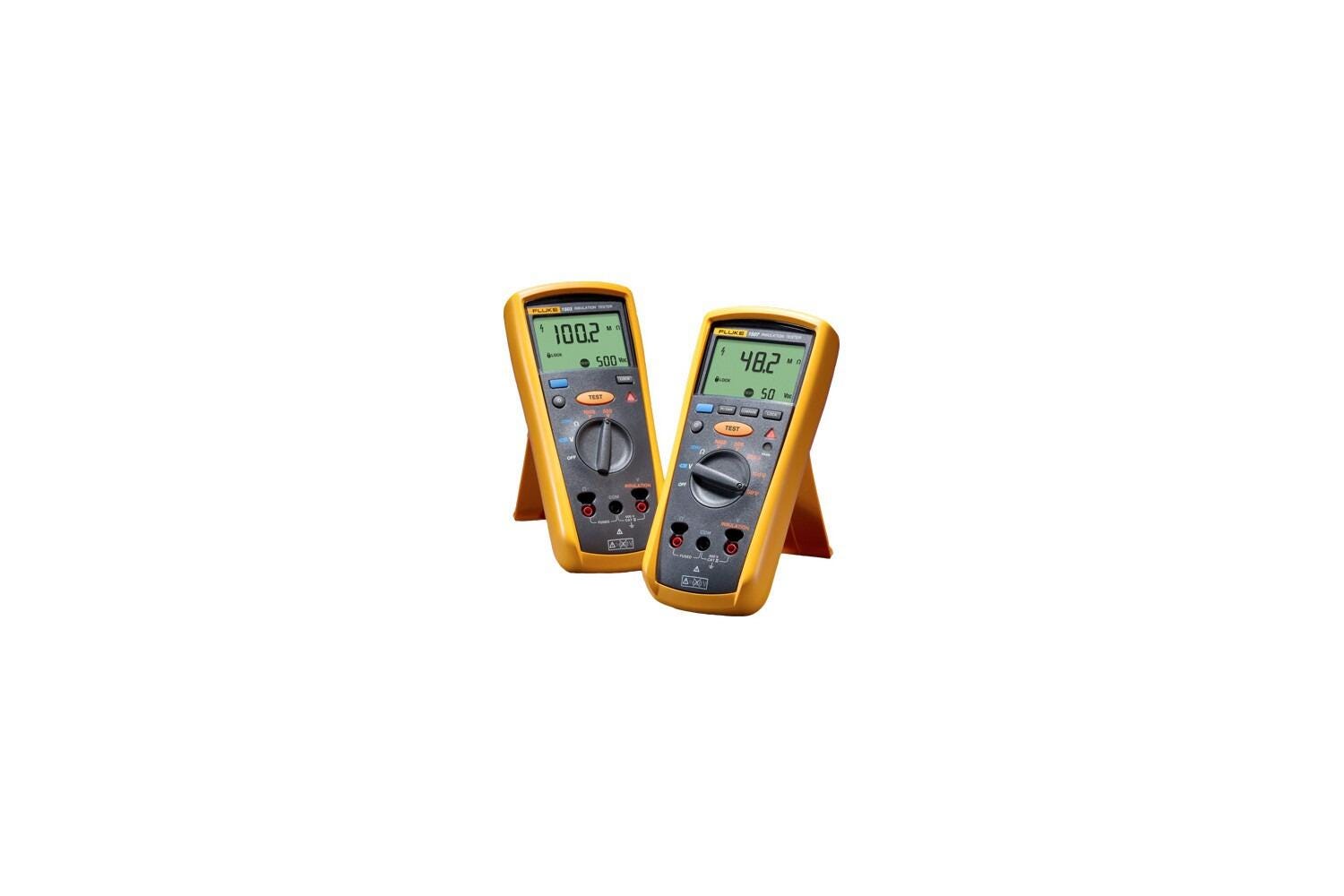
The Fluke 1503 is a dedicated insulation resistance tester offering two test voltages, 500 V and 1000 V, according to official Fluke specifications (checked 2026-08-08). It covers insulation resistance from 0.01 MΩ to 2000 MΩ, and doubles as a basic resistance meter from 0.01 Ω to 20.00 kΩ for continuity-style checks.
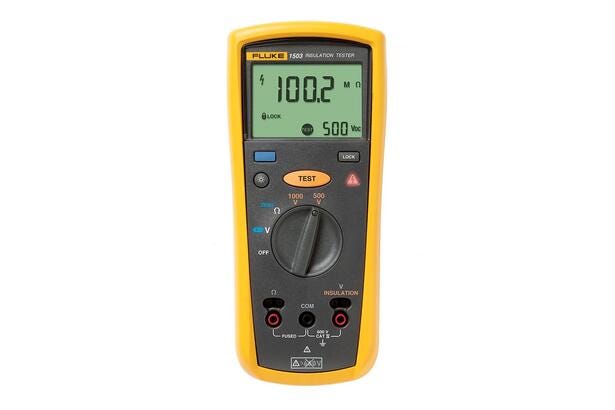
Live circuit detection blocks an insulation test if it senses more than 30 V on the line, a simple but important safeguard against testing a circuit you thought was de-energized. Test voltage accuracy is rated at +20%/-0%, with a nominal short-circuit test current of 1 mA.
This is a straightforward, no-frills tester built for residential and commercial electricians who want dependable insulation checks without paying for a full multimeter combo.
Amprobe AMB-45 Digital Megohmmeter Insulation Resistance Tester
MenaFor industrial work where you need to step up to 1000 V and actually log your results, I reach for the AMB-45. The built-in DAR timer and PC download save a lot of manual note-taking on inspection rounds.
| Test voltage | 250 V / 500 V / 1000 V (selectable) |
|---|---|
| Insulation resistance range | 0 to 4000 MΩ |
| Voltage measurement | 0 to 600 V AC/DC |
| Safety rating | 600 V CAT III, 1000 V CAT II |
| Extra functions | DAR timer, data logging, PC download |
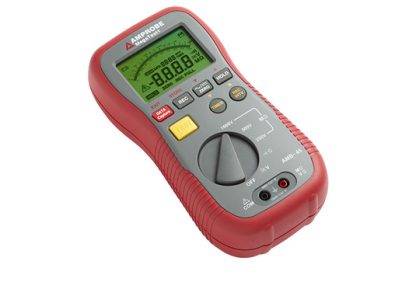
The Amprobe AMB-45 measures insulation resistance from 0 to 4000 MΩ using a selectable 250 V, 500 V, or 1000 V DC test voltage, per official Amprobe specifications (checked 2026-08-08). It’s rated 600 V CAT III / 1000 V CAT II for safety, and includes a low-resistance range (0 to 4000 Ω) for checking motor windings.
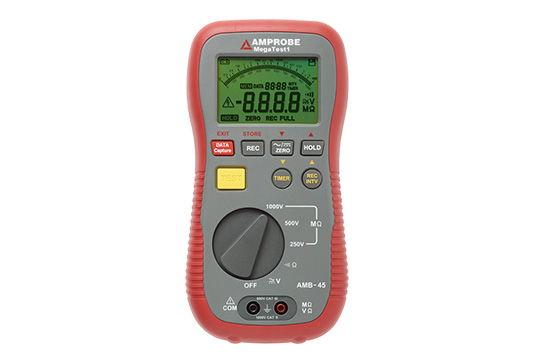
A programmable timer runs the dielectric absorption ratio (DAR) test automatically, and the AMB-45 logs measurements to internal memory with software and a download cable included for pulling data to a PC later — useful if your inspection reports need a paper trail.
This is the pick for industrial and motor/transformer work where you need the full 1000 V range plus a record of what you measured, not just a one-off reading.
Supco M500 Insulation Tester / Electronic Megohmmeter


 Mena
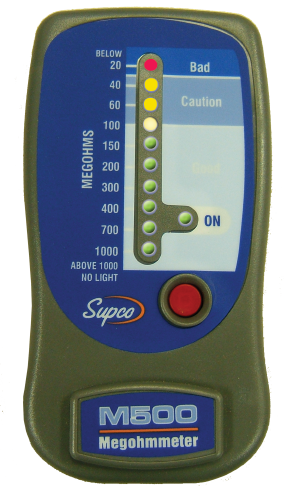
MenaFor HVAC and compressor work specifically, the M500 is the budget pick I keep coming back to. You don’t have to read a number off a needle — the colored LED zone tells you good, caution, or bad at a glance.
| Test voltage | 500 V AC |
|---|---|
| Insulation resistance range | 0 to 1000 MΩ |
| Readout | LED bar: bad / caution / good zones |
| Typical use | HVAC compressors, motors, relay circuits, panel boards |
The Supco M500 is a compact, battery-operated electronic megohmmeter built as an affordable alternative to swing-needle analog testers, according to Supco’s official product page (checked 2026-08-08). It tests insulation resistance from 0 to 1000 MΩ at a fixed 500 V test voltage.
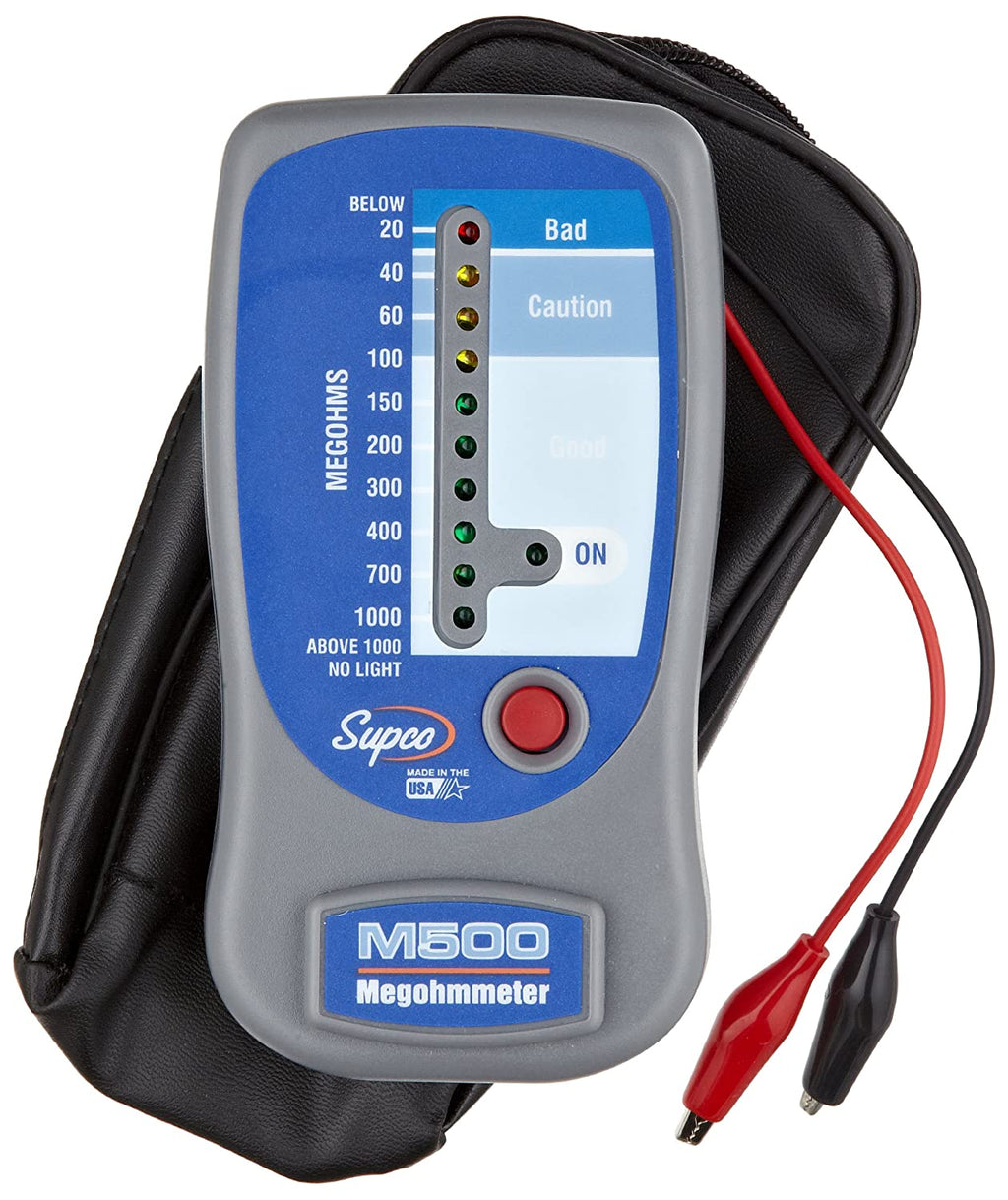
Rather than reading a precise ohm value, the M500 uses a scale of colored LEDs across bad/caution/good zones, which makes for a fast pass/fail read on hermetic compressors, motor windings, relay control circuits, and panel boards — exactly the kind of go/no-go check HVAC techs do dozens of times a day.
It’s the most budget-friendly option in this comparison, and a good fit if your work is mostly HVAC/refrigeration rather than general electrical inspection.
Fluke 1587 FC 2-in-1 Insulation Multimeter


 Mena
MenaIf you want one tool that’s a full digital multimeter and an insulation tester at the same time, the 1587 FC is the one to get. Fluke Connect lets you push readings straight to your phone, which is genuinely handy when you’re up a ladder.
| Test voltage | 50 V / 100 V / 250 V / 500 V / 1000 V (selectable) |
|---|---|
| Insulation resistance range | 0.01 MΩ to 2 GΩ |
| Display | 6000-count backlit display |
| Extra functions | Fluke Connect wireless, PI/DAR timed tests, VFD low-pass filter |
The Fluke 1587 FC combines a true-RMS digital multimeter with a full insulation tester in one handheld unit, according to official Fluke specifications (checked 2026-08-08). Insulation test voltage steps through 50 V, 100 V, 250 V, 500 V, and 1000 V, covering a resistance range of 0.01 MΩ to 2 GΩ on a 6000-count backlit display.
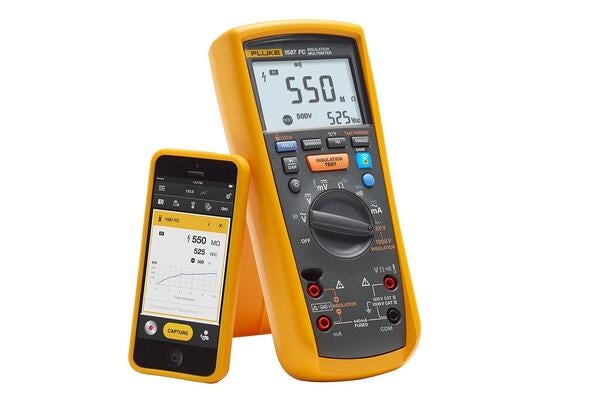
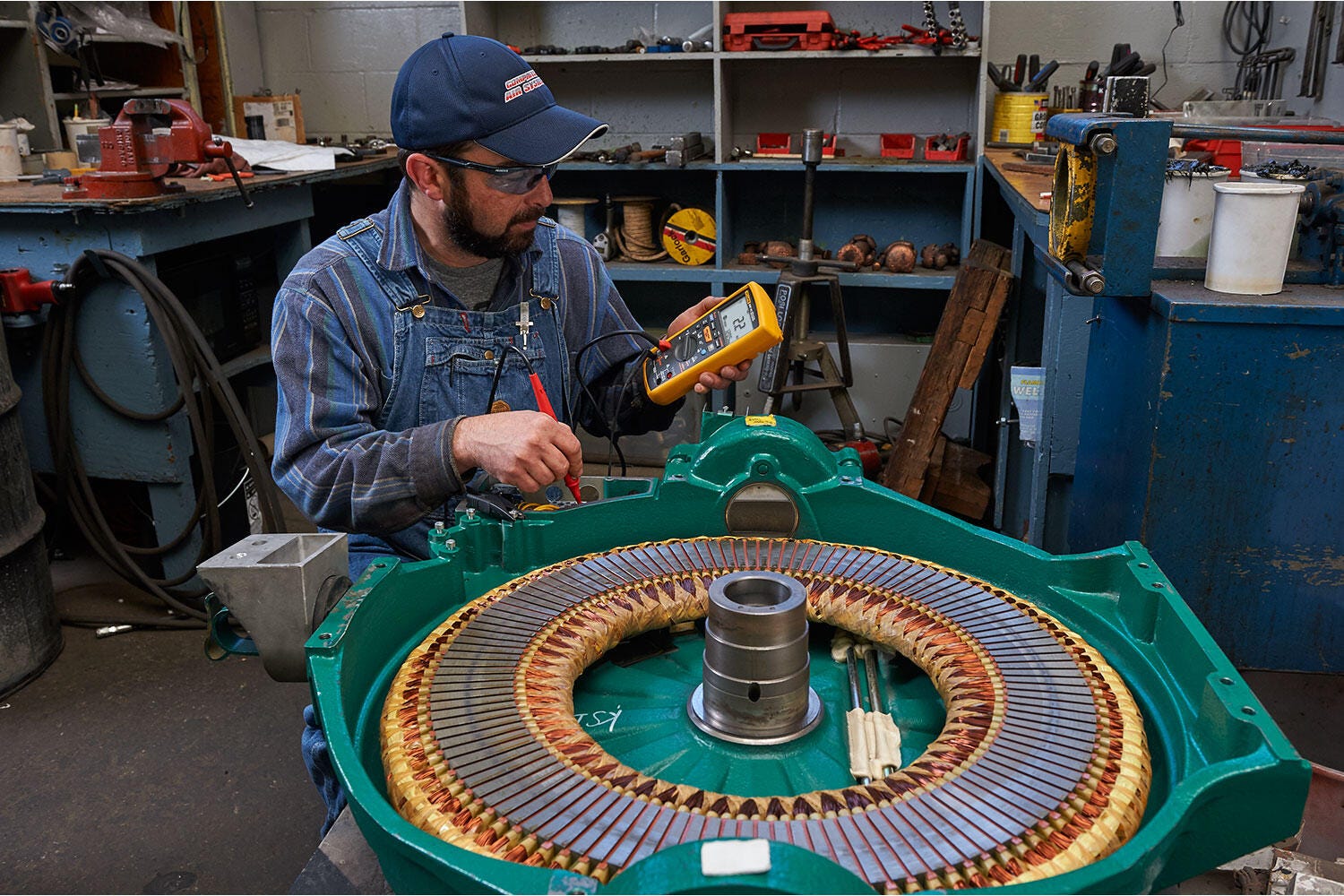
Beyond insulation testing, it measures AC/DC voltage, current, frequency, capacitance, and temperature, with PI/DAR timed ratio tests and TrendIt graphs built in. A VFD low-pass filter helps get clean readings on variable-frequency drive motors, and Fluke Connect wireless lets you send results to your phone on the spot.
This is the premium, do-it-all option in this comparison — worth it if you want one meter to replace both your multimeter and your standalone insulation tester.
Accessories: the rest of your electrical test kit
Beyond the insulation tester itself, it’s worth rounding out your electrical test kit. The following guides are currently available in Japanese only, but they give a good sense of our approach to electrical test equipment.
Voltage testers / non-contact testers
Before you test insulation resistance, you need to confirm the circuit is actually de-energized with a voltage tester. Our Japanese guide compares 10 voltage testers and meters from hands-on field experience.
Ground resistance testers
Where an insulation tester checks the wiring and equipment itself, a ground resistance tester confirms your grounding path is actually doing its job — another must-have for electricians. Our Japanese guide covers 4 ground resistance testers.
How to choose the right insulation tester
Pick a test voltage for the circuit you’re testing
Higher test voltages stress the insulation more and reveal weaknesses that lower voltages miss. 500 V is typically enough for standard 120/240 V residential wiring, while 1000 V testers are the safer choice for motors, panel boards, and industrial equipment. Confirm the correct voltage for your equipment before testing.
Resistance range and readout style
If you need precise numeric readings for a compliance record, look at the resistance range and display resolution (the Fluke 1587 FC’s 2 GΩ range is the widest here). If you just need a fast pass/fail check, a simpler LED-zone readout like the Supco M500’s can actually be faster to work with on repetitive checks.
Extra features: logging, wireless, and DAR timers
The Amprobe AMB-45 and Fluke 1587 FC both add data logging or wireless transfer, which matters if you need a documented record of your test results. For a quick one-off check, those extra features add cost without much benefit.
MenaPick your test voltage by circuit type first, then compare resistance range and extra features — that order gets you to the right tester. And remember, UL 61010-2-034 tells you the meter is safe to use, not which voltage to pick.
Bottom line: the right insulation tester for your work
Four insulation resistance testers compared: the Fluke 1503 for one dependable standard tester, the Amprobe AMB-45 for industrial work with logging, the Supco M500 for budget HVAC/compressor checks, and the Fluke 1587 FC for a full multimeter plus insulation tester in one unit.
★All test voltage and resistance range figures in this article come directly from official manufacturer specifications as of 2026-08-08. Specs and availability can change, so always check the current product page or instruction manual before you buy.