
 Mena
MenaHey, I’m Mena — as a hybrid engineer I work across both mechanical and electrical trades, and a ground resistance tester is the tool that tells you whether your grounding path can actually do its job when it matters. Today I’m comparing four earth testers, from a budget general-purpose model up to a clamp-style unit for multi-grounded systems.
Affiliate Disclosure: As an Amazon Associate, I earn from qualifying purchases at no extra cost to you.
A ground (earth) resistance tester checks whether a grounding system can actually carry fault current safely away — it’s the counterpart to an insulation tester, which checks the wiring and equipment instead. Every resistance range and test method in this article comes straight from official manufacturer specs, with no guessing or rounding on my part.
Short version: for a straightforward budget tester, go with the Extech 382252; for precise 3-pole testing with clamp-assisted flexibility, the Megger DET3TC; for auto-ranging convenience in any weather, the Megger DET2/2; and for multi-grounded systems where you can’t drive a rod, the clamp-style Fluke 1630-2 FC.
Standards first: what IEEE Std 81 actually guides
Japan doesn’t have a single numbered standard specifically for ground resistance testing practice either — the JA original article for this comparison focuses on test method (2-pole/3-pole/clamp) instead. In the US, the closest equivalent reference is IEEE Std 81-2012, the IEEE guide for measuring earth resistivity, ground impedance, and earth surface potentials of a grounding system (Source: ANSI Webstore, IEEE 81-2012, accessed 2026-08-11).
| Standard / Reference | What it covers |
|---|---|
| IEEE Std 81-2012 | Methodology guide: how to measure earth resistivity, ground impedance, and step/touch voltages (a practice guide, not an equipment safety cert) |
| IEC/EN 61010-1 | General safety requirements for the measuring instrument itself (the base standard the Megger DET2/2 in this comparison is certified to) |
| CAT rating | Separately indicates how much transient overvoltage the meter can safely withstand (e.g. CAT IV 100 V) — check this against where you’ll actually be testing |
IEEE Std 81-2012 replaced and combined the older IEEE Std 81-1983 and IEEE Std 81.2-1991 into one unified guide, and remains the current edition as of 2026-08-11 with no newer revision or withdrawal on record (Source: IEEE Xplore, 81-2012, accessed 2026-08-11). It tells you how to measure correctly — it doesn’t certify the safety of a specific meter, so always check the meter’s own CAT rating and IP rating separately.
As a rule of thumb, the fall-of-potential (3-pole) method IEEE Std 81 describes is the standard reference technique for verifying an individual ground electrode, while clamp-on testers use a different principle (loop resistance) that’s faster but only valid on multi-grounded systems. ★Always confirm which test method is appropriate for your specific grounding system before testing.
Quick comparison: all 4 testers at a glance
All test method and resistance range figures come directly from official manufacturer specifications as of 2026-08-08. Always check the current product page or manual before you buy, since specs and availability can change.
| Model | Test method | Resistance range | Best for |
|---|---|---|---|
| Extech 382252 | 2-pole / 3-pole | 20 – 2000 Ω | Straightforward budget tester |
| Megger DET3TC | 2-pole / 3-pole + ART clamp | 0.01 – 2000 Ω | Precise 3-pole testing |
| Megger DET2/2 | 2/3/4-pole auto-ranging | 0.010 Ω – 19.99 kΩ | Auto-ranging, any weather |
| Fluke 1630-2 FC | Clamp-on | 0.025 – 1500 Ω | Multi-grounded systems, no rod needed |
4 ground resistance testers compared
Extech 382252 Ground Resistance Tester

 Mena
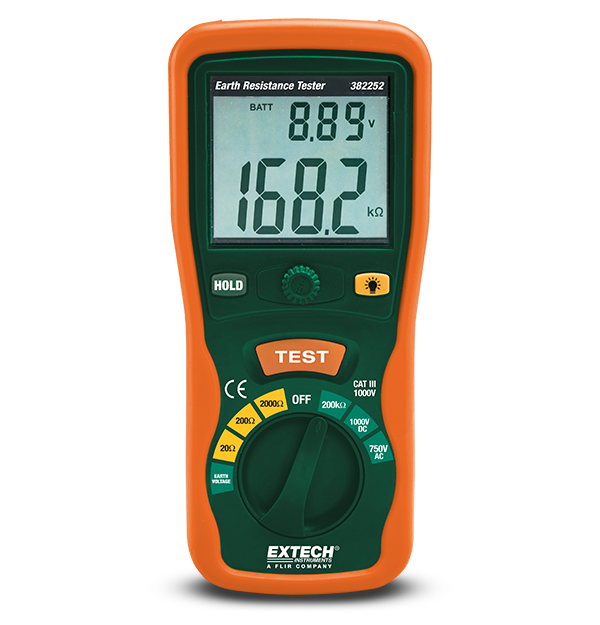
MenaIf you just need a straightforward tester for general 2-pole or 3-pole ground checks, the 382252 is where I’d start. It’s the simplest, most affordable way to confirm a grounding path is doing its job.
| Test method | 2-pole / 3-pole |
|---|---|
| Resistance range | 20 Ω / 200 Ω / 2000 Ω |
| Test current | < 2.5 mA @ 820 Hz |
| Extra function | AC voltage measurement up to CAT III 1000 V |
The Extech 382252 is a general-purpose ground resistance tester supporting both 2-pole and 3-pole test methods, according to official Extech specifications (checked 2026-08-08). It covers three resistance ranges — 20 Ω, 200 Ω, and 2000 Ω — using a low test current of under 2.5 mA at 820 Hz.
Beyond ground resistance, it doubles as an AC voltage meter rated CAT III 1000 V, handy for a quick voltage check on the same job. It doesn’t have the auto-ranging or clamp capability of the other testers in this comparison, but for straightforward residential and light commercial ground checks that’s rarely a problem.
This is the pick for electricians who want one dependable, budget-friendly tester for routine 2-pole and 3-pole ground resistance checks.
Megger DET3TC Digital Ground Resistance Tester

 Mena
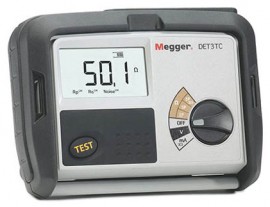
MenaFor precise 3-pole ground testing where you can’t afford to be wrong, I reach for the DET3TC. The ART function lets you use a clamp alongside the standard 3-pole method without disconnecting the ground system — a real time-saver on multi-ground sites.
| Test method | 2-pole / 3-pole (switchable) + ART clamp-assisted |
|---|---|
| Resistance range | 0.01 Ω to 2000 Ω |
| Safety rating | CAT IV 100 V |
| Water resistance | IP54 |
The Megger DET3TC is a switchable 2-pole/3-pole digital ground resistance tester according to official Megger specifications (checked 2026-08-08), covering a resistance range from 0.01 Ω to 2000 Ω. It’s rated CAT IV 100 V and IP54 for outdoor field use.
Its ART (Attached Rod Technique) function combines a clamp with the standard 3-pole test, letting you verify individual ground rods in a multi-ground system without disconnecting them from the network — something the simpler 382252 can’t do.
This is the precision 3-pole choice for electricians and technicians who need accurate readings on A-class or B-class ground systems and want the flexibility to test individual rods in place.
Megger DET2/2 Digital Ground Resistance Tester
 Mena
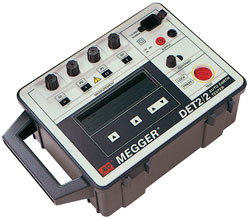
MenaWhen I don’t want to think about which range to select, I grab the DET2/2. Auto-ranging across 2, 3, and 4-pole modes plus IP54 sealing means it just works, rain or shine.
| Test method | 4-terminal, auto-ranging 2-pole/3-pole/4-pole |
|---|---|
| Resistance range | 0.010 Ω to 19.99 kΩ |
| Certification | IEC/EN 61010-1 |
| Water resistance | IP54 |
The Megger DET2/2 is a 4-terminal digital ground resistance tester with auto-ranging across 2-pole, 3-pole, and 4-pole test methods, according to official Megger specifications (checked 2026-08-08). Its resistance range spans 0.010 Ω to 19.99 kΩ, certified to IEC/EN 61010-1 and rated IP54 for water resistance.
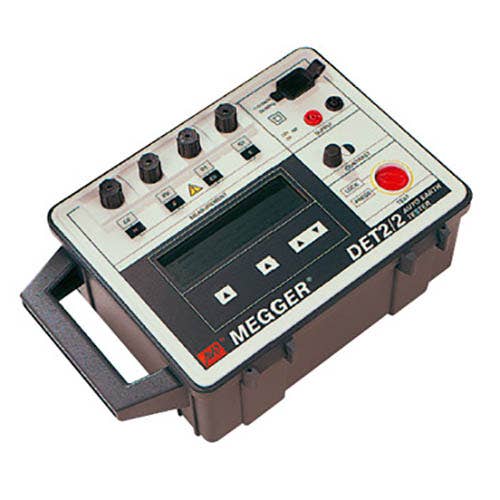
Auto-ranging means you don’t have to manually select a resistance range before testing, which speeds up repetitive ground checks across a large site. The IP54 rating makes it a reliable choice for outdoor and wet-weather field work.
This is the pick for technicians who want one tester that adapts to whatever ground system they’re checking — auto-ranging and full weather sealing included.
Fluke 1630-2 FC Earth Ground Clamp


 Mena
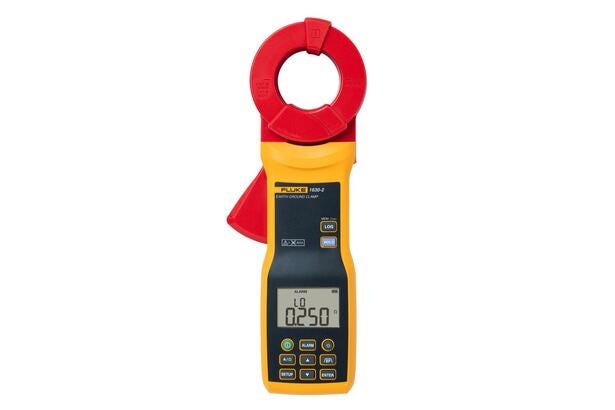
MenaFor multi-grounded systems where there’s no room to drive a rod, the 1630-2 FC is the only realistic option — just clamp it around the ground conductor and read the result, no disconnection needed.
| Test method | Clamp-on (no ground rod required) |
|---|---|
| Resistance range | 0.025 Ω to 1500 Ω (8 ranges) |
| Leakage current range | 0.2 mA to 39.99 A |
| Safety rating | CAT III, IP30 |
The Fluke 1630-2 FC is a clamp-on earth ground tester according to official Fluke specifications (checked 2026-08-08), measuring ground resistance from 0.025 Ω to 1500 Ω across 8 ranges without needing an auxiliary ground rod or disconnecting the circuit. It also measures leakage current from 0.2 mA to 39.99 A.
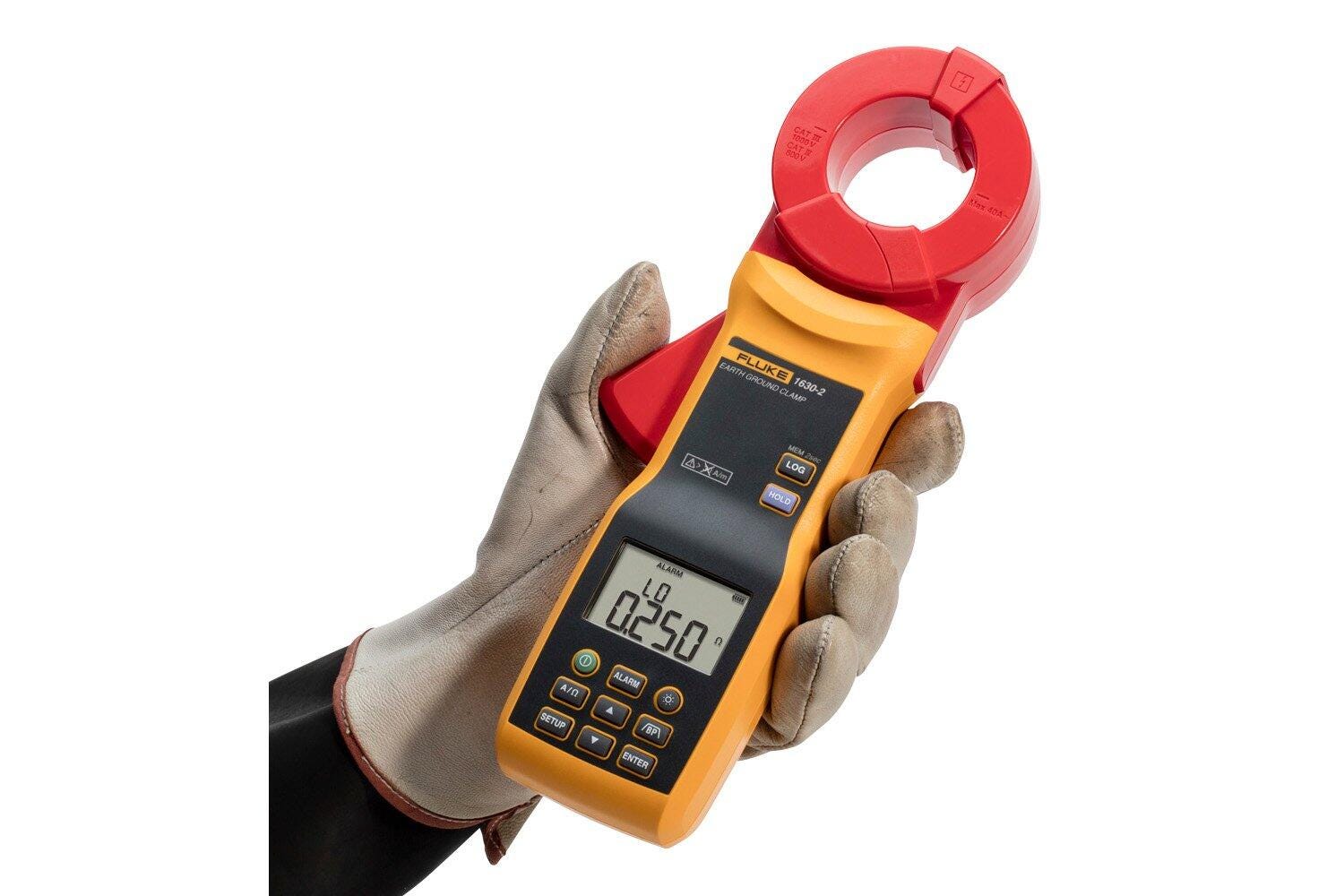
It’s rated CAT III with IP30 protection, built for the kind of multi-grounded systems — commercial buildings, industrial sites, telecom towers — where driving auxiliary rods or isolating the ground loop simply isn’t practical.
This is the clamp-style pick for anyone working on multi-grounded systems where ground rods or circuit disconnection aren’t an option, and where leakage current readings are also useful.
Accessories: the rest of your electrical test kit
Beyond the ground resistance tester itself, it’s worth rounding out your electrical test kit. The following guides are currently available in Japanese only, but they give a good sense of our approach to electrical test equipment.
Voltage testers / non-contact testers
Before you test ground resistance, you need to confirm the circuit is actually de-energized with a voltage tester. Our Japanese guide compares 10 voltage testers and meters from hands-on field experience.
Insulation resistance testers
Where a ground resistance tester checks that your grounding path is doing its job, an insulation resistance tester checks the wiring and equipment itself for degraded insulation — another must-have for electricians. See our insulation resistance tester comparison for details.
How to choose the right ground resistance tester
Match the test method to your ground system
A simple 2-pole check is fine for a quick sanity check, but 3-pole (fall-of-potential) testing is the accurate reference method for a single ground electrode. If the system is multi-grounded — commercial buildings, telecom towers — you often can’t isolate a single electrode at all, which is where clamp-on testing becomes the only practical option.
Resistance range and readout style
If you need to catch very low resistance faults with precision, look at the lower end of the resistance range (the Megger DET2/2’s 0.010 Ω resolution is the finest here). For a fast pass/fail check across many ground points, auto-ranging saves time over manually selecting a range each time.
Weatherproofing and field durability
Ground testing is outdoor work by nature, so IP-rated water resistance matters more here than on most electrical meters. The Megger DET3TC and DET2/2 are both rated IP54; check the rating before buying if you’ll be testing in wet conditions regularly.
MenaGround resistance testers are less about brand and more about matching the test method to your ground system. Figure out whether you can isolate a single electrode or need to clamp onto a multi-grounded system first — everything else follows from that.
Bottom line: the right ground resistance tester for your work
Four ground resistance testers compared: the Extech 382252 for a straightforward budget tester, the Megger DET3TC for precise 3-pole testing with clamp-assisted flexibility, the Megger DET2/2 for auto-ranging convenience in any weather, and the Fluke 1630-2 FC for multi-grounded systems where you can’t drive a rod.
★All test method and resistance range figures in this article come directly from official manufacturer specifications as of 2026-08-08. Specs and availability can change, so always check the current product page or instruction manual before you buy.