
Affiliate Disclosure: This article contains affiliate links. If you make a purchase through these links, we may earn a commission at no additional cost to you.
 Mena
Hey, I’m Mena (@menachite), a hybrid engineer. Ever figured “a caliper’s a caliper, they’re all the same” and grabbed a dollar-store one, only to find out later it wasn’t precise enough for the job? This time I’m laying out “how much precision DIY actually needs,” backed by sourced tolerances for each use case.
Short answer: the precision you need from a caliper depends entirely on what you’re measuring. For woodworking a shelf, a dollar-store caliper is plenty; for something like selecting valve-clearance shims on a motorcycle, even an entry-level caliper isn’t confidence-inspiring — you need a genuinely more precise instrument. The very idea that “one caliper covers everything” is itself the trap when it comes to picking the right precision.
This article checks the actual required tolerance (the acceptable margin of error) for 4 DIY use cases — woodworking, 3D printing, motorcycle maintenance, and electronics — against primary sources, then applies the field rule of thumb that “an instrument’s precision should be roughly 1/10th of the tolerance” to draw the line between a dollar-store caliper, a $10-20 vernier model, a standard digital caliper, and a micrometer. If you’re unsure, start by thinking about how much margin for error your own task can actually tolerate.
At a Glance: Required Tolerance and the Right Instrument, by Use Case
Here’s the conclusion up front. Work you can judge “by the millimeter” — woodworking, or eyeballing motorcycle brake pad thickness — is fine with a dollar-store to $10-20 vernier caliper. Once the tolerance narrows to around ±0.1mm — checking a 3D print or a circuit board — a vernier caliper falls short, and you need a standard digital caliper with 0.01mm resolution. And when the tolerance itself is only about ±0.02mm — like selecting a shim for motorcycle valve clearance — a caliper of any kind is the wrong tool entirely; you need a micrometer or a thickness gauge. The single biggest point of this article: even within “motorcycle maintenance,” the precision required swings wildly by task.
| Use case | Typical required tolerance | Matching instrument |
|---|---|---|
| Woodworking (shelves, furniture DIY) | Thickness ±0.5mm / width & length ±1mm or so | Dollar-store to $10-20 vernier caliper is enough |
| Motorcycle maintenance — brake pad thickness check | Millimeter-scale threshold judgment against the service manual’s guideline | A dollar-store caliper is enough |
| Checking a 3D-printed part | Roughly ±0.1–0.3mm (±0.05mm under tight conditions) | Standard digital 0.01mm caliper needed (±0.02–0.03mm) |
| Electronics — checking PCB hole diameter, component leads | Hole tolerance roughly ±0.1mm | Standard digital 0.01mm caliper needed (±0.02–0.03mm) |
| Motorcycle maintenance — valve clearance shim selection | As narrow as roughly ±0.02mm, depending on the model | Not feasible with a caliper — needs a micrometer / thickness gauge |
For the Everyday User: Why “1/10th of Tolerance” Is the Rule of Thumb
In measurement-heavy fields, you’ll hear the guideline that “an instrument’s precision should be roughly 1/10th of the tolerance (acceptable margin of error) of whatever you’re measuring.” This isn’t a fixed standard — it’s a field-tested rule of thumb for keeping misjudgments (calling something out of tolerance when it’s actually fine, or vice versa) to a minimum. Follow it, and once you know how much margin your own task can tolerate, the precision you need from an instrument falls right out of it.
Woodworking: A $10-20 Vernier Caliper Is Plenty
In woodworking, a common rule of thumb for acceptable error is roughly ±0.5mm for thickness and ±1mm for width or length. The analog vernier caliper we feature in this article publishes a manufacturer-stated accuracy of ±0.1mm — plenty of margin against woodworking’s ~±0.5mm thickness tolerance. One independent blogger’s hands-on test (a single unit) reported that even a dollar-store caliper was “accurate to the millimeter,” a level that’s unlikely to cause practical problems for woodworking use either.
3D Printing & Electronics: A Vernier Caliper Falls Short, a Standard Digital Caliper Is Needed
A typical FDM 3D printer’s dimensional error runs around ±0.1–0.3mm (about ±0.05mm even with conditions tightened), and PCB hole tolerances typically run around ±0.1mm too. Apply a vernier caliper’s ±0.1mm accuracy to that, and you’re measuring with an instrument whose own error is nearly as large as the tolerance itself — nowhere near the “1/10th of tolerance” guideline. Both of these use cases call for a standard digital caliper with 0.01mm resolution (instrument error around ±0.02–0.03mm). If a vernier caliper is all you have, it’s worth buying or borrowing a digital one specifically for this kind of work. Note too that against the best-case 3D-printing scenario (±0.05mm), even a standard digital caliper’s ±0.02–0.03mm error falls slightly short of a true 1/10th (0.005mm) — it’s “good enough for practical purposes,” not the theoretical ideal.
Motorcycle Maintenance: A Textbook Case of “Required Precision Varies Wildly by Task”
Checking brake pad remaining thickness is usually a millimeter-scale threshold judgment against a guideline figure in the service manual — well within what a dollar-store caliper (accurate to the millimeter) can handle. But valve clearance shim selection, still “motorcycle maintenance,” is a different story entirely. The shims themselves are made in 0.05mm steps, but the allowed clearance range specified for some models is as narrow as ±0.02mm (a 0.04mm tolerance band). One-tenth of a 0.04mm tolerance band is 0.004mm — a figure equal to or tighter than the instrument error of even a Mitutoyo-class standard digital caliper (around ±0.02mm). In other words, for this specific task, any caliper — vernier or digital, any brand — has an instrument error on par with or larger than the tolerance band itself, meaning you could measure and still get the judgment wrong. This is a job for a micrometer (0.001mm resolution), a thickness gauge, or a dedicated shim gauge — not a caliper.
MenaEven within the single category of “motorcycle maintenance,” a brake pad thickness check and a valve clearance shim selection demand wildly different levels of precision. It’s worth getting into the habit of checking the actual tolerance for the specific task, rather than judging by the job’s name alone.
MenaTo sum up: work you can judge “by the millimeter” is fine with a dollar-store to $10-20 vernier caliper; work dealing with tolerances around ±0.1mm calls for a standard digital 0.01mm caliper; and work where the tolerance band itself is as narrow as ~0.04mm calls for a micrometer or similar, not a caliper.
So What Should the Average Person Actually Buy?
For work with tolerances in the 0.5-1mm range — woodworking, checking motorcycle pad thickness — a low-cost vernier caliper causes no practical problems. For work where the tolerance narrows to around ±0.1mm — checking a 3D print, checking a circuit board — a vernier caliper doesn’t meet the “1/10th of tolerance” guideline, so switch to a standard digital caliper with 0.01mm resolution. And for work like motorcycle valve clearance adjustment, where the tolerance band itself is measured in tens of microns, a caliper as a category simply isn’t the right tool — use a micrometer or a dedicated shim gauge instead. A caliper isn’t a universal measuring instrument; think of it as a tool you choose based on “does it hit 1/10th of my tolerance for this specific job.”
One Caliper for Woodworking and Motorcycle Pad Checks


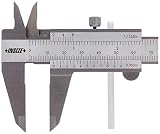

This is an analog vernier caliper with a manufacturer-published accuracy of ±0.1mm, sitting in the accessible entry-level price bracket. For 0.5-1mm-class tolerances — woodworking dimension checks, motorcycle brake pad thickness checks — this one delivers plenty of precision for the job.
On the other hand, for work where the tolerance narrows to around ±0.1mm — checking a 3D print, checking a circuit board — this vernier-class accuracy falls short of the “1/10th of tolerance” guideline. For that, look at a standard digital caliper with 0.01mm resolution instead. And keep in mind that for something like motorcycle valve clearance shim selection, where the tolerance band itself is extremely narrow, you need a micrometer or dedicated shim gauge rather than any caliper.
MenaNow let’s run through some frequently asked questions.
FAQ
Q. What’s the actual difference between a dollar-store caliper and a $10-20 one like the one here?
A. One independent blogger’s hands-on test (a single unit) reported that even a dollar-store caliper was “accurate to the millimeter,” but a $10-20 vernier caliper like the one here has a manufacturer-published accuracy of ±0.1mm, which you can use with confidence for 0.5-1mm-class tolerances like woodworking or motorcycle pad checks. For work where the tolerance narrows to around ±0.1mm — 3D printing, circuit boards — this class falls short either way.
Q. Can I use a caliper for motorcycle valve clearance adjustment?
A. Not recommended. On models with a tight ±0.02mm specified tolerance, even a Mitutoyo-class standard digital caliper (instrument error around ±0.02mm) has error on the same order as the tolerance band itself, making any caliper the wrong tool for the job. Use a micrometer (0.001mm resolution), a thickness gauge, or a dedicated shim gauge instead.
Q. Is “1/10th of tolerance” a hard standard I have to follow?
A. No — it’s not a fixed, codified value, but a field rule of thumb for keeping misjudgments to a minimum. Use it as a guideline for the idea that “an instrument’s precision should be comfortably finer than the tolerance of whatever you’re measuring.”
Measuring Precautions
Whatever precision tier your caliper is, always close the jaws and check the zero point before measuring. Metal shavings or oil left on the measuring faces will introduce error regardless of price tier. Don’t over-tighten the jaws on soft materials or thin sheet stock, and for materials like metal where temperature differences show up easily, letting the workpiece settle to room temperature before measuring gives more stable results.
MenaA caliper is a tool whose required precision changes with what you’re measuring. As a rule of thumb: a dollar-store to $10-20 vernier caliper for millimeter-scale judgment calls, a standard digital caliper for tolerances around ±0.1mm, and a micrometer or similar (not a caliper) for tasks where the tolerance band itself is tens of microns wide.
Summary
We laid out the required tolerance and matching instrument for 4 DIY use cases: woodworking, 3D printing, motorcycle maintenance, and electronics. Following the field rule that “an instrument’s precision should be roughly 1/10th of the tolerance,” woodworking dimension checks and motorcycle pad thickness checks are fine with a dollar-store to $10-20 vernier caliper, but checking a 3D print or a circuit board involves tolerances narrow enough (±0.1mm-ish) that you need a standard digital caliper with 0.01mm resolution. And motorcycle valve clearance shim selection has a tolerance band narrow enough (~0.04mm) that you need a micrometer or thickness gauge rather than any caliper at all.