
Affiliate Disclosure: This article contains affiliate links. If you make a purchase through these links, we may earn a commission at no additional cost to you.
 Mena
Hey, it’s Mena (@menachite), the hybrid engineer. This time we’re looking at an often-overlooked part of whetstone “types”: the difference in abrasive grain (the material of the cutting grit itself). I already covered how to choose grit number (coarseness) in an earlier article, so this time I’ll answer the material-side question: “What’s actually different between WA and GC?”
Short answer up front: a whetstone’s suitability for a given material depends not just on grit number (coarseness) but also on abrasive grain (material). WA works well for stainless steel and hardened steel, GC for cemented carbide and glass, C for cast iron and non-ferrous metals, A for general steel, and for high-speed machine grinding of iron you want CBN rather than diamond — that’s the big-picture rule of thumb.
If you just want to know what to buy, the quick-reference table below is all you need. For the basics of grit number (the “#” figure), see our companion article on choosing oil stones and water stones — it’s worth a look too.
Conclusion: Quick-Reference Table for Abrasive Grain by Purpose
Here’s the conclusion first. Use WA for hard-but-heat-sensitive materials (hardened steel, stainless steel), GC for hard-but-brittle materials like cemented carbide or glass, C for cast iron and non-ferrous metals, A for rough-grinding general steel, diamond for hand-sharpening at home, and CBN for high-speed machine grinding of ferrous materials. You won’t go far wrong following this.
| Abrasive | Full Name | Hardness / Toughness | Best For |
|---|---|---|---|
| WA | White Fused Alumina | Hard, chips easily | Hardened steel, stainless steel, tool steel |
| GC | Green Silicon Carbide | Hardest of the conventional grains, brittle | Cemented carbide, glass, ceramics |
| C | Black Silicon Carbide | Slightly softer & more brittle than GC | Cast iron, non-ferrous metals, glass, stone |
| A | Brown Fused Alumina | Slightly softer than WA, tougher | General steel, mild steel (high tensile-strength materials) |
| Diamond | Superabrasive | Hardest (natural) | Cemented carbide, ceramics, glass, stone |
| CBN | Superabrasive (synthetic) | Second only to diamond, doesn’t react with iron | Hardened steel, HSS (hard ferrous materials) |
What Does Whetstone “Type” Actually Mean? Two Axes: Grit Number and Abrasive Grain
There are actually two independent axes to a whetstone’s “type.” One is “grit number” — the coarseness of the finish, expressed as a “#” figure. The other is “abrasive grain” — the material of the cutting grit bonded into the stone itself. Grit number is a single axis (smaller number = coarser, larger = finer), but abrasive grain varies in hardness, toughness, and heat resistance depending on the material, so even at the same grit number, suitable materials can differ completely.
A whetstone is abrasive grain bonded together with a binder (vitrified = ceramic-based, resinoid = resin-based, etc.). What mainly determines grinding/polishing performance is the material of this abrasive grain, which broadly falls into two families.
Conventional abrasives = four types: WA (white fused alumina), A (brown fused alumina), C (black silicon carbide), GC (green silicon carbide). These are artificially produced, relatively low-cost grains that cover a wide range of materials from common steel to cast iron and non-ferrous metals.
Superabrasives = two types: diamond and CBN (cubic boron nitride). These are for hard materials that conventional abrasives can’t handle, and they cost more than conventional abrasives.
Relationship With Grit Number: The Coarseness Logic Stays the Same Across Materials
The basic idea behind grit number (the “#” figure) — smaller number means coarser and more aggressive cutting — is the same whether the abrasive grain is WA or GC. The three-stage division of rough/medium/finishing stones, and which one to buy first, is covered in detail in our companion article on choosing oil stones and water stones, so we won’t repeat that here.
What’s worth remembering here is that “even at the same grit number, cutting behavior changes with the abrasive material.” For example, at the same #120 grit, A (brown fused alumina) is tough and long-lasting, while C (black silicon carbide) is brittle and cuts fast but wears down quickly — a difference you can easily miss if you only look at the grit number.
Choosing Conventional Abrasives: The Difference Between WA, GC, C, and A
Of the four conventional abrasives, WA and A belong to the alumina (aluminum oxide) family, while C and GC belong to the silicon carbide family. Even within the same family, purity affects color and characteristics, so let’s look at each.
WA (White Fused Alumina)
WA is a synthetic abrasive grain made by fusing high-purity aluminum oxide at high temperature and crushing it. Because it has few impurities, the grains themselves chip away just enough (called high “self-sharpening” ability) to keep exposing fresh cutting edges, giving a sharp cut with low heat generation. Its toughness, however, is somewhat lower than A.
In industrial use, it’s used for finish-grinding precision parts that scorch easily from grinding heat, and for grinding “hard but heat-sensitive” materials like hardened steel, stainless steel, and tool steel.
At home, it’s easy to find as a replacement wheel for double-ended bench grinders when repairing chipped knife edges electrically. It’s a good option when you want to coarse-regrind a hard blade like a stainless kitchen knife.
PFERD Bench Grinding Wheel — Aluminum Oxide (WA-equivalent), 80 Grit, for Hardened Steel & Stainless Steel
MenaThis wheel is a straightforward, widely-stocked example of a white/aluminum-oxide bench grinding wheel built for hardened steel and stainless steel — a good stand-in for the WA (white fused alumina) role in this comparison.
This bench grinding wheel uses an aluminum-oxide abrasive at 80 grit (the WA-equivalent role, #80), sized for a standard double-ended bench grinder. Aluminum-oxide wheels in this class are aimed at “hard but heat-sensitive” materials such as hardened steel and stainless steel, which is exactly the WA abrasive’s characteristic profile (chips away easily, generates little heat).
It mounts on a double-ended (bench) grinder and is suited to repairing chipped edges on chisels and plane blades, or deburring stainless parts. Before mounting, always confirm that the grinder’s rated speed matches the wheel’s maximum operating surface speed.
GC (Green Silicon Carbide)
GC is a high-purity, green-colored variant within the silicon carbide (SiC) family. It’s among the hardest of the conventional abrasives, but that comes with lower toughness and easier chipping, which makes it well suited to grinding hard, brittle materials.
Industrially, it’s used for grinding and polishing cemented carbide (tungsten-carbide tooling material), glass, ceramics, stone, and non-ferrous metals like aluminum. Re-sharpening carbide-tipped blades and drills is a classic job for GC.
Home users rarely need to grind carbide tools, but it’s worth considering if you work with carbide-edged cutters, glasswork, or pottery tools — materials that conventional WA/A abrasives can’t handle.
Green Silicon Carbide Bench Grinding Wheel — 120 Grit, 150mm
MenaGreen silicon carbide (GC) wheels like this one are labeled by grain type right on the packaging, which is reassuring if you want to confirm the abrasive material before buying.
This grinding wheel is a vitrified-bond (ceramic binder) wheel at 120 grit using green silicon carbide (GC) abrasive. GC is among the hardest of the conventional abrasives, and it’s well suited to grinding hard, brittle materials such as cemented carbide, glass, and ceramics.
It mounts on a bench grinder as a flat wheel; the vitrified bond resists degradation from moisture, so the wheel can be used down to the last of its abrasive. Home users rarely need to grind carbide tools, but it’s an option if you want to re-sharpen carbide-tipped cutters or drill bits.
C (Black Silicon Carbide)
C is the same silicon carbide family as GC but with slightly lower purity, giving it a black-to-gray color. It’s a bit softer than GC, but its lower cost and the speed advantage that comes from its brittleness make it useful in certain situations.
Industrially, it’s used for deburring cast iron and grinding non-ferrous metals like brass and aluminum, plus low-tensile-strength materials such as glass, stone, rubber, and leather.
Surprisingly, its main home use is as a “coarse stone” for rough-regrinding. Because rough grinding to fix chipped edges prioritizes cutting speed, C’s brittleness actually works in its favor. Note that the flattening stone (Kai 093AP2475) featured in our companion article “Choosing Oil Stones and Water Stones” also appears, by color, to be a silicon-carbide (C) type (though the maker doesn’t officially state the abrasive material) — which fits the pattern that C suits “want to cut fast” jobs like rough-grinding and flattening.
Norton Crystolon Coarse Benchstone — Silicon Carbide, Extra-Large Rough Stone
MenaThis is a silicon-carbide (C-family) rough stone. Rough stones that prioritize aggressive cutting speed tend to use the more brittle C (black silicon carbide) rather than GC.
Norton’s Crystolon coarse benchstone is made of silicon carbide (C = black silicon carbide) and is built for “rough re-shaping” of a badly chipped kitchen knife edge — the kind of heavy-duty task found in commercial kitchens. It’s lower purity than GC (green), which keeps cost down, and its brittleness gives it a cutting-speed advantage that’s well suited to rough grinding.
Its large size gives more stable footing for sharpening than a small home-use rough stone. You won’t reach for it in everyday touch-ups, but it earns its place when repairing chipped edges or reshaping a knife significantly. After use, wipe off any moisture and store it somewhere well-ventilated to prevent mold.
A (Brown Fused Alumina)
A is the same aluminum-oxide family as WA, but it contains impurities such as titanium oxide, giving it a brown color. It’s less hard than WA but tougher (more resistant to chipping).
Industrially, it’s used for base-grinding and deburring “high tensile-strength” materials like general and mild steel. The combination oil stone (coarse + fine) from our companion article is also in this same A group.
At home, it’s an easy-to-handle material for DIY repair of chipped edges on steel tools, or as an oil stone for deburring metal parts.
Norton India Stone — Aluminum Oxide (A-equivalent), Fine Grit Oil Stone
MenaNote: the finest grade readily available for this India-stone line is “Fine” rather than an extra-fine grade, so it’s used here as the closest equivalent to the JA original’s extra-fine A stone — the toughness of A (brown fused alumina) is well regarded for industrial base-grinding regardless of the exact grit.
Norton’s India oil stone uses A = brown fused alumina abrasive in a rectangular oil-stone format. Compared with WA it’s lower purity but tougher (resists chipping), making it well suited to base-grinding and deburring “high tensile-strength” materials like iron and steel.
It’s the same abrasive family as the coarse+fine combination oil stone from our companion article “4 Oil Stones and Water Stones,” though this is a single-grit stone rather than a combo. It suits finishing deburring work in industrial settings, or DIY repair of chipped edges on steel tools. After use, wipe off the oil with a dry cloth — never rinse it with water.
Choosing Superabrasives: The Difference Between Diamond and CBN
For materials too hard for the four conventional abrasives, there are two “superabrasives”: diamond and CBN. Even though both are superabrasives, they suit clearly different materials, so be careful not to mix them up.
Diamond
Diamond is the hardest naturally-occurring substance, though the diamond used as abrasive grain is mainly industrially synthesized. It’s used for grinding and polishing hard materials that conventional abrasives (WA/A/C/GC) can’t handle, such as cemented carbide, ceramics, glass, and stone.
Industrially, diamond wheels are used to sharpen carbide and ceramic tooling. But it has a weakness: at high-speed, high-heat machine grinding of ferrous metals (steel), iron reacts chemically with diamond (carbon), causing rapid wear (graphitization) — so it’s not well suited to high-speed machine grinding of iron.
On the other hand, when hand-sharpening a knife slowly, heat generation is low and graphitization isn’t an issue, which is why diamond sharpeners are so widely used at home. Resistance to clogging and near-zero need for flattening are also big reasons for their popularity.
DMT DuoSharp Double-Sided Diamond Sharpener — Fine/Coarse, for Home Double-Bevel Sharpening



 Mena
Diamond stones skip the soaking step and resist clogging, which makes them easy to live with if you want to cut down on flattening chores.
This double-sided diamond sharpener pairs a coarse and a fine diamond surface (roughly the coarse/fine role that #400/#1000 plays on conventional stones — exact micron ratings vary by model, but the coarse/fine role mapping is the same), electroplated onto a metal plate. Diamond is the hardest natural substance (and, as with this product, industrially synthesized diamond is the norm for abrasive use); even a hard stainless kitchen knife that would take a long time on a conventional water stone like King or Shapton can be sharpened relatively quickly.
Its resistance to clogging and near-zero flattening requirement have made it a popular home sharpener, but it’s not well suited to high-speed, high-heat grinding of steel with a power grinder (explained further in the caution section below). It works on a wide range of blades — knives, scissors, axes, and more.
CBN (Cubic Boron Nitride)
CBN is a synthetic superabrasive second only to diamond in hardness. Unlike diamond, it doesn’t react chemically with ferrous metals, so it can be used reliably even in high-speed machine grinding of hard ferrous materials like hardened steel and high-speed steel (HSS).
Industrially, CBN handles the “high-efficiency, high-speed machine grinding of ferrous materials” that diamond struggles with. It’s a specialized abrasive used by professional blade sharpeners and mold makers who frequently re-sharpen HSS lathe tools or woodturning chisels.
Its price is very high, and there’s almost no scenario where an ordinary household sharpening kitchen knives would need it. We cover this in more detail later in “Abrasives You Don’t Need to Buy.”
UF-SHARP CBN Grinding Wheel — 8-Inch (20.3cm), 80 Grit
MenaThe price tag alone tells you this CBN wheel is squarely for pros and specialists. It’s safe to assume there’s basically no everyday home use for it.
UF-SHARP’s CBN (cubic boron nitride) grinding wheel is a replacement wheel for an 8-inch bench grinder. CBN is a synthetic superabrasive second only to diamond in hardness, but unlike diamond it doesn’t react chemically with ferrous metals, so it can be used reliably even in high-speed machine grinding of hard ferrous materials like hardened steel and high-speed steel (HSS).
It’s built for specialists — professional blade sharpeners and mold makers who frequently re-sharpen HSS lathe tools or woodturning chisels. At well over $100/€100, it’s simply not needed if you’re just sharpening kitchen knives at home (see “Abrasives You Don’t Need to Buy” for details).
How to Combine Them: Using Multiple Abrasive Grains Together
You don’t need to own every abrasive type — the point is to switch between them based on the job. Here are some practical combinations.
Fixing a chipped kitchen knife edge: start by reshaping with a C (black silicon carbide) coarse stone, then move to your regular WA-family/alumina-family medium and finishing stones (see our companion article for choosing grit numbers).
Metalworking: use an A (brown fused alumina) oil stone for deburring iron and steel, and only add GC (green silicon carbide) when you need to work carbide tools or glass. This order avoids waste.
Getting serious about blade sharpening: for home use, one diamond sharpener covers coarse and medium work, and you can add a finishing water stone as needed. CBN is a specialized abrasive for high-speed machine grinding of ferrous materials, so it has essentially no role in home blade sharpening.
Maintenance Accessories: Upkeep Differs by Abrasive Grain
Flattening water stones and oil stones (fixing dished-out surfaces) is covered in detail in our companion article “Choosing Oil Stones and Water Stones,” so here we’ll just note how the terminology and approach to upkeep differ by abrasive material.
Conventional-abrasive (WA/A/C/GC) water stones and oil stones = rub with a flattening stone to restore a flat surface.
Vitrified (ceramic-bonded) bench-grinder wheels = use a process called “dressing,” done with a dedicated tool called a diamond dresser. This is a different name and different tool from a water stone’s “flattening,” so remember that GC/WA bench wheels need a dresser.
Diamond sharpeners = electroplated types resist clogging and need almost no flattening or dressing. A quick rinse with water after use is all the maintenance they need.
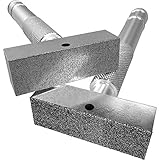
Diamond Grinding Wheel Dresser — Dedicated Dressing Tool for Bench Grinders


 Mena
If you’re running vitrified-bond bench-grinder wheels like WA, GC, or A, it’s worth keeping one of these dressers on hand too.
This diamond grinding wheel dresser is a dedicated dressing tool for bench (double-ended) grinders. Its diamond-tipped point re-cuts the wheel’s surface, restoring grinding power that’s dropped from clogging, and truing up any uneven wear that develops with use.
As noted above, this is a different process and tool from “flattening” a water or oil stone. To use it on a WA/GC/A vitrified wheel on a bench grinder, press it lightly against the spinning wheel and let it scrape the surface true — actually, always stop the grinder first and wear eye protection while dressing.
Abrasives You Don’t Need to Buy: Overkill for Home Use
Like grit number, abrasive grain tempts you to think “more is better,” but for home use it’s easy to over-invest. Let’s be honest about that here.
CBN wheels: priced well over $100/€100 per wheel, aimed at specialized high-speed machine grinding of ferrous materials. If you’re just sharpening kitchen knives, chisels, or plane blades at home, you basically never need one.
GC bench-grinder wheels: unnecessary unless you plan to grind carbide tools, glass, or ceramics. A or WA is plenty for ordinary steel blades.
Owning multiple grains from the same family: you rarely need both members of the same group (WA and A from the alumina family, or GC and C from the silicon-carbide family). Start with one family suited to your main material, and add the other only once you actually need it.
FAQ
Q. What if a whetstone doesn’t say “WA,” “GC,” etc.?
A. If the package or product page mentions a color (white, brown, black, green), you can use this article’s table as a guide. For cheap stones with no material labeling at all, don’t try to guess the material — it’s safer to pick a proven brand suited to the material you’re actually working (kitchen knife vs. metal parts).
Q. If I have a diamond stone, do I still need CBN?
A. For hand-sharpening blades at home, a diamond stone is plenty. CBN really shines in industrial-scale high-speed, high-heat machine grinding of ferrous materials, so for home use you can consider it essentially unnecessary.
Q. Should I buy GC or C?
A. Choose GC for hard, brittle materials like cemented carbide, glass, or ceramics; choose C for cast iron, non-ferrous metals (aluminum, brass), or “I just want to cut fast” jobs like rough-grinding. If you’re unsure, starting with the cheaper C is a reasonable approach.
Q. Does a different abrasive grain change how I should pick grit number?
A. No — the basic idea (smaller “#” number means coarser) is the same regardless of material. For a detailed guide to choosing and combining grit numbers, see our companion article “Choosing Oil Stones and Water Stones.”
Cautions When Using
When using a bench-grinder wheel (WA, GC, etc.), the grinder’s rated speed and the wheel’s maximum operating surface speed must always match. Forcing on a mismatched wheel can cause it to break or burst at high speed — a serious safety hazard — so always check the compatible RPM and surface-speed rating before buying.
Diamond stones handle hard materials well, but they wear rapidly when used to machine-grind ferrous metals at high speed and high heat. This isn’t an issue for slow hand-sharpening (like touching up a kitchen knife), but keep in mind that diamond wheels aren’t well suited to power-tool grinding of steel.
CBN wheels are expensive, so we recommend being clear about your actual need before buying. Picking one just because “it seems good” tends to be overkill for home use.
MenaChoosing a whetstone isn’t just about grit number — paying attention to abrasive grain (material) cuts down on mistakes. Check what material your blade or part is made of first, then pick the abrasive grain to match.
Summary
A whetstone’s “type” has two axes — grit number (coarseness) and abrasive grain (material) — and the difference in abrasive grain has a big impact on which materials it suits. WA works for hardened steel and stainless steel, GC for cemented carbide and glass, C for cast iron and non-ferrous metals, A for general steel, diamond for hand-sharpening at home, and CBN for high-speed machine grinding of ferrous materials.
Specific guidance on choosing and combining grit numbers is covered in detail in our companion article “Choosing Oil Stones and Water Stones.” Combine that with what you’ve learned here about abrasive grain to pick the right stone for your blade or part.