

Affiliate Disclosure: This article contains affiliate links. If you make a purchase through these links, we may earn a commission at no additional cost to you.
I’m Mena. Cordless vacuum pumps are quickly becoming standard on HVAC and refrigeration jobsites, and Makita’s 18V lineup is leading that shift for crews already invested in the platform. This article compares Makita’s DVP180Z and DVP181ZK on ultimate vacuum, flow rate, and the kind of job each one actually fits.
 Mena
The single biggest factor when picking a cordless vacuum pump is the battery system you already own. If you’re already on Makita 18V, the DVP180Z/DVP181ZK family costs you nothing extra to add. If you’re starting from zero, compare the full system price — pump plus battery plus charger — before deciding.
How to choose a cordless vacuum pump — 3 things to check
Check ultimate vacuum and flow rate
Pump performance comes down to two numbers: ultimate vacuum (lower Pa/higher micron rating is better) and flow rate (L/min or CFM). Larger commercial AC units (roughly 4 HP and up) call for a 3 Pa-class pump; a 20 Pa pump is fine for residential work. A higher flow rate gets you to target vacuum faster, which matters more on bigger jobs.
Minimize cost through battery compatibility
The single biggest cost factor when adding a cordless vacuum pump is the battery system. Already running Makita 18V tools? The DVP180Z or DVP181ZK cost you nothing extra in batteries. Starting from zero? Compare the full system price — pump, battery, and charger together — rather than the bare tool price alone.
MenaBattery compatibility is the real cost driver here, more than the pump’s sticker price. Adding a second platform just for one tool rarely pays off — check what you already run before comparing pumps.
Match the pump to the job scale
Residential work is well covered by the DVP180Z. Commercial units in the 7–20 HP range call for the higher-flow DVP181ZK. On rooftops, in mechanical rooms, or anywhere a power outlet is hard to reach, cordless is the only practical option — that’s the core reason this category exists.
Makita’s cordless vacuum pumps compared
1. Makita DVP180Z 18V Cordless Vacuum Pump (Tool Only)






| Manufacturer | Makita |
| Model | DVP180Z |
| Battery | 18V |
| Ultimate Vacuum | 20 Pa |
| Free Air Flow | 50 L/min (1.8 CFM) |
| Pump Type | single-stage rotary |
| Weight | 3.5 kg (with battery) |
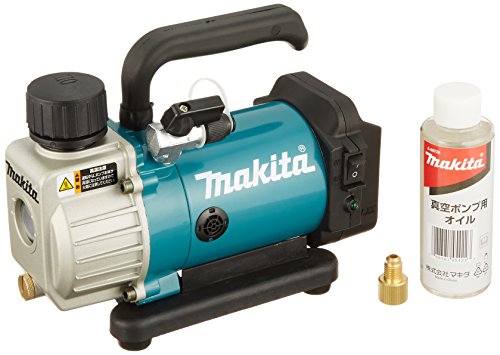
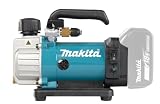
The DVP180Z is Makita’s long-running 18V cordless vacuum pump. Its single-stage rotary pump reaches 20 Pa ultimate vacuum at 50 L/min (1.8 CFM), enough for residential AC units (roughly 4 HP and under). It has a solid track record of availability through Amazon, which keeps it easy to source.
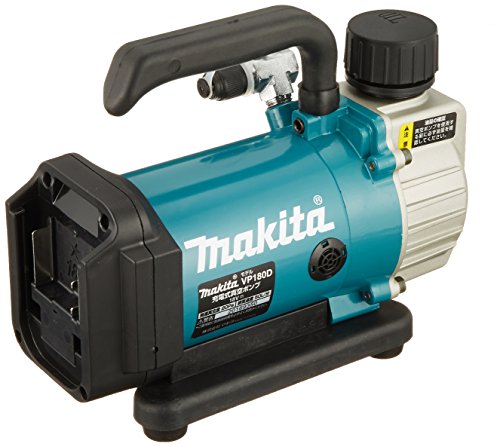
The main draw is price: it costs less and is more widely stocked than the newer dual-stage models. For a shop that already runs Makita 18V tools and wants to try a cordless pump without committing to a big-flow model, this is a reasonable starting point. Once commercial-scale jobs start showing up more often, stepping up to a dual-stage pump like the DVP181ZK is the natural upgrade.
MenaResidential AC work doesn’t need much more than 20 Pa in practice. I’d only bother upgrading to a 3 Pa pump once commercial jobs start showing up more regularly.
2. Makita DVP181ZK 18V LXT Dual-Stage Vacuum Pump, 4 CFM (Tool Only)


| Manufacturer | Makita |
| Model | DVP181ZK |
| Battery | 18V+18V (dual battery) |
| Ultimate Vacuum | 3 Pa |
| Free Air Flow | 113 L/min (4 CFM) |
| Pump Type | dual-stage rotary |
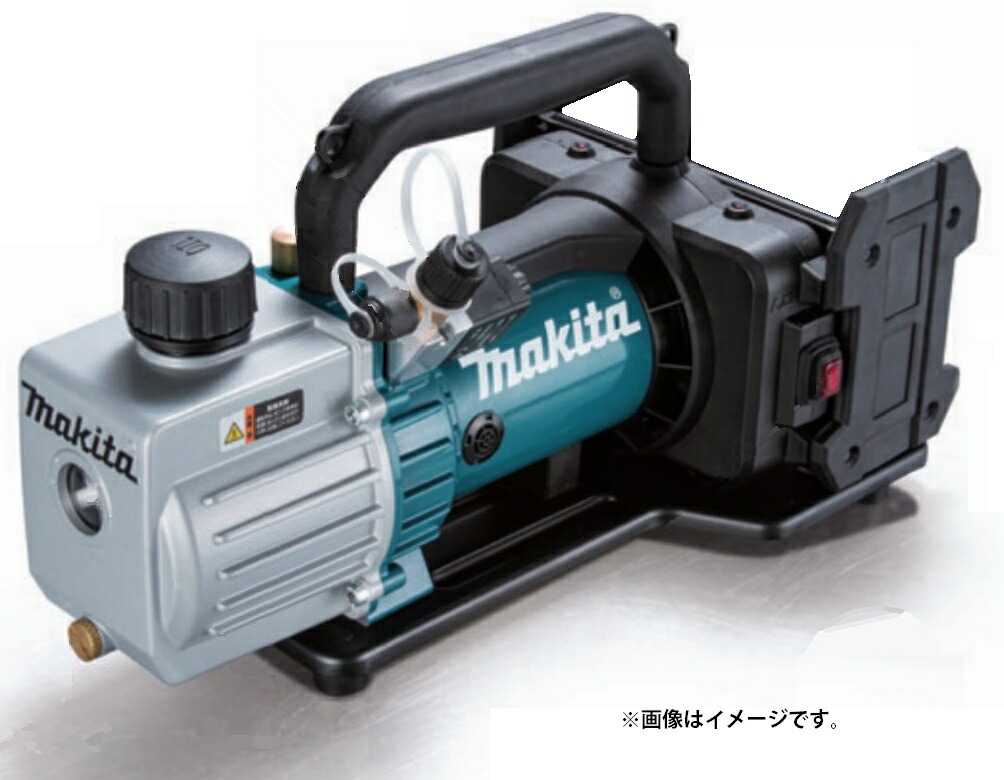
The DVP181ZK draws extra power by running two 18V batteries in series, delivering 113 L/min (4 CFM) of free air displacement — among the fastest cordless pumps on the market. Its dual-stage rotary pump reaches 3 Pa ultimate vacuum, holding commercial-grade performance while staying cordless, and is rated for units up to roughly 20 HP.
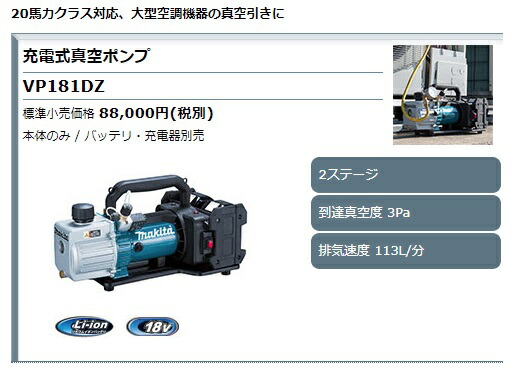
It is clearly overkill for a single residential split system, but for shops handling larger commercial and building AC installs it removes a real pain point: corded AC-powered pumps of this capacity are heavy to carry and need a power source on site, while the DVP181ZK gets the same job done on two batteries.
MenaThe 4 CFM flow rate is the real differentiator on the DVP181ZK. On a big commercial unit that difference alone can cut real time off an evacuation.
Accessories: a digital vacuum gauge
Elitech VGW-Mini Digital Vacuum Gauge


| Manufacturer | Elitech |
| Connection | 1/4″ SAE, works with any evacuation setup |
Ultimate-vacuum specs on a pump datasheet only mean something if you can actually confirm the system reached that level. A digital micron gauge like the Elitech VGW-Mini reads the real vacuum in the line during evacuation, which is the only reliable way to know the job is actually done — a pump running for X minutes is not proof by itself.
MenaI think it’s worth investing in tools a professional will use for years. On Amazon, Makita can look pricier than a bargain import pump, but given how long these last it evens out. If you already run Makita 18V, the DVP180Z is close to a free upgrade.
Summary
For residential AC work, the Makita DVP180Z covers the job at a lower price point. For commercial-scale installs, the DVP181ZK’s 4 CFM flow and 3 Pa ultimate vacuum handle units up to about 20 HP without a power cord. Either way, pair the pump with a digital vacuum gauge — flow rate alone doesn’t confirm the job is done.
Related reading
Featured image: U.S. Air Force photo by Senior Airman Mark Colmenares (Public Domain), via Wikimedia Commons, source
