

Affiliate Disclosure: This article contains affiliate links. If you make a purchase through these links, we may earn a commission at no additional cost to you.
 Mena
Hey, it’s Mena (@menachite), the hybrid engineer who handles both mechanical and electrical work. On electrical job sites, there’s always a moment where “a regular impact driver just won’t fit.” Ceiling voids, in-wall wiring, screws inside a breaker panel — in spots like these, a pen impact driver genuinely becomes your “second right hand.” This time I put the Bosch GDR series and Makita TD series head to head, comparing 10 pen and compact impact drivers from an electrician’s point of view.
This article compares compact impact drivers spanning a wide voltage range, from 7.2V to 18V. I’ve felt firsthand how much I need a pen impact driver on electrical job sites, so I’ll focus on the practical points. I’ll answer real-world questions like “Bosch GDR or Makita TD — which suits electrical work better?”, “pen-style (7.2V) versus 18V — which is easier to use in tight spaces?”, and “how should I think about battery compatibility?”
How to Choose a Pen Impact Driver — 4 Points from an Electrician’s Perspective
① Voltage & Torque: Match It to the Job
7.2V pen-style models (Makita TD022/TD023, HiKOKI WH7DL) top out around 25 N·m, ideal for light screws and installing electrical fixtures. The 18V Bosch GDR line delivers 200–220 N·m of serious torque for heavier-duty site work. The pen style’s strength is its straight body that slips into tight spaces; the 18V’s strength is power that covers a wide range of jobs with one tool. Ideally an electrician owns both — usually an 18V model first, with a pen-style added as the second tool.
② Battery Compatibility: Staying Within One Brand Pays Off
Makita’s 7.2V (BL0715), HiKOKI’s 7.2V (BSL712), and Panasonic’s 7.2V (EZT006) batteries are all mutually incompatible. Bosch’s 18V ProCore batteries, on the other hand, are shared across the entire GDR 18V lineup. Choosing a pen impact driver from the same brand as your existing tools lets you share batteries and cut costs. Note that Makita’s TD line splits across 10.8V (CXT), 18V, and 40Vmax platforms, and the 7.2V TD022/TD023 use their own dedicated BL0715 battery.
③ Control Style: Trigger vs. Joystick
Makita, Panasonic, and Bosch all use a conventional trigger. Only the HiKOKI WH3DA uses a joystick-style control. A trigger is intuitive — anyone can pick it up and use it right away. The joystick wins on speed when switching between forward and reverse, but it takes some getting used to. If your work involves constantly removing then re-driving screws, the WH3DA’s joystick pays off in a big way.
④ LED Lighting: A Real Difference in Dark Spaces
The Panasonic EZ7521’s independent LED switch is the only one here that lets the light stay on even when the tool isn’t running — genuinely useful for precise work inside ceiling voids or breaker panels. Makita, HiKOKI, and Bosch all tie the LED to the trigger (it goes dark the moment you let go). If you frequently work in dark spaces, the EZ7521 is worth a look; otherwise any of the other models will serve you fine.
Full Spec Comparison — All 10 Pen Impact Driver Models
Here’s a full spec rundown for every model, so you can narrow things down by voltage, torque, weight, and body style.
| Model | Voltage | Max Torque | Weight (bare tool) | Type | Highlight |
|---|---|---|---|---|---|
| GDR 18V-220C | 18V | 220 N·m | 1.0 kg | Pistol | Bosch’s flagship, Bluetooth-equipped |
| GDR 18V-215 | 18V | 215 N·m | 1.0 kg | Pistol | 2025 model, value-focused |
| GDR 18V-200H | 18V | 200 N·m | 1.1 kg | Pistol | Bare-tool workhorse standard |
| GDR 10.8V-LIN | 10.8V | 105 N·m | 0.88 kg | Pistol | Compact, 12V-platform compatible |
| Makita TD023D | 7.2V | 25 N·m | 0.57 kg | Pen-style | Newest 2026 model, one-touch bit change |
| Makita TD022DSHX | 7.2V | 25 N·m | 0.55 kg | Pen-style | The long-running standard, comes in an aluminum case |
| HiKOKI WH7DL | 7.2V | 25 N·m | 0.58 kg | Pen-style | Multi-layer battery protection circuit |
| HiKOKI WH3DA | 3.6V | 25 N·m | 0.73 kg | Pen-style | Industry-first joystick switch |
| Panasonic EZ7521 | 7.2V | 25 N·m | 0.85 kg | Stick | Independent LED switch |
| Shinko Seisakusho DCPI-7220 | 7.2V | 22 N·m | 0.65 kg | Pen-style | Budget-friendly DIY entry point |
10 Recommended Pen Impact Drivers — 2026 Bosch GDR vs. Makita TD Head-to-Head
From the newest 2026 releases to long-running standards and budget picks — here are all 10 models, each with my own hands-on, job-site take.
Bosch GDR 18V-220C — Peak Power at 220 N·m / Bosch’s 18V Flagship


 Mena
The GDR 18V-220C sits at the top of the current GDR lineup with 220 N·m of torque. Its 126mm compact head still slips into tight panel spaces inside a ceiling void. If a pro can own only one, this is it.
| Voltage | 18V |
| Max torque | 220 N·m |
| Speed | 0-800/2,300/3,400 rpm (3-stage) |
| Impact rate | 0-1,500/3,400/4,000 bpm |
| Weight (bare tool) | approx. 1.0 kg |
| Head length | 126 mm |
| Bluetooth | Yes (Bosch Toolbox app) |
| One-handed bit change | Yes |
Released in August 2024, the GDR 18V-220C is the flagship of the GDR line. Its 220 N·m max torque is the highest in the series, covering nearly every fastening job across electrical, mechanical, and interior finishing work.

Its standout feature is one-handed bit insertion. Being able to swap bits with a single hand means your other hand stays free while working overhead or on scaffolding. Once I used it for repeated ceiling-void work, I could genuinely feel how much less time bit changes were eating up. It’s made ceiling work noticeably faster for me. The 3-speed control (low/medium/high) also makes it easy to dial in finishing precision.

If you’re an electrician or mechanical contractor wanting Bosch’s top-of-the-line model, this is the current answer. If you already own compatible batteries, the bare-tool version (GDR18V-220CH) is the smarter cost pick — I usually go bare-tool myself to keep using one battery platform. Its weak point is the price — a battery kit often lands well above what a comparable Makita kit costs.

Bosch GDR 18V-215 — 2025’s High-Value Standard, Aiming for 215 N·m on a Budget


| Voltage | 18V |
| Max torque | 215 N·m |
| Speed | 0-2,100/3,300 rpm (2-stage) |
| Impact rate | 0-3,000/3,800 bpm |
| Weight (bare tool) | approx. 1.0 kg |
| Head length | 126 mm |
| Bluetooth | No |
| LED | 3 lights |
| One-handed bit change | Yes |
Released February 6, 2025, the GDR 18V-215 packs in pro-grade features at a much friendlier price. Its list price runs at less than half of the 220C’s.

No Bluetooth here, but it still packs one-handed bit insertion, three LED lights, ETP dust/water resistance, 2-stage power control, and automatic slowdown/shutoff. Those three LEDs make a real difference on dark job sites, lighting up wiring work in ceiling voids and inside walls.

This one’s a great fit for electricians and mechanical contractors who don’t need a tool-tracking app but do want power and compact size. I lean price-conscious over Bluetooth myself, so the GDR215’s balance appeals to me. If you already own compatible batteries, the bare-tool version (GDR 18V-215H) is an excellent value option too.

Bosch GDR 18V-200H — The Pro Standard, Built for Tight-Space Work with a Compact Head
| Voltage | 18V |
| Max torque | 200 N·m |
| Speed | 0-3,400 rpm |
| Impact rate | 0-4,000 bpm |
| Weight (bare tool) | approx. 1.1 kg |
| Head length | 126 mm |
| Bluetooth | No |
| Kit contents | Bare tool only (battery/charger sold separately) |
The GDR 18V-200H is the standard model in Bosch’s Professional line — no Bluetooth, but it delivers 200 N·m of torque with a genuinely practical 126mm compact head. It’s a great match for electricians who spend a lot of time working in tight quarters, like around outlet boxes inside a ceiling void or breaker panel.

Since it’s bare-tool only, it’s excellent value if you already have Bosch 18V batteries on hand. Bosch’s 18V batteries are shared across drill/drivers, circular saws, and more, so building out a battery ecosystem pays off over time.

The catch is no Bluetooth or one-handed bit change. If you’re buying fresh, it’s worth also checking newer models like the 215H, where the price gap has narrowed. But if you already own the batteries and want to keep costs down, the 200H has more than enough performance.

Bosch GDR 10.8V-LIN — Compact 10.8V, Battery-Compatible with Bosch’s 12V System


| Voltage | 10.8V (12V-class) |
| Max torque | 105 N·m |
| Weight (bare tool) | approx. 0.88 kg |
| Battery | Compatible with Bosch 10.8V / 12V ProCore series |
| Included | 2x 2.0Ah batteries, charger, case |
The Bosch GDR 10.8V-LIN is a cordless impact driver on the 10.8V platform (today’s Bosch 12V system). Its 105 N·m max torque is modest next to the 18V models, but it’s light, easy to handle, and well suited to light interior-finish work and precision screw driving.

It shares batteries with Bosch’s 10.8V (now ProCore 12V) drill/drivers, like the GSR 12V-15, so anyone already on Bosch’s 12V system can add it without extra battery costs.

For the bulk of your professional work I’d still recommend an 18V model, but for “a dedicated light-duty tool” or DIY wood-screw driving, this 10.8V is an affordable pick. Note the difference between Bosch’s Professional (green) and DIY (blue) lines — green is built for pro-grade durability, blue leans toward value.

Makita TD023D — The New 2026 Pen Impact Driver Where One-Touch Bit Change Changes the Job


 Mena
The TD023D’s one-touch bit change is the kind of upgrade that makes you feel “this is the first full redesign in 10 years.” Being able to swap bits one-handed while still wearing gloves is a small thing that adds up in a big way when you’re installing outlet after outlet.
| Voltage | 7.2V |
| Max torque | 25 N·m |
| Impact rate | up to 3,600 bpm |
| Weight | 0.57 kg (with battery) |
| Bit change | One-touch (new mechanism) |
| Battery | BL0715 7.2V 1.5Ah (compatible with TD022D) |
The Makita TD023D is the newest 7.2V cordless pen impact driver, released in Japan in February 2026. It’s the first full model change from the previous TD022D in roughly a decade, and the headline update is one-touch bit insertion: just push the bit in and it locks, making bit swaps far easier even with gloves on.
Core specs match the TD022D (25 N·m max torque, 3,600 bpm), while the case switches from aluminum to resin to optimize cost. The battery (BL0715) and charger (DC07SB) carry over from the TD022D, so existing owners can reuse what they already have — I consider battery compatibility one of the top priorities when choosing a new tool. It’s offered in five colors: blue, black, olive, deep purple, and deep red.
It suits electricians, mechanical contractors, and interior finishers who spend a lot of time installing electrical fixtures and driving light screws. I can genuinely feel how much that straight, 7.2V-only body helps in tight in-wall spaces — this is exactly the shape that lets a pen impact driver become your “second right hand.”
Availability note: as of publication, the TD023D itself was a Japan-market release with no confirmed listing on Amazon.com, Amazon.de, or Amazon.es. The link above points to the closest widely available equivalent — the long-running TD022DSHX, which shares the TD023D’s torque and impact-rate specs but does not have the new one-touch bit mechanism. See the dedicated TD023D vs. HiKOKI WH3DA comparison (original article in Japanese) for a closer look at the TD023D specifically.
Makita TD022DSHX — The Classic Blue Model, a Trusted Pen Impact Driver for Nearly a Decade

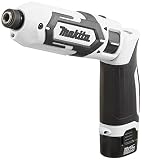


| Voltage | 7.2V |
| Max torque | 25 N·m |
| Impact rate | up to 3,600 bpm |
| Weight | 0.55 kg (with battery) |
| Bit change | Sleeve-style |
| Included | 2x batteries, charger (DC07SB), aluminum case |
The Makita TD022DSHX (blue) is still the widely used standard pen impact driver. On the market continuously since 2016, it’s earned a long track record with electricians, mechanical contractors, and interior finishers. Specs match the TD023D (25 N·m, 3,600 bpm) — the only real difference is its older sleeve-style bit change.

This kit ships ready to use — two batteries, a charger, and an aluminum case that holds up well inside a tool bag. The blue finish is also easy to spot, which helps on job sites where several people are sharing tools.

It’s typically priced below the TD023D, which suits anyone who wants full functionality at a lower cost. If you already own the batteries, the bare-tool version (TD022DZ) is also an option. It’s a solid pick both as a first pen impact driver and as a reliable second tool.

HiKOKI WH7DL — The 7.2V Standard with a Multi-Layer Battery Protection Circuit

| Voltage | 7.2V |
| Max torque | 25 N·m |
| Impact rate | up to 3,600 bpm |
| Weight | 0.58 kg (with battery) |
| Battery protection | Multi-layer protection circuit |
| Included | 1x battery, quick charger, case (Japan-market set) |
The HiKOKI WH7DL is HiKOKI’s standard 7.2V pen impact driver. Its 25 N·m max torque and 3,600 bpm impact rate match the Makita TD022D/TD023D. It also includes HiKOKI’s own multi-layer battery protection circuit (overload protection, over-discharge protection, per-cell voltage monitoring), which does a lot for battery longevity.
It uses a trigger, so it’s just as intuitive as the Makita models. If the WH3DA’s joystick control feels intimidating, the trigger-style WH7DL is the easier one to pick up right away. At 0.58 kg with the battery, it’s roughly on par with the TD022D.

If you already own HiKOKI’s BSL712 battery, reusing it keeps costs down. If you’re torn between HiKOKI and Makita, it’s reasonable to decide based on whichever battery platform you already own. It also makes a dependable “second tool” for electricians and mechanical contractors.

Availability note: HiKOKI’s international (US/EU) power-tool lineup does not currently list a pen impact driver category, so the WH7DL is not confirmed available through Amazon.com, Amazon.de, or Amazon.es retail. It remains primarily a Japan-market product.
HiKOKI WH3DA — The Industry’s First Joystick Switch, Reinventing Forward/Reverse at 3.6V
 Mena
The first thought with the WH3DA’s joystick switch is usually “wait, how do I even hold this?” — but once it clicks, switching direction with one hand feels completely natural. For electricians and mechanical contractors who constantly remove then re-drive screws, productivity climbs once you’re past the learning curve.
| Voltage | 3.6V |
| Max torque | 25 N·m |
| Impact rate | up to 4,200 bpm |
| Weight | 0.73 kg (with battery) |
| Switch | Joystick-style (industry first) |
| Slow mode | 3-stage slow-start function |
Released in Japan in February 2026, the HiKOKI WH3DA is a pen impact driver built around the industry’s first “joystick switch.” Instead of a conventional trigger, you tilt the joystick (lever) forward or back to switch between forward and reverse rotation. That switch is fast, which really shows its value in repetitive remove-then-drive work.
The 3-stage slow-start function helps prevent stripped screw heads on precision fastening work. Despite the low 3.6V rating, its 25 N·m max torque matches the Makita TD023D’s (7.2V). At 0.73 kg with the battery, it’s also on the lighter side of this comparison, which helps with fatigue over long stretches of continuous work.

The joystick takes some getting used to, so it’s worth trying one in person first if you can. It particularly suits electricians and mechanical contractors whose work involves repeatedly removing and re-driving screws. HiKOKI’s existing owners should double-check battery compatibility (BSL36A18BX) before switching over. For a closer look specifically comparing this model with the Makita TD023D, see our dedicated TD023D vs. WH3DA comparison (original article in Japanese).

Availability note: as with the WH7DL, HiKOKI’s US/EU catalog does not currently list a pen-style impact driver category, so the WH3DA is not confirmed available through Amazon.com, Amazon.de, or Amazon.es retail. It remains primarily a Japan-market product.
Panasonic EZ7521LA2S — An Independent LED Switch That Wins Over Electricians Working in the Dark
 Mena
The EZ7521’s independent LED switch is the only feature here that keeps your work light on even when the tool isn’t spinning. For careful inspection work inside a ceiling void or panel, that’s a real practical edge Makita and HiKOKI don’t have. For electricians who work in the dark a lot, that alone can be reason enough to choose it.
| Voltage | 7.2V |
| Max torque | 25 N·m |
| Impact rate | up to 4,100 bpm |
| Weight | 0.85 kg (with battery) |
| LED | Wide + spot, independent switch |
| Included | 2x batteries, charger, case |
The Panasonic EZ7521LA2S-B (black, 2-battery kit) is a rechargeable stick impact driver. Its headline feature is the independent LED switch: a switch separate from the trigger keeps the LED lit continuously, so the light stays on even when you’re not pulling the trigger — genuinely useful in dark spaces. You can also toggle between spot and wide beam.
Its 4,100 bpm impact rate runs slightly higher than the Makita and HiKOKI models, which helps with fine adjustments during precision screw driving. The two included batteries mean you can keep working through long stretches without waiting on a charge. It’s a model that’s remained popular for a long time among electricians, mechanical contractors, and HVAC installers.

Panasonic’s 7.2V batteries (like the EZT006) are shared across their broader 7.2V tool line. If lighting matters to you, that independent LED switch is a genuine differentiator no competitor here offers. If you mostly work in bright indoor or outdoor spaces, it’s a feature you may not need — choose based on your actual use case.

Availability note: Panasonic does not currently sell this tool through Amazon’s US or EU retail channels; it’s primarily distributed in Japan, with only secondhand or import listings turning up elsewhere. Not confirmed available via Amazon.com, Amazon.de, or Amazon.es as of publication.
Shinko Seisakusho DCPI-7220 — A Value-First DIY Starter Tool, Good for Trying Before You Commit

| Voltage | 7.2V |
| Max torque | 22 N·m |
| Capacity | 2.0 Ah |
| Weight | approx. 0.65 kg (with battery) |
| LED | Built-in light |
| Intended use | DIY / light-duty work |
The Shinko Seisakusho DCPI-7220 is a budget-oriented 7.2V cordless pen impact driver. Its 22 N·m max torque falls short of the 25 N·m offered by Makita, HiKOKI, and Panasonic, so it can feel underpowered for long screws into hardwood or frequent heavy use. It’s better suited to light fastening and loosening work, or occasional DIY use.
It comes in well below the price of the three major brands here, making it a solid pick if you just want to try out a pen impact driver. The built-in LED light also handles simple work in dim spaces. Since it ships as a full kit with battery and charger, you can start using it right away with no extra cost.

For daily professional work (electrical, mechanical), I’d still recommend Makita, HiKOKI, or Panasonic for their reliability and durability. Think of the DCPI-7220 as a “price-first DIY tool” — a smart way to get a feel for a pen impact driver before stepping up to a pro-grade model.

Availability note: Shinko Seisakusho is a small Japan-only DIY brand with no confirmed overseas distribution. Not confirmed available via Amazon.com, Amazon.de, or Amazon.es as of publication.
Best Pen Impact Driver by Trade
For Electricians & Mechanical Contractors
For daily job-site work, the golden rule is picking a brand with strong durability, battery longevity, and after-sales support. If you’re building around an 18V main tool, the Bosch GDR 18V-215 (2025’s high-value model) or something in the Makita TD173D/TD001G class is a solid choice, paired with a tight-space secondary tool like the Makita TD023D or HiKOKI WH3DA. If lighting matters most to you, the Panasonic EZ7521 stands apart with its independent LED switch.
For Interior Finishing & Remodeling
Interior work involves a lot of installing switches and outlets and driving light screws — exactly where the 7.2V pen style (Makita TD023D, HiKOKI WH7DL) shines with its light weight and easy handling. The pen style’s straight body has a clear edge when reaching into walls and tight framing. Meanwhile, the Bosch GDR 10.8V-LIN is a solid compact option if you’re already on Bosch’s 12V platform.
For DIY & Weekend Users
If you won’t be using it often, it’s realistic to start by choosing on price. The Shinko Seisakusho DCPI-7220 is the cheapest way in, though its torque is a bit low at 22 N·m. Stepping up your budget slightly to the Makita TD022DSHX gets you pro-grade specs (25 N·m) that will serve you for years. If you just want to try a pen impact driver, starting with the DCPI-7220 to get a feel for it, then moving up to a pro model later, is a smart approach.
Frequently Asked Questions
Q. Bosch GDR or Makita TD — which is better for electrical work?
A. It depends on the job and how often you’ll use it.
For serious electrical work needing real fastening power (heavy cable terminals, bolted connections, etc.): the Bosch GDR 18V line excels.
For light screws and installing fixtures in tight spaces: the Makita TD023D (7.2V pen-style) is easier to work with.
Most electricians end up switching between both depending on the task — if you can only get one, an 18V model is usually the pick; if you’re adding a second tool, go pen-style.
Q. Pen-style (7.2V) vs. 18V impact driver — what’s the real difference for tight spaces?
A. The pen style’s straight body is designed to slide straight into ceiling voids and in-wall wiring runs. An 18V pistol-grip tool has a longer head, which can limit how well it fits into tight spots. For fastening inside a breaker panel or reaching into a wall switch box, the pen style’s straight shape has a clear edge. The Bosch GDR’s 126mm compact head is excellent for an 18V-class tool, but it still can’t match how small a 7.2V pen style is.
Q. Is the HiKOKI WH3DA’s joystick switch hard to learn?
A. Most reviews mention a 2–3 day adjustment period, but the overwhelming consensus is “once you’re used to it, you can’t go back.” Being able to switch between removing (reverse) and driving (forward) with one finger boosts productivity for electricians and mechanical contractors doing repetitive work. Watch out for accidental direction mix-ups while you’re still learning — it’s worth practicing at low speed at first.
Pen Impact Driver Accessories — Compatible Bits & Batteries
Getting the most out of a pen impact driver comes down to choosing the right bits and consumables. Here’s what’s compatible with each model.
Compatible Bits: 6.35mm (1/4″) Hex-Shank
The Makita TD line, HiKOKI WH7DL/WH3DA, and Panasonic EZ7521 all use the standard 6.35mm (1/4″) hex-shank bit. The Bosch GDR line takes the same 1/4″ hex shank too, which is convenient for electricians since bits can be shared across brands. Adding a magnetic bit holder is also worth it — it dramatically cuts the risk of dropping a bit while working in a tight space.
Makita 7.2V Battery (BL0715) Compatibles
The TD023D and TD022D both run on the BL0715 (7.2V, 1.5Ah). Genuine Makita batteries are the most reliable choice and offer the best warranty coverage. Since the battery carries over from TD022D to TD023D, upgrading doesn’t force you to replace it, which keeps switchover costs down. Third-party compatible batteries are cheaper but vary in quality, so proceed carefully.
Bosch 18V ProCore Battery System Compatibility
The Bosch GDR 18V line (220C, 215, 200H) all share Bosch’s 18V ProCore batteries. Paired with the GAL18V-40 fast charger, you’re looking at roughly a 40-minute charge time. Bosch’s Prolixium batteries (36V) are not compatible with the GDR 18V tools, so keep that in mind. The 12V system (GDR10.8-LIN) needs ProCore 12V batteries instead, and those aren’t interchangeable with the 18V lineup either.
Summary — Bosch GDR vs. Makita TD: Which Model Should You Pick?
Serious pro use: Bosch GDR 18V-215 (2025’s value pick) or the GDR 18V-220C (top-tier flagship)
Dedicated tight-space secondary tool: Makita TD023D (newest 2026 model, one-touch bit change) or HiKOKI WH3DA (joystick innovation)
Lighting matters most: Panasonic EZ7521 (unique independent LED switch)
DIY starter: Shinko Seisakusho DCPI-7220 (just want to try it) or Makita TD022DSHX (a long-running standard you’ll keep using)