
Affiliate Disclosure: This article contains affiliate links. If you make a purchase through these links, we may earn a commission at no additional cost to you.
Bosch Professional GDR Series Impact Driver: Complete Model Comparison [2026 Edition] — The Complete Guide for Professionals
Introduction
Hey, I’m Mena — an electrician and equipment technician who also enjoys DIY on the side.
My first encounter with a Bosch impact driver on the job site was when a German craftsman handed one to me and said, “Try this.” I remember thinking, “Why Bosch?” — but after using it, I was completely won over. Compact, yet delivers serious torque. Short head, so it works in tight spaces too. “Okay, now I get why the pros use this,” I remember thinking.
“There are so many GDR models — I can’t figure out which one is right for me.” I hear that constantly from people on job sites and at tool enthusiast gatherings. From the GDR 18V-200 to the 220C, the model names look similar and the differences aren’t obvious at first glance.
In this article, I’ve organized all major models in the Bosch Professional GDR series (including GDX) by voltage and application. Drawing on my experience as an electrician, I’ll walk through how to read the model numbers, specs, strengths, and weaknesses of each — covering “which model fits which trade.”
By the time you finish reading, you should be able to identify exactly which model number you need.
 メナ
メナThe GDR series excels at combining a compact head with high torque. It’s less well-known than Makita in Japan, but use it on the job and the difference is clear. Start by deciding on voltage — 18V or 12V — and your options narrow down fast.
The GDR series is the flagship cordless impact driver line from Bosch Professional. The lineup centers on 18V with compact 12V models as well. Available through official channels in Japan, it’s gradually making its mark on electrical, mechanical, and woodworking job sites.
What Is Bosch Professional?
Where It Fits in the Brand
Bosch (Robert Bosch GmbH) is a Germany-based company and one of the world’s largest power tool manufacturers. In Japan, the “Bosch Professional” brand covers professional-grade power tools, unified under a blue color scheme. It’s a separate product line from the DIY-oriented green Bosch, meeting professional standards across durability, power, and battery compatibility.
In Japan’s market — where Makita and HiKOKI dominate — Bosch Professional occupies the position of “niche but the brand that craftsmen in the know choose.” Electricians and mechanical technicians who use Bosch on the job often say they can’t go back to anything else.
Key features include three built-in electronic protection systems: ECP (overheating protection), ETP (dust and water protection), and EMP (overload protection). These come standard on all models, protecting the tool even in harsh job site conditions.
GDR Series Features and Why Pros Choose It
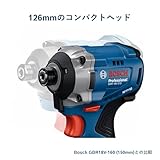
The GDR series’ greatest strength is combining a compact head with high torque. Compared to Makita products in the same class, the GDR’s head length is often shorter — making it invaluable for work in ceiling cavities, distribution panels, and tight spaces. Speaking from years of experience as an electrician, GDR’s edge in accessing confined areas is genuinely a step above the competition.
Another strength is the brushless motor. All current GDR models feature a brushless EC motor — no brush replacement needed, long service life, and high efficiency. For craftsmen who use their tools daily over many years, the near-maintenance-free design offers real cost savings.
More recent models (210C, 220C) also feature Bluetooth connectivity, enabling torque customization and tool management via the “ToolTrack” smartphone app. This capability for equipment management at contracting companies and workshops is an area where Makita and HiKOKI haven’t yet caught up.
Complete Guide to GDR Series Model Naming
GDR model numbers may look random at first, but once you know the system, the structure becomes clear. Being able to read model numbers accurately means you won’t get lost browsing catalogs or online stores — and it changes how you talk to tool shop staff.
GDR vs GDX
| Symbol | Type | Feature |
|---|---|---|
| GDR | Impact Driver | 1/4″ hex bit only. The most standard type |
| GDX | Impact Driver + Wrench combo | 1/4″ hex bit + 1/2″ square drive 2-in-1. Can also tighten bolts |
Voltage Notation
| Notation | Voltage | Notes |
|---|---|---|
| 18V | 18V | Current main line. Widest lineup. ProCORE battery compatible |
| 12V | 12V | Compact focus. For lightweight tasks and DIY |
Numbers (Torque Indicator)
| Model Example | Max Torque | Generation |
|---|---|---|
| GDR 18V-110 | 110 N·m | Older compact generation |
| GDR 18V-200/200H | 200 N·m | Standard professional |
| GDR 18V-210C | 210 N·m | Bluetooth-connected generation |
| GDR 18V-220C | 220 N·m | 2024 flagship |
| GDR 12V-110 | 110 N·m | 12V compact |
Suffix Letters
| Symbol | Meaning |
|---|---|
| (none) | Standard kit (battery and charger included) |
| H | Compact head emphasis model (same tool body) |
| C | Connected (Bluetooth equipped) |
| CH | Connected + compact head (body only — battery sold separately) |
GDR Series: Full Model Comparison Table
Here’s the current lineup summarized by voltage, torque, weight, and key features. Use this to get a general sense of positioning before purchasing.
| Model | Voltage | Max Torque | RPM | BPM | Weight (body) | Bluetooth | Head Length |
|---|---|---|---|---|---|---|---|
| GDR 18V-220C | 18V | 220 N·m | 0–3,400 | 0–4,000 | ~1.1 kg | ✓ | 126 mm |
| GDR 18V-210C | 18V | 210 N·m | 0–3,400 (3-speed) | 0–4,200 (3-speed) | ~1.1 kg | ✓ | 127 mm |
| GDR 18V-215 | 18V | 215 N·m | 0–2,100/3,300 | 0–3,000/3,800 | ~1.0 kg | ✗ | 126 mm |
| GDR 18V-215H | 18V | 215 N·m | 0–2,100/3,300 | 0–3,000/3,800 | ~1.0 kg | ✗ | 126 mm |
| GDR 18V-200H | 18V | 200 N·m | 0–3,400 | 0–4,000 | ~1.1 kg | ✗ | 126 mm |
| GDR 18V-200CH | 18V | 200 N·m | 0–3,400 | 0–4,000 | ~1.1 kg | ✗ | 126 mm |
| GDX 18V-200 | 18V | 200/350 N·m | 0–3,400 (3-speed) | 0–4,000 (3-speed) | ~1.3 kg | ✗ | 147 mm |
| GDR 12V-110 | 12V | 110 N·m | 0–2,600 (2-speed) | 3,100 | 0.725 kg | ✗ | Compact |
※ Weights are without battery. Add approximately +800g for a 5.0Ah battery during actual use. The 350 N·m for GDX 18V-200 is the removal torque (loosening). Tightening torque is 200 N·m.
Detailed Reviews: Each Model
Here I’ll go into the real-world feel, strengths, and weaknesses of each model. I’ll focus on job-site perspectives that specs alone don’t convey.
GDR 18V-220C — 2024’s Latest Flagship, the Peak at 220 N·m
メナWhen I used the GDR 18V-220C for wiring outlet boxes in a ceiling cavity, the short head made maneuvering easy. Even at 220 N·m, the light body means your arms don’t fatigue. For professional use, this is currently my top pick.






| Manufacturer | Bosch Professional |
| Model | GDR 18V-220C |
| Voltage | DC18V |
| Max Torque | 220 N·m |
| RPM | 0–800/2,300/3,400 rpm (3-speed) |
| BPM | 0–1,500/3,400/4,000 bpm (3-speed) |
| Weight (body) | ~1.0 kg |
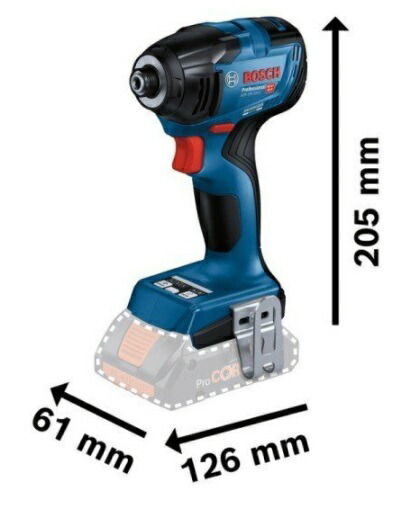
| Head Length | 126 mm |
| Bluetooth | ✓ (BOSCH Tool Box) |
| One-Hand Bit | ✓ |
| LED | Dual |
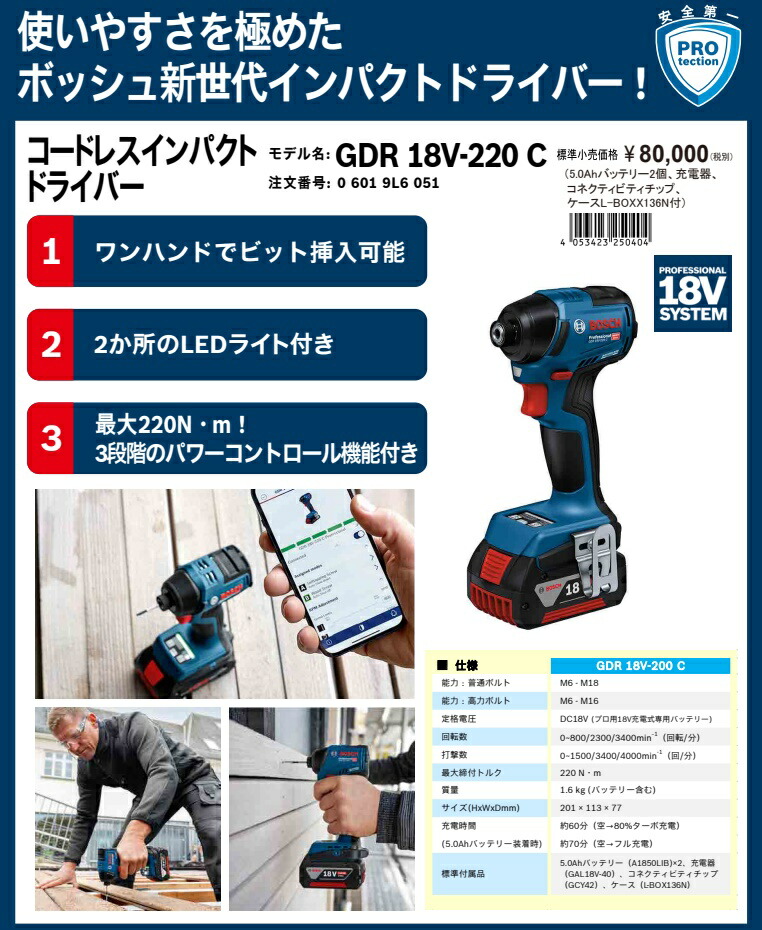
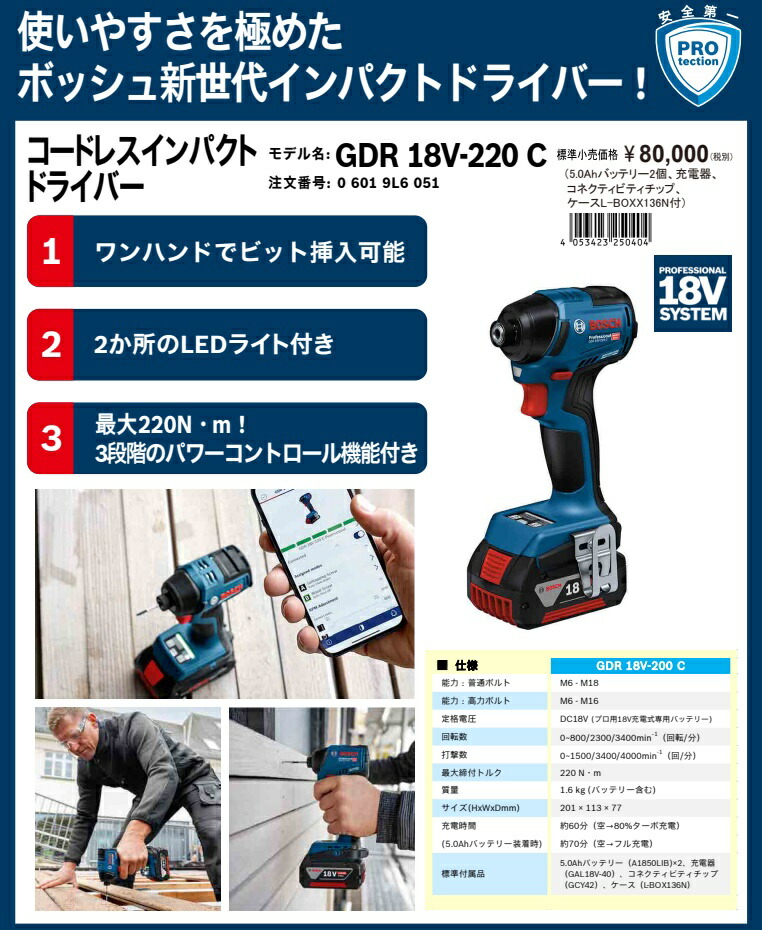
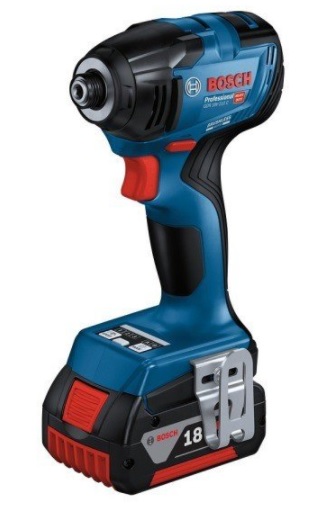
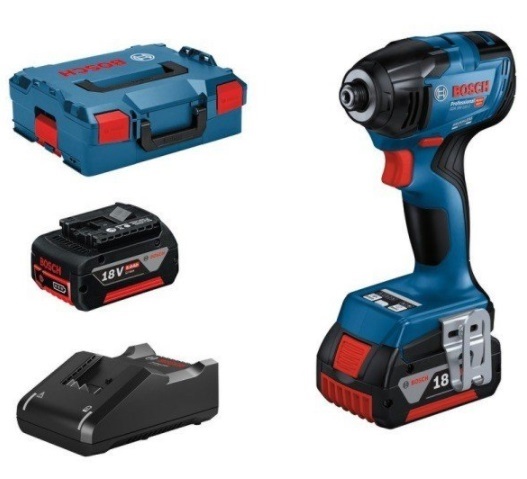
Released in August 2024, the GDR 18V-220C is the current flagship of the GDR series. Its 220 N·m max torque is the highest in the lineup, capable of handling virtually all tightening tasks required in professional settings.
The biggest advancement is the “one-hand bit insertion” feature. Being able to swap bits with one hand is invaluable when working at height or on scaffolding. Previous models required both hands for bit changes, but this improvement noticeably boosts job site efficiency. I’ve used this during pre-completion electrical work and felt the difference firsthand.
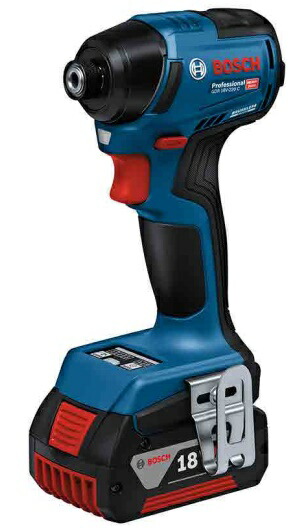
The three-speed control (low 1,100 / mid 2,300 / high 3,400 rpm) is practical for controlling finishing precision during screw driving. The dual LED lights improve visibility in dark spaces — a small but genuinely helpful upgrade. ECP/ETP/EMP protection systems are standard, making it dependable outdoors and in dusty environments.
The downside is the price. A kit with battery and charger can run into the ¥80,000+ range — slightly higher than comparable Makita TD173D class tools. That said, the total value — tool quality, durability, and Bluetooth features — fully justifies the investment.
Target users: electricians, mechanical technicians, and structural ironworkers who want Bosch’s latest tech without compromise. If you’ll use it constantly, get the kit set. If you already own batteries, the body-only version (GDR18V-220CH) is the smarter cost choice.
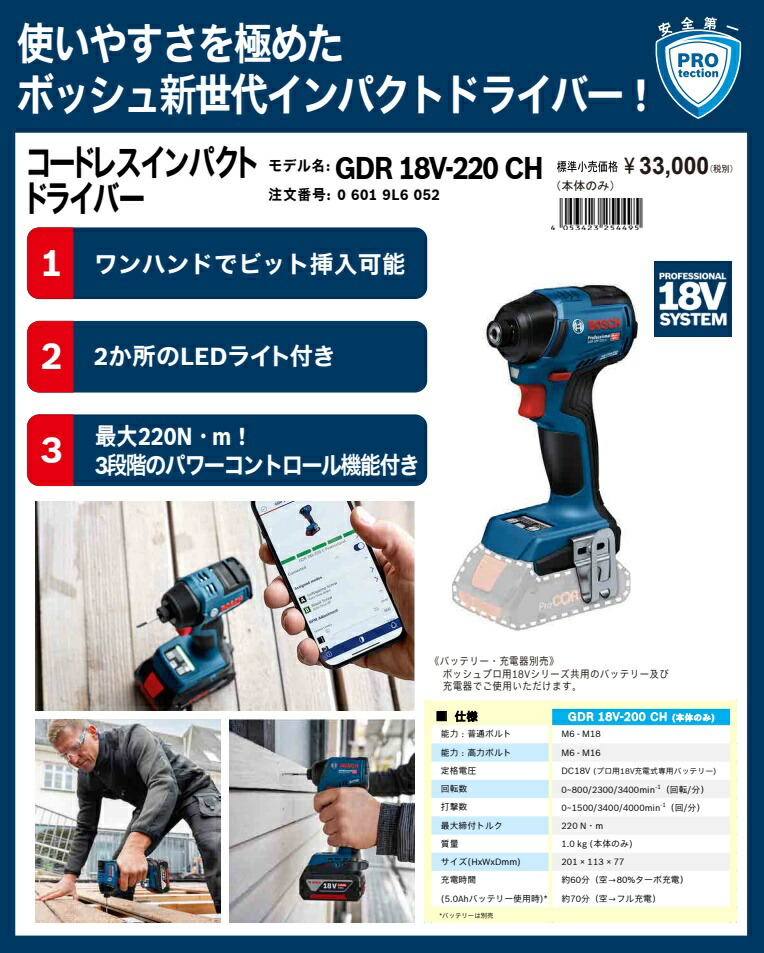
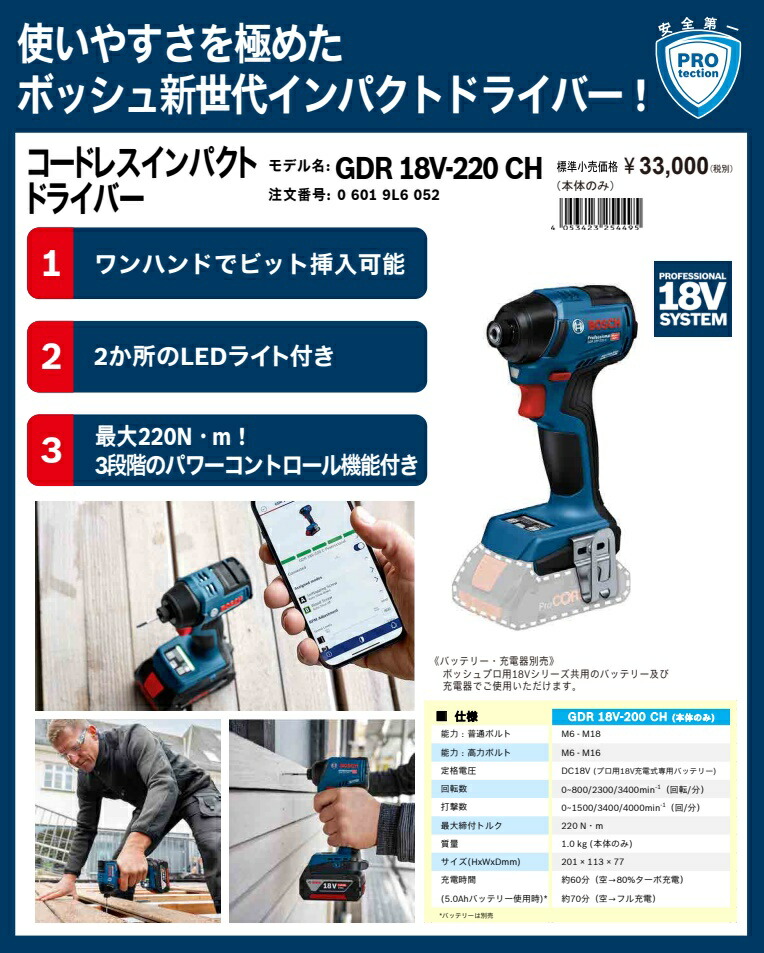
GDR 18V-220CH — Body-Only Version of the 220C, for Those Who Already Have Batteries
メナIf you already have two or more 18V batteries, buying just the 220CH body is clearly the better deal. The price difference between a kit and the body-only unit is often equivalent to two batteries or more.




| Manufacturer | Bosch Professional |
| Model | GDR 18V-220CH |
| Voltage | DC18V |
| Max Torque | 220 N·m |
| RPM | 0–800/2,300/3,400 rpm (3-speed) |
| BPM | 0–1,500/3,400/4,000 bpm (3-speed) |
| Weight (body) | ~1.0 kg |
| Head Length | 126 mm |
| Bluetooth | ✓ |
| One-Hand Bit | ✓ |
| Kit Contents | Body only (battery and charger sold separately) |
The GDR 18V-220CH is the same tool body as the GDR 18V-220C, minus the battery and charger. The specs are identical to the 220C (220 N·m, 3-speed, one-hand bit, Bluetooth, dual LED) — only the package contents differ.
This is the ideal choice for craftsmen who already own Bosch 18V batteries or are considering switching from another Bosch tool. On Amazon, the body-only price is sometimes about 40% of the full kit price — the cost savings can be substantial.
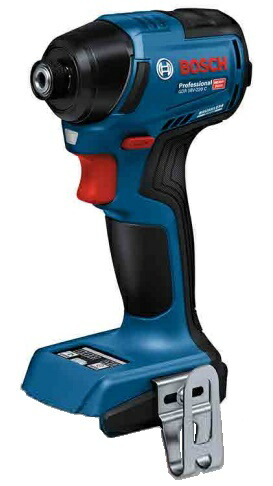
Note that no carrying case is included, so you’ll need to arrange your own storage and transport. Not a problem for pros managing multiple tools, but it may feel slightly inconvenient early on. If you’re buying your first GDR, the kit version (220C) is more beginner-friendly.
GDR 18V-215 — 2025’s Latest High Standard, for Value-Conscious Pros
メナThe GDR 18V-215 is the new-generation model released in February 2025. More affordable than the 220C, and without Bluetooth, it balances power and maneuverability. Three LED lights make dark-space work comfortable — a solid choice for pros who prioritize value.



| Manufacturer | Bosch Professional |
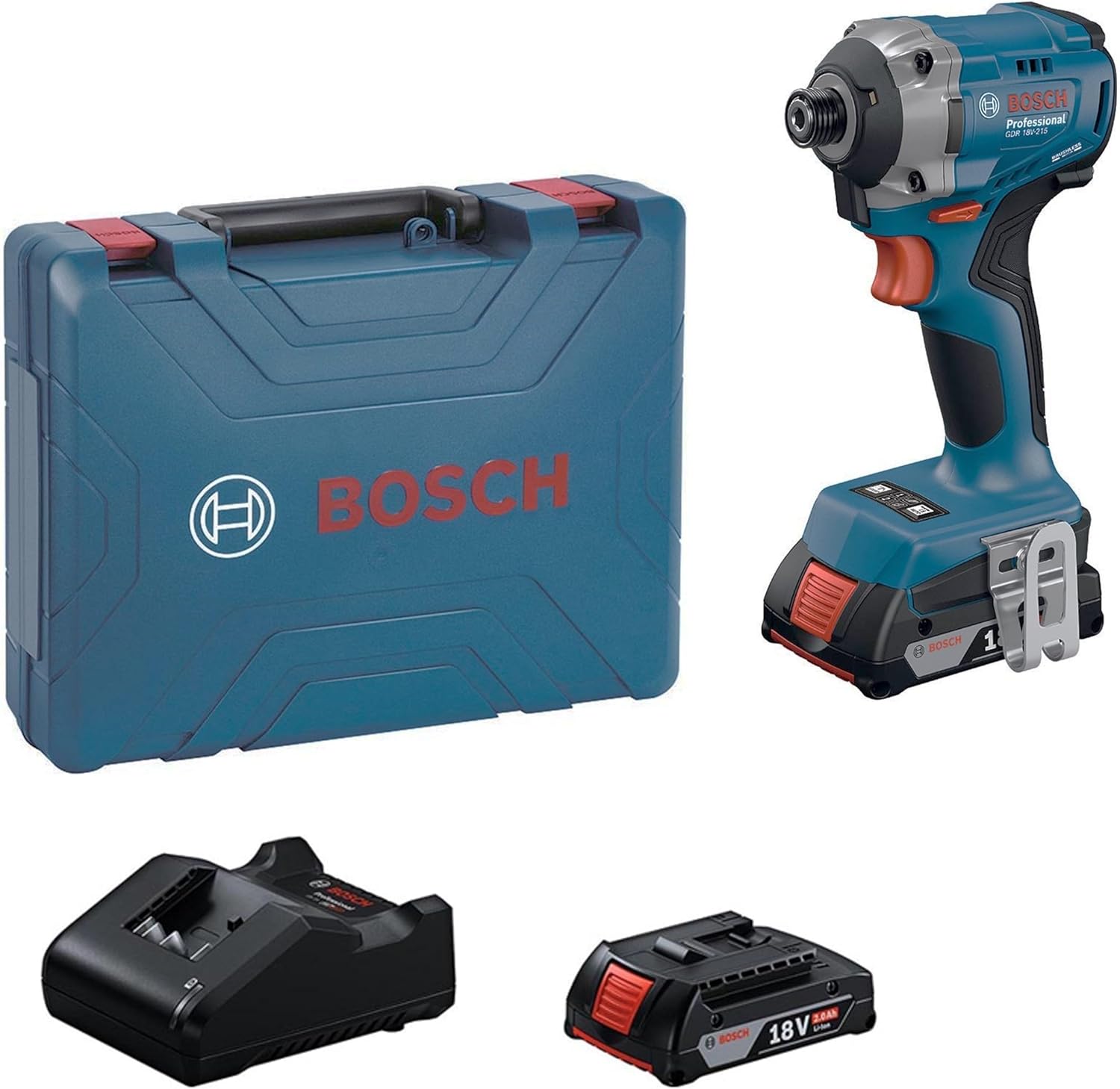
| Model | GDR 18V-215 |
| Voltage | DC18V |
| Max Torque | 215 N·m |
| RPM | 0–2,100/3,300 rpm (2-speed) |
| BPM | 0–3,000/3,800 bpm (2-speed) |
| Weight (body) | ~1.0 kg |
| Head Length | 126 mm |
| Bluetooth | ✗ |
| One-Hand Bit | ✓ |
| LED | 3-light |
| Release Date | February 6, 2025 |
| Standard Price | ¥37,000 (excl. tax) |
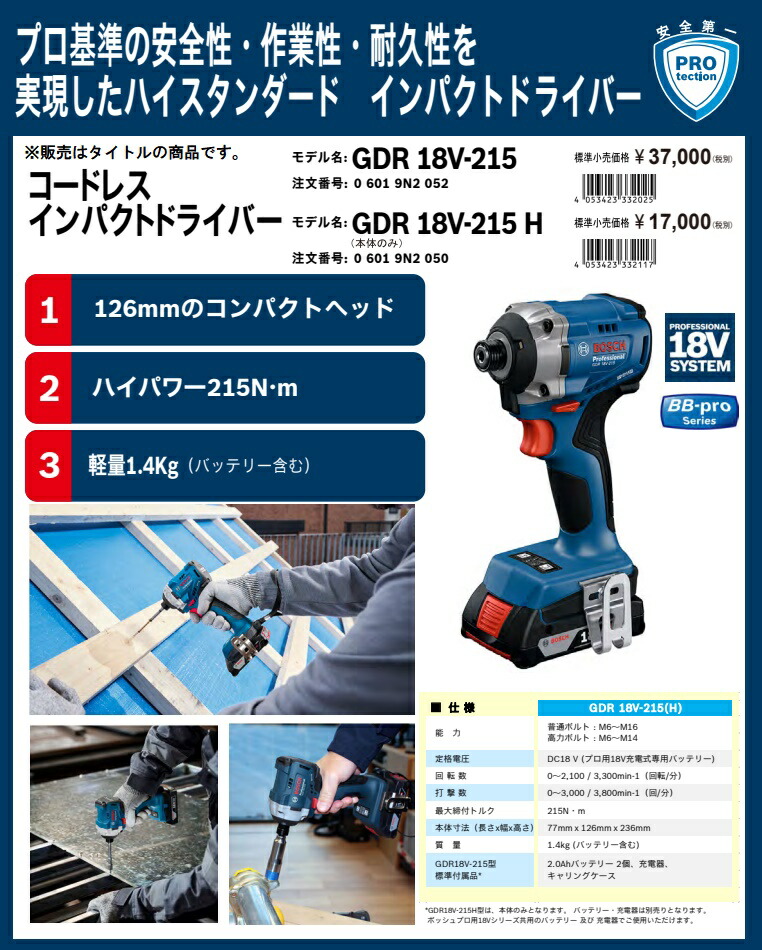
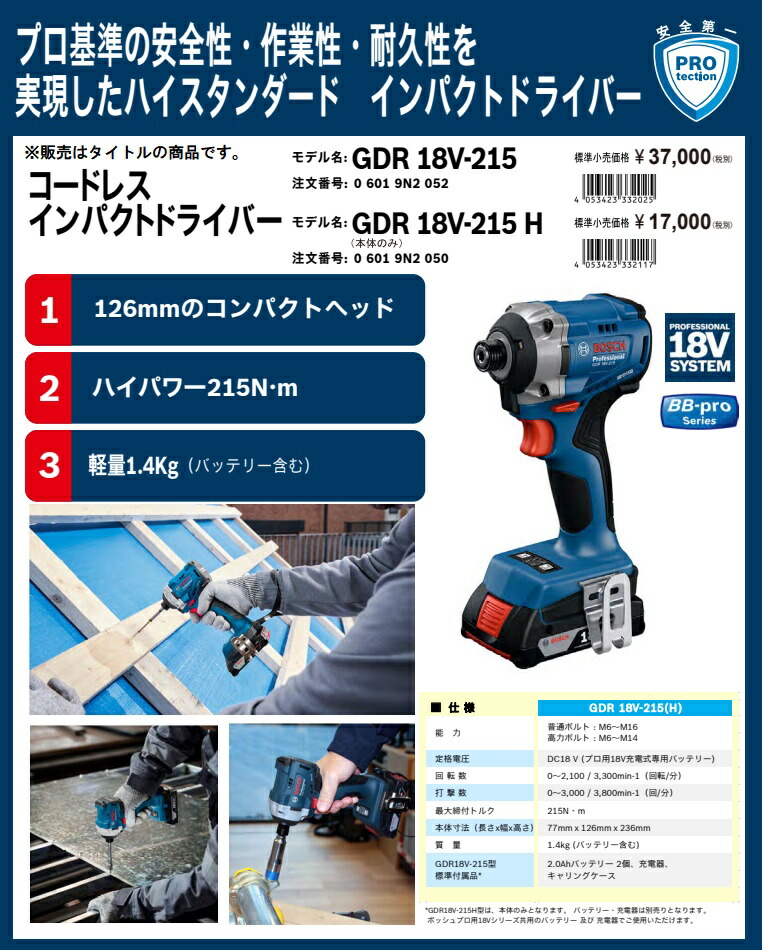
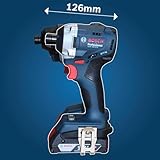
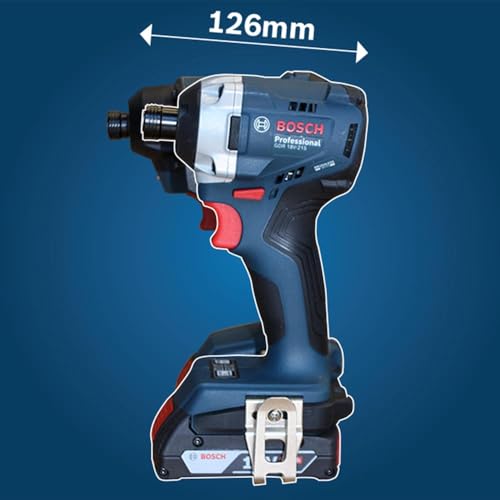
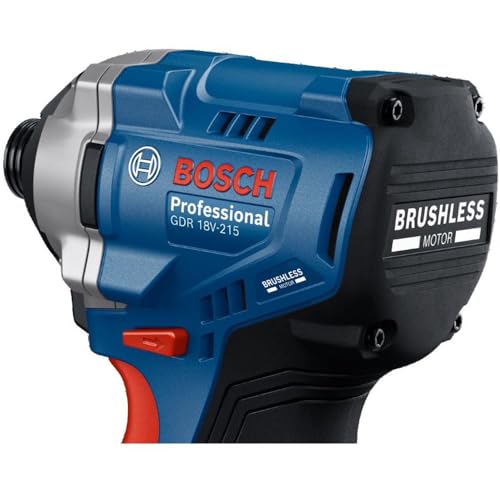
Released February 6, 2025, the GDR 18V-215 is a high-standard model with a 126mm compact head and 215 N·m. At a suggested retail price of ¥37,000 (excl. tax) — less than half of the 220C — it’s a compelling option for cost-conscious pros.
Despite lacking Bluetooth, it includes many premium features: one-hand bit insertion, three LED lights, ETP dust/water protection, 2-stage power control, and auto slow-down/auto shutdown. Its biggest selling point is delivering next-generation usability while keeping costs down.
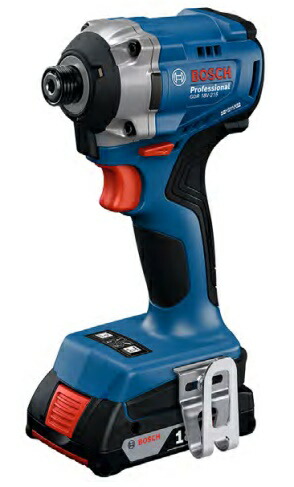
The ideal model for electricians and mechanical engineers who think: “I don’t need a tool management app, but I do need pro-grade power and compact size.” If you want the battery included at a lower total cost, go for the 215 kit. If you already own batteries, the 215H is the alternative.
GDR 18V-215H — Body-Only Version of the 215, the Lowest-Cost Choice for 18V Battery Owners
メナThe 215H is the body-only model with a separately sold battery. At a suggested retail price of ¥17,000 (excl. tax), it’s among the most affordable in the 18V class. If you already own 18V batteries, this is the lowest-cost way to get 215-generation performance.


| Manufacturer | Bosch Professional |
| Model | GDR 18V-215H |
| Voltage | DC18V |
| Max Torque | 215 N·m |
| RPM | 0–2,100/3,300 rpm (2-speed) |
| BPM | 0–3,000/3,800 bpm (2-speed) |
| Weight (body) | ~1.0 kg |
| Head Length | 126 mm |
| Bluetooth | ✗ |
| One-Hand Bit | ✓ |
| Kit Contents | Body only (battery and charger sold separately) |
| Standard Price | ¥17,000 (excl. tax) |
The GDR 18V-215H is the body-only version of the GDR 18V-215, with identical specs and features. Without battery, charger, or carrying case, it’s the highest-value choice for users who already own Bosch 18V batteries. At a suggested retail price of ¥17,000 (excl. tax), it’s an exceptional deal for a new 18V class tool.
A carrying case is included, so storage and transport aren’t an issue. Well-suited to electricians looking to expand their tool lineup, or craftsmen already running a Bosch 18V system across multiple job sites.
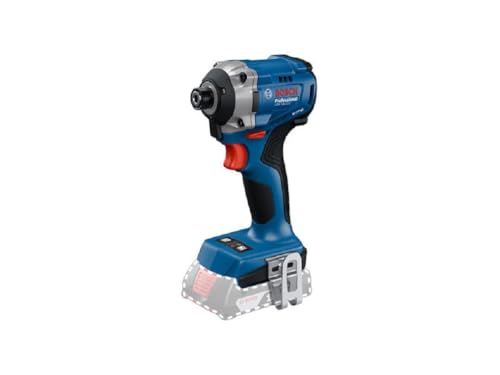
Comparing 215H vs 220CH: check the price gap, Bluetooth availability, and one-hand bit (both support it) before deciding. The price difference — 215H (~¥17,000) vs 220CH (~¥33,000) — is significant, while the torque difference (215 vs 220 N·m) is barely noticeable in use. For cost-focused buyers, the 215H is a strong choice.
GDR 18V-210C — The Bluetooth-Generation Standard Model, for Pros Who Think About Tool Management
メナI started using the GDR 18V-210C on the recommendation of a colleague who had moved to a mechanical contractor. “You can sync it with a tool management app and track who’s using which tool across job sites,” he said. That made me appreciate just how German-engineer this brand is.




| Manufacturer | Bosch Professional |
| Model | GDR 18V-210C |
| Voltage | DC18V |
| Max Torque | 210 N·m |
| RPM | 0–3,400 rpm (3-speed) |
| BPM | 0–4,200 bpm (3-speed) |
| Weight (body) | ~1.1 kg |
| Head Length | 127 mm |
| Bluetooth | ✓ (ToolTrack compatible) |
| One-Hand Bit | ✗ |
The GDR 18V-210C is the previous-generation Bluetooth flagship. At 210 N·m max torque, it’s 10 N·m below the 220C, but in actual job site use, you’ll almost never notice the difference. For typical electrical and mechanical tightening tasks, 210 N·m is more than enough power.
The biggest difference from the 220C is the absence of one-hand bit insertion. The 210C uses the conventional single-hand bit insertion method — slightly less convenient than the 220C, but fine once you’re used to it. Three-speed control, LED lighting, and ECP/ETP/EMP protection are all included.
The Bluetooth-enabled “ToolTrack” app integration is useful for tool management at contracting companies and construction firms. Manage multiple tools centrally through the app, deterring theft and simplifying on-site tool tracking. This feature is better suited to corporate or team use than individual craftsmen.
In today’s market, with the 220C and 215 now available, the 210C is considered an older generation and prices have dropped in some cases. If the 210C’s performance suits your needs, buying it at a lower price is a smart value choice.
GDR 18V-210CH — Body-Only Version of the 210C, for Battery Owners
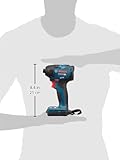
メナThe 210CH has Bluetooth but a separately sold battery — a great combination. If you own multiple Bosch 18V tools, this is one of the most cost-efficient options available.



| Manufacturer | Bosch Professional |
| Model | GDR 18V-210CH |
| Voltage | DC18V |
| Max Torque | 210 N·m |
| RPM | 0–3,400 rpm (3-speed) |
| BPM | 0–4,200 bpm (3-speed) |
| Weight (body) | ~1.1 kg |
| Head Length | 127 mm |
| Bluetooth | ✓ |
| Kit Contents | Body only (battery and charger sold separately) |
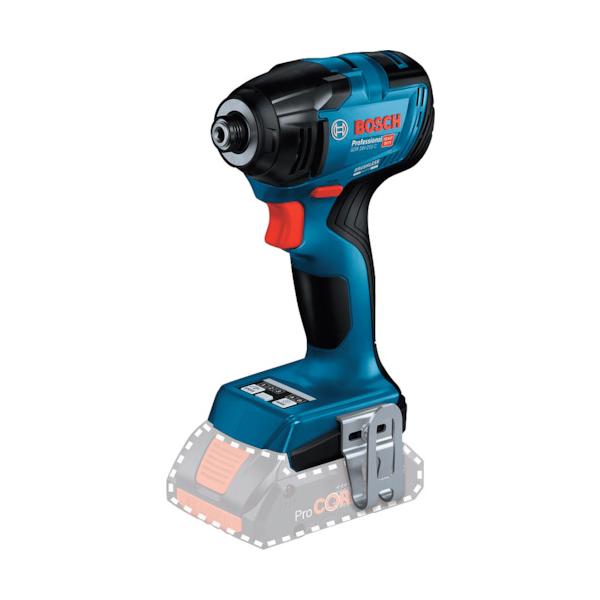
The GDR 18V-210CH is the body-only version of the GDR 18V-210C. Specs and features are identical to the 210C. Without battery, charger, or carrying case, this is an excellent value option for users who already own Bosch 18V batteries. Bluetooth is retained.
Especially ideal for users who own multiple Bosch 18V batteries. No need to re-purchase battery and charger — just upgrade the body to the latest Bluetooth generation. If you’re building a Bosch tool lineup, the most economical approach is to buy the first kit, then add body-only units as you expand.
Like the 220CH, the downside is that no case is included. Now that the 215H and 220CH are available, compare the price and features (Bluetooth, one-hand bit) before deciding which to buy. The 210CH remains a valid choice for battery owners who want Bluetooth at a reasonable price point.
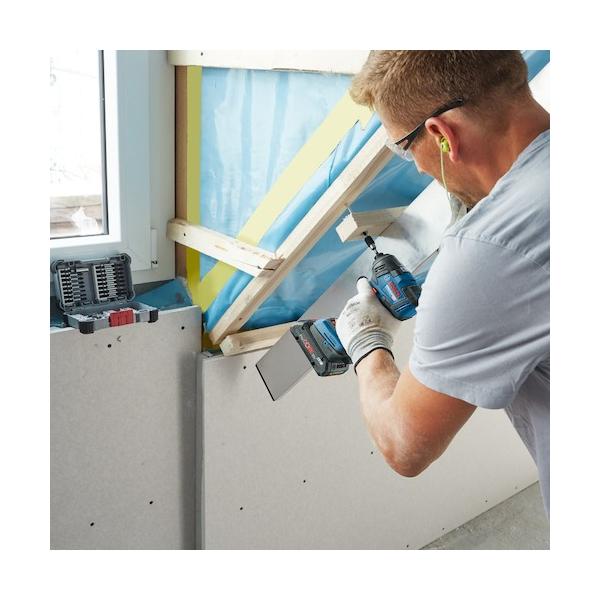
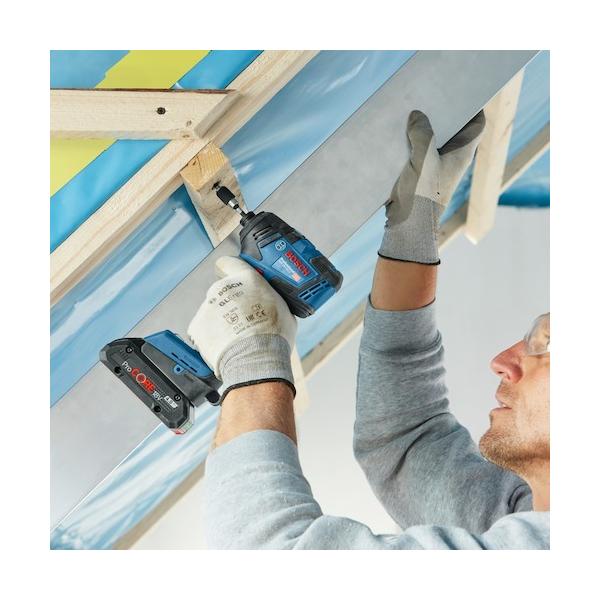
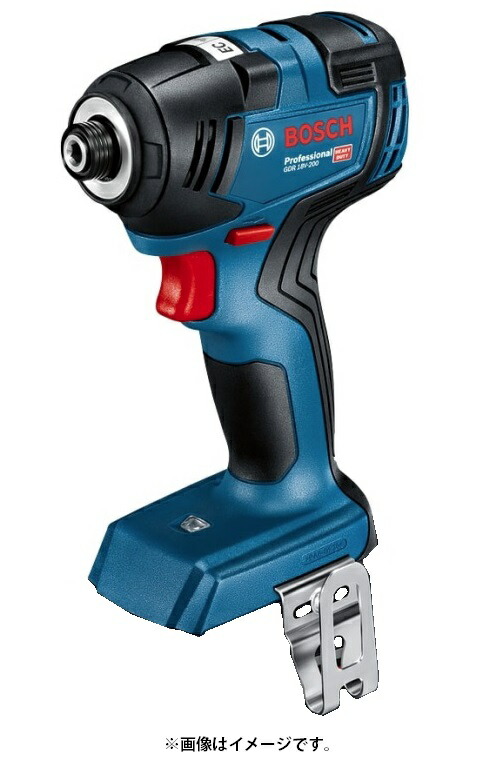
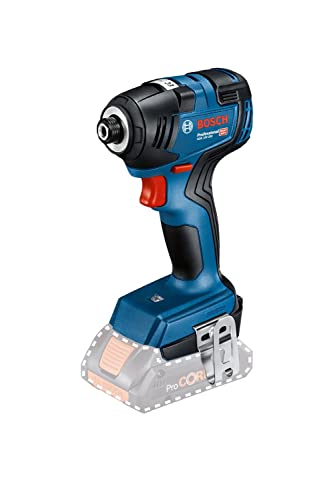
GDR 18V-200H — The Standard Pro Model, Balancing Value and Performance
メナThe GDR 18V-200H is the “just right” model. It hits the spot for people who don’t need 220 N·m but still want genuine professional specs. The compact head handles tight spaces, and 200 N·m covers all typical job site tasks.


| Manufacturer | Bosch Professional |
| Model | GDR 18V-200H |
| Voltage | DC18V |
| Max Torque | 200 N·m |
| RPM | 0–3,400 rpm |
| BPM | 0–4,000 bpm |
| Weight (body) | ~1.1 kg |
| Head Length | 126 mm |
| Bluetooth | ✗ |
| One-Hand Bit | ✗ |
The GDR 18V-200H is the standard model in the Professional line — no Bluetooth, but packed with 200 N·m torque and a compact head in a practical, no-frills package. It’s ideal for craftsmen who think: “I don’t need a tool management app — just give me power and usability.”
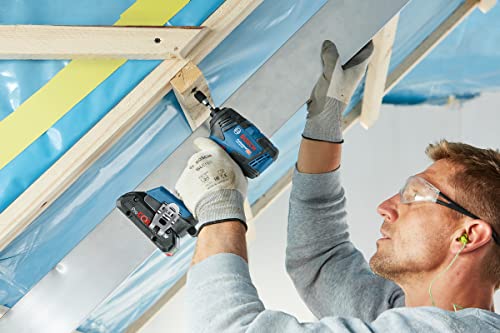
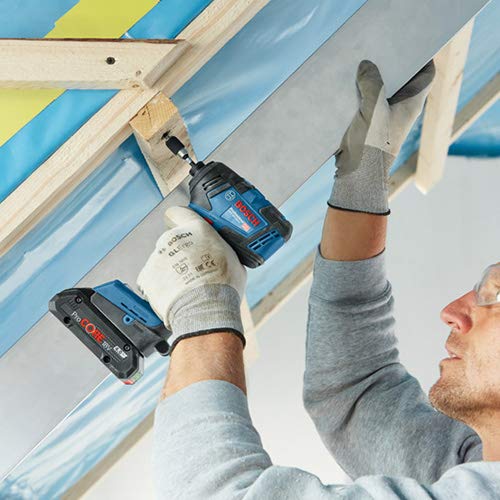
The 126mm head length matches the series-standard compact design, excelling at work in confined spaces. For electricians and mechanical technicians with frequent work inside distribution panels, ceiling cavities, and cramped outlet box areas, this design fits perfectly. In my experience on the job, the difference vs a tool with a longer head is often dramatic in tight spots.
Pricewise, this model often sits in a more accessible range than the higher models. Combined with the body-only purchase option, it’s an excellent value for battery owners.
Note: No Bluetooth and no one-hand bit insertion makes this a simpler spec than the 210C or 220C. If your work requires precise torque management or integration with a tool management system, consider one of the higher-end models.
GDR 18V-200CH — Body-Only Version of the 200 Generation, Compatible with Older Batteries
メナThe 200CH is from an earlier generation, but it’s still a viable performer if you’re cost-focused. It circulates in the used tool market too, making it an option for budget-conscious buyers.



| Manufacturer | Bosch Professional |
| Model | GDR 18V-200CH |
| Voltage | DC18V |
| Max Torque | 200 N·m |
| RPM | 0–3,400 rpm |
| BPM | 0–4,000 bpm |
| Weight (body) | ~1.1 kg |
| Head Length | 126 mm |
| Bluetooth | ✗ |
| Kit Contents | Body only (battery and charger sold separately) |
The GDR 18V-200CH is the body-only version of the GDR 18V-200 generation, equipped with 200 N·m torque, a brushless motor, and ECP/ETP/EMP protection. The 200 N·m torque is plenty for everyday electrical, woodworking, and mechanical tasks.
The main advantage is price. The 200-generation is now considered an older model, and new units are increasingly available at affordable prices.
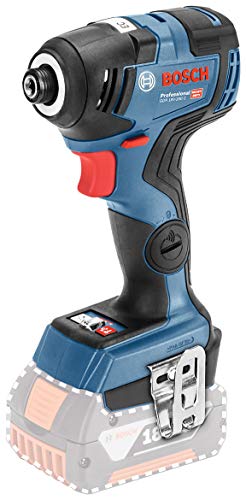
However, like the 200H, there’s no Bluetooth and no one-hand bit insertion. If you’re buying new today, the current 215H and later models offer additional incremental improvements. View the 200CH as an option for replacement or a second tool when you need to keep costs down.
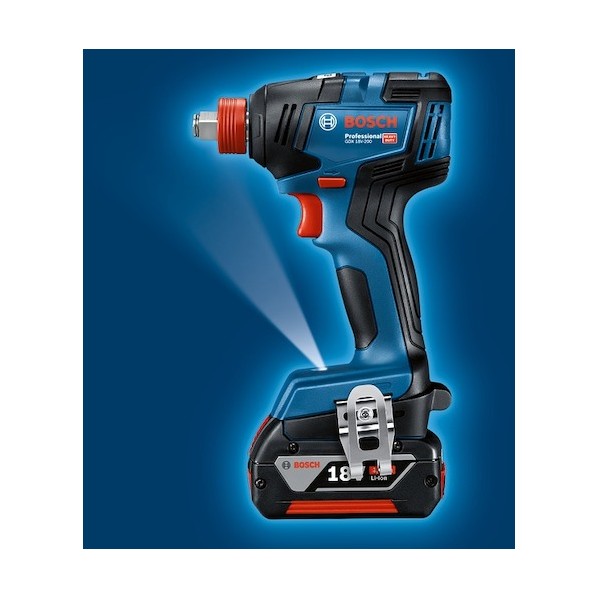
GDX 18V-200 — The 2-in-1 Impact Driver + Wrench Model
メナThe GDX 18V-200 is a fascinating model that handles both impact driver and impact wrench work with one tool. On mechanical job sites where bolt tightening is also required, there are many situations where “this one tool is enough” — and it’s invaluable there.


| Manufacturer | Bosch Professional |
| Model | GDX 18V-200 |
| Voltage | DC18V |
| Max Torque | 200 N·m (350 N·m removal) |
| RPM | 0–3,400 rpm (3-speed) |
| BPM | 0–4,000 bpm (3-speed) |
| Weight (body) | ~1.3 kg |
| Head Length | 147 mm |
| Bluetooth | ✗ |
| 2-in-1 | 1/4″ hex bit + 1/2″ square drive |
The GDX 18V-200 is the only model in the GDR lineup that supports both 1/4″ hex bits (driver) and 1/2″ square drive (wrench). Being able to switch between screw driving and bolt tightening with a single tool is especially powerful on job sites with varied tasks.
Tightening torque matches the GDR series at 200 N·m, but removal torque (loosening) goes up to 350 N·m. Useful for loosening seized bolts and for flange bolts or equipment bolts requiring strong tightening.
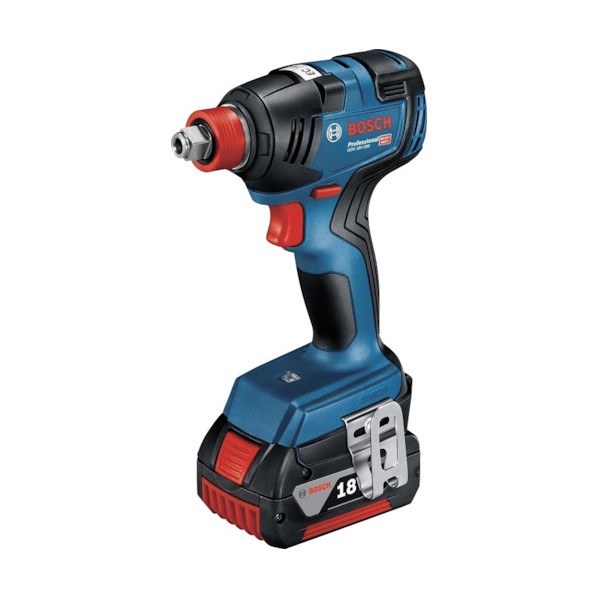
The 3-speed design (low/mid/high) works well for both driver and wrench applications, letting you choose the optimal speed for each. However, compared to the GDR series, the head is longer at 147mm (vs GDR18V-200H’s 126mm), so GDR has the edge in confined spaces.
Recommended trades: Plumbers, HVAC technicians, and electrical systems workers — anyone on job sites where both screw driving and bolt tightening are part of daily work. Carrying separate impact drivers and wrenches adds tool cost; consolidating with the GDX 18V-200 keeps the tool bag lean.
The downside is that as an impact wrench, it lacks bolt-specific features that dedicated impact wrenches offer (torque management, anvil shape options, etc.). If your job involves frequent heavy bolt work, consider pairing a GDR with a dedicated impact wrench.
GDX 18V-200CH — Body-Only Version of the GDX, 2-in-1 at Lower Cost
メナThe GDX18V-200CH is the option for those who already own batteries. Buying body-only is the way to enter the 2-in-1 world while keeping spending in check.



| Manufacturer | Bosch Professional |
| Model | GDX 18V-200CH |
| Voltage | DC18V |
| Max Torque | 200 N·m (350 N·m removal) |
| RPM | 0–3,400 rpm (3-speed) |
| BPM | 0–4,000 bpm (3-speed) |
| Weight (body) | ~1.3 kg |
| Head Length | 147 mm |
| Bluetooth | ✗ |
| Kit Contents | Body only (battery and charger sold separately) |
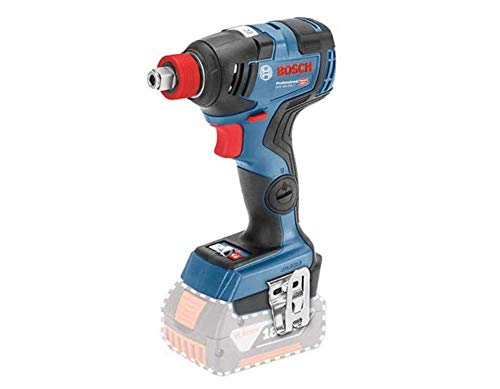
The GDX 18V-200CH is the body-only version of the GDX 18V-200, with identical specs and features. Without battery, charger, or case, it’s the most cost-efficient way to access the 2-in-1 function for users who already own Bosch 18V batteries.
Compared to the GDX 18V-200 (full kit), the body-only version is significantly cheaper. Especially suitable for craftsmen adding a second tool, or those already within the Bosch battery ecosystem.
Note: like the GDX 18V-200, the head is slightly longer (147mm) than GDR models. If you primarily need driver use in tight spaces, the GDR 18V-215H/220C range may be a better fit. Think about your task split (mostly driver vs. also using wrench) before buying.
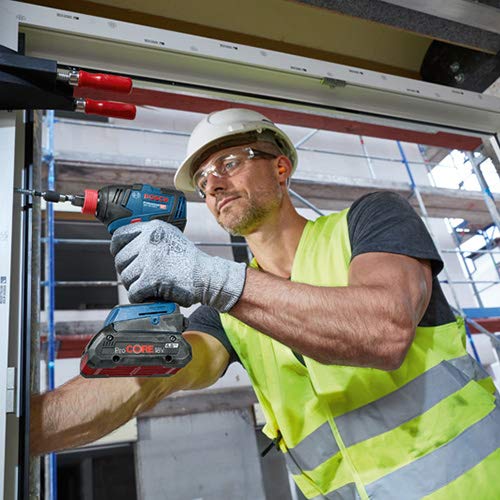
Trade-by-Trade Buying Guide — Which One Fits Your Job Site?
Here’s a breakdown of “which model to buy” by trade and application. This should help narrow your choices down to one.
Electricians — For Tight Spaces and Speed: GDR 18V-220C or 200H
Electricians use impact drivers across a wide range of tasks: tightening outlet box screws, terminal work inside distribution panels, cable tray assembly, conduit fixings, and more. What all of these share is the need for “maneuverability in tight spaces” and “speed.”
In that regard, the GDR series’ compact head (126mm) is ideal for electrical job sites. Makita’s 18V class tools often have heads in the 130mm range — that seemingly small difference noticeably impacts workability in tight wiring spaces.
Recommended: For the latest features, go with GDR 18V-220C; for cost-consciousness, the GDR 18V-200H. Both have equivalent suitability for confined spaces. The 220C’s advantages are one-hand bit insertion, Bluetooth, and slightly higher torque.
Mechanical (HVAC, Plumbing, Sanitary) — If You Need Both Driver and Wrench: GDX 18V-200
Mechanical job sites involve both screw driving and bolt tightening. HVAC hanger bolt tightening, pipe flange bolts, sanitary fixture fixing bolts — there are many situations where just an impact driver isn’t enough.
That’s where the GDX 18V-200 comes in. Supporting both driver bits and socket drives minimizes tool switching. If your day includes “needing to alternate between driver and wrench many times on the same site,” centering your toolkit on the GDX 18V-200 can dramatically improve efficiency.
Full tightening torque of 200 N·m and removal torque of 350 N·m cover most mechanical bolt work. Practical for M10-class bolts and below. For sites with many large-diameter bolts, consider a dedicated impact wrench (GDW/GDS series) separately.
Carpenters / Woodworkers — For Speed and Torque: GDR 18V-220C
In carpentry and woodworking, impact drivers are mainly used for driving course thread screws and wood screws. What’s needed here is speed, torque, and a light body that won’t fatigue the arms during long sessions.
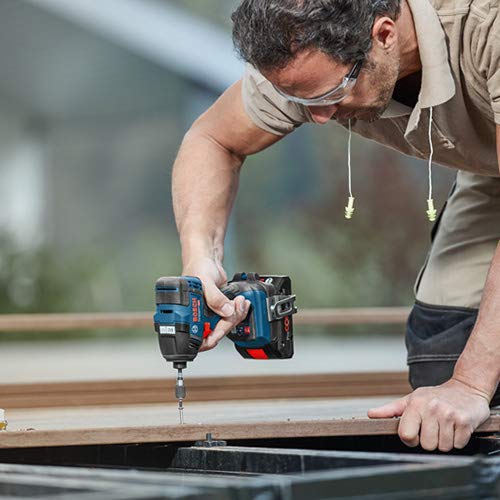
The GDR 18V-220C’s max RPM of 3,400 and max BPM of 4,000 delivers enough power to drive course thread screws into wood smoothly. At ~1.1 kg (body only), the light weight directly reduces arm fatigue over long shifts.
The 3-speed control also enables careful finish tightening at low speed — a technique woodworkers use to avoid splitting wood. The 3-speed 220C and 210C are well-suited to this practice.
DIY Users — For Compact and Lightweight: GDR 12V-110 May Be Worth Considering
For DIY users, the professional 18V models can feel like overkill. If your home DIY mainly involves course screws, wood screws, and furniture assembly, the GDR 12V-110 may be the ideal choice.
The GDR 12V-110 delivers 110 N·m max torque and weighs just 725g — plenty of power for DIY combined with outstanding lightness. Its smaller battery makes the body compact and easy to store or carry. If you find the size and weight of the 18V class burdensome for once- or twice-a-week DIY, the 12V class makes perfect sense.
However, if you anticipate professional use in the future, starting with the 18V system from the beginning makes it easier to build out your tool and battery ecosystem. If you plan to add more power tools down the line, I recommend starting with 18V.
Bosch 18V Battery Compatibility and ProCORE
Bosch’s 18V system is a shared battery system across all current 18V products. The GDR series, GDS series, GGS (grinder), GHO (planer), and all other 18V Bosch Professional tools share the same battery system.
What is ProCORE18V Battery?
ProCORE18V is the high-power battery for the Bosch 18V series, introduced in 2020 and later. It uses prismatic cells instead of cylindrical cells, making it more compact and better at heat dissipation for equivalent capacity. Available in large-capacity options of 4.0Ah, 8.0Ah, and 12.0Ah, it delivers better continuous-use performance than conventional batteries.
Current flagship models like the GDR 18V-220C and 210C are ProCORE-compatible and designed to deliver maximum output with ProCORE batteries. Conventional 18V batteries still work, but output may be slightly limited in some cases. For long-term Bosch system users, transitioning to ProCORE is worth planning for.
Estimated Charging Times
| Battery Capacity | GAL18V-40 Charger | GAL18V-80 Fast Charger |
|---|---|---|
| 2.0Ah | ~35 min | ~17 min |
| 4.0Ah | ~55 min | ~30 min |
| 5.0Ah | ~70 min | ~40 min |
| 8.0Ah (ProCORE) | ~110 min | ~60 min |
For continuous on-site work, keeping two 5.0Ah+ batteries in rotation is the practical approach. The fast charger (GAL18V-80) costs more but substantially cuts charge time per battery — a worthwhile investment for high-frequency users.
メナBosch 18V battery compatibility is excellent — once you start building a Bosch setup, all your tools share batteries, which is a huge convenience. The typical pattern on electrical job sites is running the GDR and GBH (hammer drill) off the same batteries.
Frequently Asked Questions (FAQ)
Here are some common questions I hear about the GDR series.
Q1. GDR Series vs. Makita TD Series — Which Should I Choose?
Most Japanese craftsmen use Makita mainly because of its after-service network and brand recognition. In terms of pure tool performance, durability, and compact design, the GDR series is fully competitive. The “short head for tight-space work” advantage is a clear GDR differentiator — and electricians and mechanical technicians tend to respond particularly well to it. If your workplace or colleagues are already using Bosch, go with Bosch without hesitation.
Q2. What’s the Real Difference Between GDR 18V-220C and GDR 18V-210C?
The biggest spec difference is max torque (220 vs 210 N·m) and the presence of one-hand bit insertion. For everyday electrical and mechanical screw driving, you’ll almost never feel the 10 N·m difference. The practical difference is bit swap convenience and the price gap. The 220C is a better daily-use tool, but if the 210C is available at a lower price, it’s within an acceptable range of compromise.
Q3. Are Bosch Batteries Compatible with Makita or HiKOKI Batteries?
Not natively. Bosch 18V batteries are exclusive to Bosch Professional 18V tools — physical shape and electronic circuits are different from Makita and HiKOKI. Third-party compatible batteries exist, but due to compatibility risks with the tool’s protection circuits and potential performance degradation, I strongly recommend using genuine batteries for professional use.
Q4. Can the GDX 18V-200 Replace an Impact Wrench?
Yes, for M10-class bolts and below. The 350 N·m removal torque covers the range of typical mechanical and plumbing bolt work. However, for tire changes or large machinery bolts (often M12+), a dedicated impact wrench is more appropriate. Think of the GDX 18V-200 as an extension of the impact driver concept that “can also handle bolts” — not a true wrench replacement.
Q5. Is the GDR Series Appropriate as a First Impact Driver?
If you’re aiming for professional use, the GDR series is fine from the start. The GDR 18V-200H and GDR 18V-220C cover the full range from entry-level to veteran pros in terms of features and price. If you’re a DIY beginner looking for your first impact driver, the GDR 12V-110 is lighter and easier to handle. Match your choice to your use case and goals. Note: always read the instruction manual carefully and wear protective gear (safety glasses, gloves) when operating power tools.
Q6. Can Bosch Professional Tools Be Repaired and Maintained in Japan?
Yes. Bosch Professional has a repair and support network within Japan, with service centers in major cities. Repair handling through authorized dealers is also possible. While the network isn’t as widespread as Makita or HiKOKI, getting repair support for professional use is generally manageable. I recommend confirming the nearest service network at the time of purchase.
Accessories — Choosing Your Battery and Charger
Getting the most out of the GDR series requires selecting the right battery and charger. High-power models like the GDR18V-220C and 210C are designed to deliver maximum output with a ProCORE battery. If you’re setting up a Bosch 18V system for the first time, starting with a starter set that includes battery and charger is the practical approach.
Bosch ProCORE18V4S1 — 4.0Ah Battery + Charger Set, the Recommended Starter Config for GDR18V
メナIf you’re equipping batteries alongside the GDR18V-220C, the ProCORE18V4S1 set offers the best value as a starting point. The 4.0Ah battery pairs perfectly with the GDR18V-220C, with minimal output drop during sustained work. On electrical job sites, rotating a 5.0Ah and a 4.0Ah is the standard setup.


| Manufacturer | Bosch Professional |
| Set Part No. | ProCORE18V4S1 |
| Battery | ProCORE18V 4.0Ah × 1 |
| Charger | GAL18V-40 (fast charge compatible) |
| Battery Voltage | 18V |
| Battery Capacity | 4.0Ah |
| Battery Weight | ~590g |
| Compatibility | All Bosch Professional 18V models |
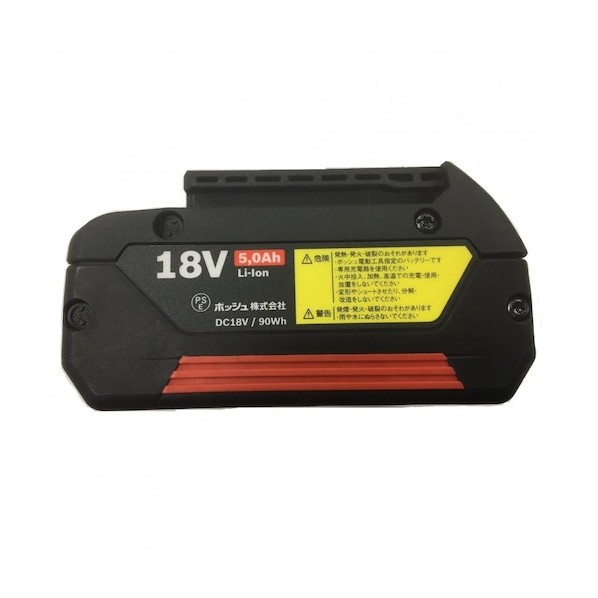
The ProCORE18V4S1 is a starter kit combining the 4.0Ah ProCORE battery with the GAL18V-40 fast charger. When purchasing current 18V models like the GDR18V-220C or GDR18V-215 in the body-only version (-H/-CH), this is the ideal first battery.
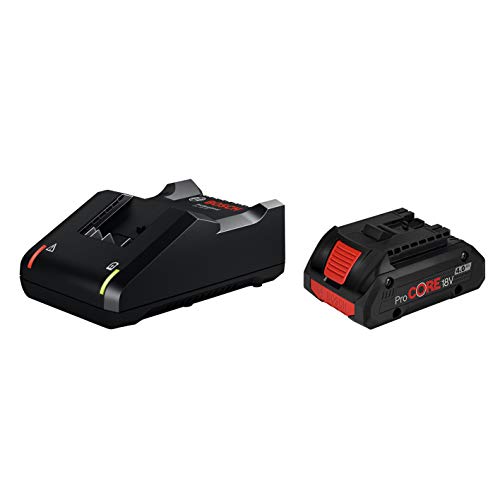
The ProCORE battery features an improved internal cell structure compared to the conventional GBA standard series, offering better peak output and sustained operation. The CoolPack design efficiently dissipates heat during use, reducing power drop during long work sessions. This difference becomes apparent during extended continuous driving on the job site.
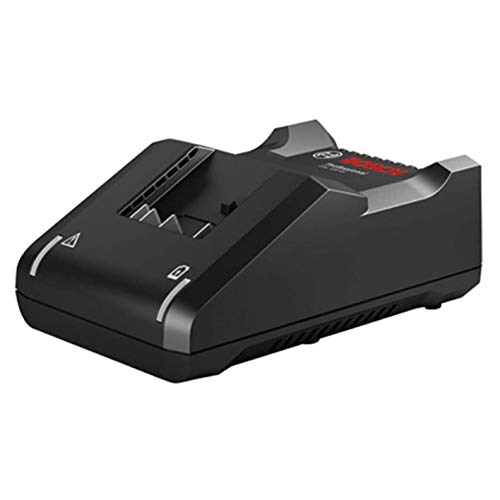
The GAL18V-40 charger can charge a 4.0Ah battery in about 55 minutes — the standard fast charger. In on-site use, the practical approach is rotating two batteries while the other charges. If you plan to expand your battery count, adding one more 4.0Ah or 5.0Ah ProCORE battery as a second unit is recommended.
Related Articles
More comparison articles in the same impact driver and power tool category:
▶ Makita TD Series Impact Driver: Full Model Comparison — The competing Makita TD series analyzed with the same approach. Great for those comparing Bosch GDR vs Makita.
▶ HiKOKI MultiVolt Impact Driver Comparison — Explaining the 36V-compatible MultiVolt system. For those considering higher-voltage models.
▶ Power Tool Maker Catalog & Model List by Brand — A comprehensive comparison guide covering tool makers beyond Bosch.