
Affiliate Disclosure: This article contains affiliate links. If you make a purchase through these links, we may earn a commission at no additional cost to you.
 Mena
Hi, I’m Mena, a hybrid engineer. This one’s for anyone who tightens wheel nuts or a drain plug by feel — most of the torque you apply is actually lost to friction, and understanding that is why re-torquing and a star pattern matter.
If you’ve ever tightened a wheel nut or a drain plug by feel — “about this tight should be fine” — this guide is for you. Over-tighten and you risk snapping a bolt; leave it too loose and it can back off while driving. This guide starts with the numbers and safety checks you need up front, then digs into why torque management matters at all, and finally covers two 1/2-inch drive torque wrenches and how to choose wheel nuts to go with them.
Quick reference: typical torque by job
These are general figures. The exact spec depends on your vehicle, model year, trim, and wheel type (OEM vs. aftermarket). Always defer to your own vehicle owner’s manual or service manual when the numbers disagree.
| Job | Typical torque | Source basis |
|---|---|---|
| Wheel nuts (passenger car) | 66-81 ft-lb (90-110 Nm) | Commonly published range across vehicle manuals/tire industry guidance (2026-09-23) |
| Oil drain plug (aluminum pan, example) | about 22 ft-lb (30 Nm) | Varies significantly by vehicle — one commonly cited service-manual example |
| Oil filter | 7-15 ft-lb (10-20 Nm) | General figure from filter-maker literature |
Tighten wheel nuts in a star (criss-cross) pattern in two or three passes, finishing at the target torque with a torque wrench. Because the wheel settles in after installation, tire shops commonly recommend re-checking torque after a short drive.
Safety checks before you start
Before the numbers, the safety basics: when jacking up a car, chock the wheels that stay on the ground, and never rely on the jack alone — use jack stands. A jack that slips while you’re under the car is a serious hazard.
Over-tightening is its own risk. Torque a wheel nut past spec and you overload the nut and stud, which can shear the stud outright. Too loose, and vibration while driving can walk the nut off — in the worst case, a wheel can separate while driving. A torque wrench exists to manage both failure modes with a number, not a feeling.
MenaDon’t rely on feel alone — torque to spec, then re-check after a short drive. Those two habits do most of the work of preventing a wheel from coming loose or a stud from snapping.
Go deeper: most of that torque number never becomes clamping force
The number a torque wrench reads isn’t the actual clamping force holding the joint together. Roughly 90% of applied torque is consumed by friction — at the thread and under the nut face — and only around 10% converts into the bolt’s stretch (clamping force, or “preload”). Two joints torqued to the identical number can end up with different actual clamping force if the friction at the threads differs (rust, oil, or dirt all change it).
Why you can’t casually add lubricant
A service manual’s torque spec almost always assumes a dry thread. Adding oil or grease that wasn’t called for reduces friction, which means the same torque reading produces a higher, potentially bolt-damaging clamping force. Rusty or corroded threads do the opposite — friction goes up and the resulting clamping force falls short, inviting loosening. The number on the dial only means what the spec assumes about the thread condition.
Why a star pattern and re-torquing matter
Tightening wheel nuts in sequence around the wheel (rather than one side first) seats the wheel evenly against the hub; tightening one side first can cock the wheel slightly and leave uneven clamping force even at the correct final torque reading. The mating surfaces also settle after the wheel has been driven on, which is why a re-torque check after a short drive is common practice.
Your torque wrench itself can be out of calibration
Torque to spec with a wrench whose indicated value has drifted, and you’ve accomplished nothing — the wrench is a measuring instrument, and its accuracy matters just as much as a caliper’s. Leaving a preset-click wrench cranked to a high setting in storage keeps the internal spring under tension, which is a common cause of drift; annual calibration checks are a reasonable habit for anyone using one regularly.
How to choose a torque wrench for 4-wheel work
For wheel-nut-centered work across all four corners, a 1/2-inch (12.7mm) drive preset-click wrench with roughly a 10-150 ft-lb (13.6-203.5 Nm) range is the standard choice — a click plus a tactile jolt tells you when you’ve hit the target, versus reading a needle (dial/beam type) or a digital display (electronic type).
The key spec to check is range: a good rule of thumb is to pick a wrench where your target torque falls within the middle 70% of its scale. A 10-150 ft-lb wrench covers passenger-car wheel nuts comfortably, but a typical drain plug (around 22 ft-lb / 30 Nm) sits too close to the bottom of that range — a second, lower-range wrench is the more accurate choice for that job.
Two 1/2-inch drive torque wrenches worth having
Both of the wrenches below share the same drive size and torque range and are widely stocked on Amazon.com — either one comfortably covers passenger-car wheel nuts. A drain plug (about 22 ft-lb / 30 Nm) falls outside a comfortable working range for both, so plan on a separate, lower-range 3/8-inch wrench for that job.
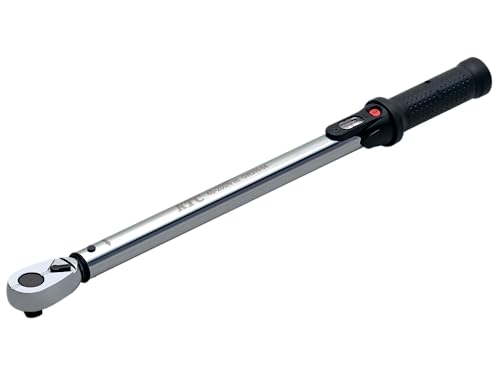
TEKTON 24335 1/2 Inch Drive Click Torque Wrench — A widely stocked preset-click wrench sized for passenger-car wheel nuts


| Drive size | 1/2 in. (12.7mm) square drive |
| Torque range | 10-150 ft-lb (13.6-203.5 Nm) |
| Type | Preset click — audible + tactile click at target torque |
| Accuracy | ±4% clockwise (per manufacturer listing) |
Mena150 ft-lb (about 203 Nm) at the top end covers passenger-car wheel nuts with room to spare, but it won’t go low enough for a typical drain plug — plan on a second, lower-range wrench for that job.
The 24335 is a standard 1/2-inch square drive preset-click wrench: dial in the target torque, and a click plus a small jolt in the handle tells you when you’ve reached it. Its 10-150 ft-lb range comfortably covers the 66-81 ft-lb (90-110 Nm) most passenger-car wheel nuts call for.
Like any preset-click wrench, accuracy depends on winding down to the lowest setting after use and having it re-checked periodically — a wrench left cranked up in storage can drift out of calibration over time.
LEXIVON LX-183 1/2 Inch Drive Click Torque Wrench — A dual-scale (ft-lb/Nm) preset-click wrench and a best-seller in this size class
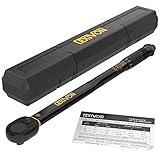


| Drive size | 1/2 in. (12.7mm) square drive |
| Torque range | 10-150 ft-lb / 13.6-203.5 Nm |
| Type | Preset click, reversible ratchet head |
| Notes | Dual ft-lb/Nm scale printed on the same barrel |
MenaSame range and drive size as the TEKTON above, so the two are mostly interchangeable for wheel-nut work — grip shape and scale readability are the real differences.
The LX-183 covers the same 10-150 ft-lb / 13.6-203.5 Nm range as the wrench above, with both ft-lb and Nm markings on one barrel so you don’t have to convert units by hand. A reversible ratchet head lets you use it for both tightening and loosening.
Since the spec overlaps almost entirely with the TEKTON, the deciding factor for most buyers comes down to grip comfort and which one is in stock — either is a reasonable choice for the 4-wheel work covered in this guide.
How to choose wheel nuts
Torquing to spec with the wrench above only pays off if the wheel nut itself suits your car and wheel. This section covers seat shape, material, and sizing.
| Seat shape | Typical use | Notes |
|---|---|---|
| Cone/taper seat (60°) | The most common shape; used across most brands and nearly all aftermarket wheels | Broad availability, moderate price |
| Ball/radius seat | Used on some vehicle families (check your own wheel) | Must match the OEM seat shape exactly |
| Flat seat | Used on some vehicle families (check your own wheel) | Must match the OEM seat shape exactly |
A nut with the wrong seat shape can thread on fine and still fail to seat correctly against the wheel — friction at that seat is exactly the friction that eats into your torque reading, discussed above. Always confirm your wheel’s seat shape before ordering.
McGard 24157 Chrome Wheel Lock Set — Cone-seat locking lug nuts, M12x1.5, 13/16 in. key hex — a theft deterrent, not a full nut set




| Thread | M12x1.5 |
| Seat shape | Cone seat (60°) |
| Key hex | 13/16 in. |
| Included | 4 locks + 1 unique key |
MenaYou only need to swap one lug per wheel for a lock nut — the unique key is the part you really have to keep somewhere you won’t lose it.
A locking lug nut set like this one replaces one standard nut per wheel with a nut that needs a matching, uniquely patterned key to remove — a common and inexpensive theft deterrent for wheels parked outdoors.
Before buying, confirm your wheel’s seat shape (cone/ball/flat) and thread size match — a locking nut in the wrong seat shape won’t seat correctly even though the thread fits.
WHEEL CONNECT Spline Lug Nuts, 12×1.5, Set of 24 — Standard steel cone-seat lug nuts for everyday use
| Thread | 12×1.5 |
| Seat shape | Conical/acorn (60°) |
| Material | Steel, black finish |
| Count | 24 pieces (enough for most 5- and 6-lug wheels with spares) |
MenaSteel is the boring, reliable default here — it doesn’t need the extra re-torque discipline that aluminum nuts do.
For everyday driving, plain steel cone-seat nuts remain the safe default: they’re inexpensive, widely available, and don’t loosen from thermal cycling as readily as lightweight aluminum nuts can.
Confirm thread size (commonly 12×1.5 on many US-market vehicles, though some use 12×1.25 — check your own lug studs) and hex size before ordering.
VMS Racing 20pc Lightweight Aluminum Racing Lug Nuts, 12×1.5mm — Forged aluminum open-end nuts for weight-conscious builds
| Thread | 12×1.5mm |
| Material | Forged aluminum (open end) |
| Weight | A fraction of a steel nut’s weight per piece |
| Count | 20 pieces |
MenaAluminum nuts are a cosmetic and weight play, not a durability upgrade — plan on checking torque more often than you would with steel.
Aluminum racing nuts shed unsprung weight and add color options, but the manufacturer explicitly recommends hand-torquing only (no impact wrenches) and checking for looseness more frequently than with steel nuts, since aluminum expands and contracts more with heat.
Treat these as a look/weight choice for enthusiasts rather than a daily-driver default, and re-torque on the same schedule you’d use after any wheel service.
Matching thread pitch, hex size, and seat shape
Lug nut sizing comes down to three numbers: thread diameter/pitch (commonly M12x1.5 on many vehicles, though M12x1.25 and M14x1.5 are also common — check your own studs), hex size for the wrench/socket (often 19mm or 21mm), and seat shape as covered above. Vehicle-specific fitment varies by make, model, and year, so treat any general chart as a starting point and confirm against your own vehicle or a physical sample before ordering.
Decide seat shape first (it must match the wheel exactly), then material/theft protection, and confirm thread/hex size last — in that order you’re less likely to end up with nuts that don’t fit.
Accessories worth pairing with your torque wrench
Two habits protect the accuracy you just paid for: using a socket deep enough to clear the stud, and resetting/re-checking the wrench itself.
TEKTON 1230 3/8 Inch Drive Deep Socket Set, Metric, 10-19mm, 8-Piece — The deep sockets a torque wrench actually needs to clear the stud
| Drive size | 3/8 in. |
| Sizes | 10, 11, 12, 13, 14, 17, 18, 19mm |
| Type | Deep (long) sockets — clear the exposed stud on wheel nuts |
| Count | 8 pieces |
MenaA standard-depth socket often can’t clear the stud sticking through the nut — that’s specifically what the “deep” in deep socket buys you.
Most passenger-car lug nuts use a 17mm or 19mm hex, but the socket itself needs to be deep enough to clear the exposed wheel stud — a standard shallow socket often bottoms out on the stud before it reaches the nut.
This set’s 3/8-inch drive is a size down from the 1/2-inch torque wrenches above; a 3/8-to-1/2-inch adapter (sold separately) lets the two work together.
Resetting the dial and periodic calibration checks
Manufacturers of preset-click wrenches recommend winding the dial back down to its lowest setting after use — leaving it cranked up keeps the internal spring compressed and is a common cause of the indicated torque drifting from actual torque over time. An annual accuracy check (through the maker’s service program or a calibration lab) catches that drift before it causes an under- or over-torqued joint.
Summary
MenaAbout 90% of the torque you apply is lost to friction, and only around 10% becomes the clamping force that actually holds the joint. That’s exactly why spec torque, a star pattern, and a re-torque check matter more than tightening by feel.
Passenger-car wheel nuts commonly call for 66-81 ft-lb (90-110 Nm), but always defer to your own vehicle’s manual when the numbers disagree. Chock your wheels and use jack stands when working underneath the car, tighten in a star pattern to spec, and re-check torque after a short drive — that sequence is what actually prevents a stud from snapping or a wheel from working loose. Pick a torque wrench whose range covers your target with room to spare, and use a separate lower-range wrench for lower-torque jobs like a drain plug.