
Affiliate Disclosure: This article contains affiliate links. If you make a purchase through these links, we may earn a commission at no additional cost to you.
 Mena
Hi, I’m Mena (@menachite), a hybrid mechanical/electrical engineer. This time the topic is: “I dressed my whetstone but the edge still won’t come back — what’s actually wrong?” I’ve covered how to pick the right grit and how to pick a stone by type or material in separate articles, but this one is narrowly about diagnosing and fixing a stone that’s already in your rotation and just isn’t performing.
Short answer: almost every case of “my whetstone stopped working” comes down to one of three things — loading, glazing, or excessive grain shedding. The causes and the fixes are completely different for each, but they’re hard to tell apart just by looking, so a lot of people just reach for a flattening stone “just in case” and call it done. This article walks through how to tell the three apart using signs you can actually observe at home — how the surface looks, the sound while sharpening, and how the slurry behaves — and how to decide whether dressing will fix it or whether you need a new stone.
★ One note up front: this article is built from industrial reference material and product specs rather than a hands-on test yet. A hands-on writeup is planned as a future update.
The basics of choosing a flattening stone and how often to dress your stone are already covered in the FAQ on choosing oil stones vs. water stones, so this article assumes that groundwork and focuses purely on “which of the three symptoms is this” and “will dressing fix it, or do I need to replace the stone.” Dressing tools (truers) for powered whetstones and bench grinders are covered in the articles on abrasive types and material-based stone selection — this article sticks to tools for hand sharpening stones (flattening stones, diamond flattening plates, nagura).
At a glance: how to tell the symptoms apart
Before getting into the details, here’s a quick-reference table for “which of these is my stone doing.” This table translates the industrial-side relationship between bond grade, porosity, and the three symptoms (explained further down) into signs you can actually observe during hand sharpening. The next sections walk through each one as a symptom → cause → fix set.
| Symptom | Surface appearance | Sound while sharpening | Slurry behavior | What to do |
|---|---|---|---|---|
| Grain shedding | Surface turns bumpy/uneven, wears down abnormally fast | Rough, gritty — the stone feels like it’s wearing out immediately | Judge by how the surface breaks down, not slurry volume (some slurry is normal, healthy self-sharpening) | Dressing won’t fix it — replace with a harder-bond stone |
| Glazing | Surface becomes smooth and shiny | High-pitched, slippery squeal; the blade doesn’t bite | Almost no slurry — just water sliding around | Diamond flattening plate or nagura restores it by re-exposing fresh grain |
| Loading | Dark, gunky residue sticks to the surface | Dull, muffled sound | Slurry appears but is dark and gummy | A flattening stone or diamond plate removes the residue and restores it |
1. Grain shedding: wears down fast, grains wash out quickly
What you’ll notice
Grain shedding is when abrasive grains detach from the bond (the material holding the grains together) prematurely (source: JTEKT Grinding Tool technical column, confirmed 2026-08-29). If the surface turns bumpy and uneven and you can feel the stone itself wearing away rapidly while you sharpen, this is what’s happening. To be clear, some slurry appearing while you sharpen is perfectly normal — it’s the self-sharpening action of old grains being replaced. The thing to judge isn’t how much slurry comes out, but whether the surface is breaking down into an uneven, pitted mess abnormally fast under normal pressure.
Why it happens
This happens when the bond’s holding strength can’t keep up with the force of sharpening — typically with a stone whose bond grade (hardness) is too soft for how you sharpen (same source). So if you switch stones and immediately notice it “wears down fast” or “gets bumpy right away,” don’t assume it’s just a fast-wearing stone — suspect that the stone itself is too soft for your normal amount of pressure.
What to do
With grain shedding, the grains have already detached, so dressing can’t “re-expose” anything — there’s nothing left to expose. If grain shedding keeps happening, the right fix isn’t adding a dressing tool, it’s replacing the stone with one that has a harder bond (i.e. holds grains more firmly). Of the two options — “add a tool” or “replace the stone” — grain shedding is squarely a “replace the stone” symptom.
2. Glazing: slick and slippery, no slurry
What you’ll notice
Glazing is when the tips of the abrasive grains wear flat and the stone loses its cutting power (source: same as above, confirmed 2026-08-29). If the surface feels smooth and glossy to the touch, the sound while sharpening turns into a high-pitched slippery squeal, and the blade doesn’t bite into the surface, this is what’s happening.
Why it happens
This tends to happen when a hard-bond stone is sharpened with light pressure. Because the bond is hard, even grains that have worn dull and lost their cutting edge stay locked in place instead of being replaced by fresh ones (same source). So if you’re sharpening a hard finishing stone “gently and carefully” and the edge keeps getting worse instead of better, suspect glazing rather than your technique.
What to do
With glazing the grains themselves are still there — they’re just worn — so shaving off a thin layer to expose fresh grain brings the stone back. In practice, a few light passes on the coarse face of a diamond flattening plate, or simply rubbing a nagura across a finishing stone to raise slurry, is usually enough. Of the two options, glazing is squarely an “add a tool (a flattening stone or nagura)” symptom.
3. Loading: dark residue sticking to the surface
What you’ll notice
Loading is when swarf and material shaved off the blade clog the surface of the stone, sealing off the gaps between grains (the chip pockets) (source: same as above, and Aion Corporation column, both confirmed 2026-08-29). If dark residue is stuck to the surface, the sound turns dull and muffled, and slurry still appears but comes out dark and gummy, this is what’s happening.
Why it happens
This tends to happen with a stone that has low porosity (the ratio of gaps between grains), or one that’s too coarse-grained or has too hard a bond (source: Aion Corporation column) — the root cause is that swarf has nowhere to escape. So if the same sharpening technique loads up some brands more than others, understand that it comes down to differences in porosity between products; that makes it easier to decide whether to switch stones.
What to do
With loading, residue is simply stuck to the surface, so shaving a thin layer off with a flattening stone or diamond flattening plate removes the clogged residue along with it and restores the stone. Try dressing first; if loading keeps recurring even so, consider switching to a stone with higher porosity (one less prone to clogging). Of the three symptoms, loading is basically an “add a tool (dressing)” issue, but since it can also point to a problem with the stone itself if it keeps happening, it’s the one symptom of the three where “both” answers are possible.
Tools that fix glazing and loading: diamond flattening plates and nagura
From here, the tools you’d actually use to deal with glazing and loading. Grain shedding can’t be fixed with a tool — it needs a stone replacement — so it isn’t covered in this section. Note also that dressers for powered whetstones and bench grinders are outside the scope of this article (this section is limited to tools for hand sharpening stones).
MenaYou won’t go wrong if you split tools by “do I need to re-true the whole flat surface” vs. “I just want to nudge a finishing stone back into producing slurry.” One diamond flattening plate on its own handles most cases.
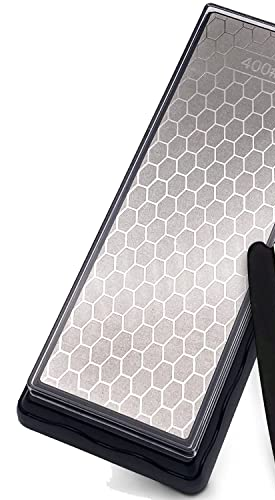
Diamond flattening plate (dual-sided, #400/#1000)


 Mena
Unlike a conventional (e.g. silicon-carbide) flattening stone, a diamond flattening plate almost never dishes out with use, so it doesn’t need “flattening the flattening tool” — that’s its biggest strength. It also has enough bite to re-cut a hardened, glazed surface with a coarser pass.
This type of product is a diamond stone with a coarse (#400) and a medium (#1000) face, so it does double duty as both a flattening tool and a sharpening stone in its own right. Most diamond flattening plates are built as diamond particles bonded to a metal plate, so unlike a conventional (e.g. silicon-carbide) flattening stone, they rarely wear down and dish out with use, and hold a flat surface for a long time. Coming with a base and a case also makes it easier to store without scratching the diamond face.
For a medium or finishing stone whose surface has hardened and gone glassy from glazing, the #400 face is good for a coarser pass that shaves off the worn grain layer and exposes fresh grain. For loading, the same approach works — shaving off a thin layer removes the clogged residue along with it. The basics of choosing a flattening stone and roughly how often to dress are covered in detail in the FAQ on choosing oil stones vs. water stones, so this article won’t repeat them.
For maintenance, rinse it with water after use. If the diamond particles on the plate start flaking off and cutting power clearly drops, that’s your cue to replace it. Unlike a conventional (e.g. silicon-carbide) flattening stone, a diamond flattening plate basically never needs “flattening the flattening tool” itself.
Nagura stone (#12000)
 Mena
A nagura isn’t a whetstone by itself — it’s a small companion stone you rub against a finishing stone to force slurry to form. On a finishing stone that’s glazed over and stopped producing slurry, it can restore cutting action with less effort than a diamond flattening plate.
This is a nagura stone for finishing stones. You rub the nagura itself against a finishing stone to deliberately raise slurry, exposing fresh grain on a surface that’s gone too smooth from glazing. Unlike a diamond flattening plate, it doesn’t re-true the flat surface of the stone — it’s a more delicate tool that only adjusts the condition of the surface grain layer.
It’s the right tool when you’re using a finishing stone (#3000 or finer) that has almost stopped producing slurry, and the feel while sharpening has gone slick. Use it when the surface isn’t bad enough to need a coarse re-truing — only when you want to refresh the surface grain condition. For light loading on a finishing stone too, simply rubbing a nagura across the surface to bring up fresh slurry can be enough to clear it.
For maintenance, rinse with water after use and air-dry. The nagura itself wears down over time, so replace it once the edges round off and it becomes hard to handle, or once it gets too small.
The technical side: how bond grade and porosity map to the three symptoms
From here, the industrial-side thinking behind the three symptoms. It’s a bit technical, but this is where the answer to “why do stones behave differently under the same sharpening technique” lives.
Bond grade: the letter that describes a stone’s hardness
A grinding stone is made of three elements — abrasive grain, bond, and pores — and the strength of the bond that holds the grain is called the bond grade. It’s expressed as a letter, where closer to A means softer and closer to Z means harder (source: IAR Institute for Engineer Education, “Essential Knowledge on Grinding Stones,” confirmed 2026-08-29). So even though household whetstones don’t carry a letter grade, if you just remember that “softer stones tend toward grain shedding, harder stones tend toward glazing,” you can work backward from the symptom to roughly guess how hard a product is.
Porosity: how much room swarf has to escape
In the gaps between grains held by the bond there are microscopic pores, which act as an escape route (chip pockets) for swarf. Stones with higher porosity tend to resist loading, while stones with grains that are too coarse or a bond that’s too hard tend to load up more easily (source: Aion Corporation, “Countermeasures for Loading on Abrasive Stones,” confirmed 2026-08-29). So if the same grit and the same use case loads up differently between brands, understand that it comes down to differences in porosity you can’t see — that gives you a basis for deciding not to keep fighting a stone that loads up repeatedly, and switching instead.
One caveat: the relationship between bond grade, porosity, and the three symptoms described here is originally framed around industrial grinding on a grinding machine, under numeric conditions like depth of cut, feed rate, and wheel speed. Those numeric conditions don’t map directly onto hand sharpening at home, so keep in mind that the quick-reference table and the fixes in each section above are this article’s translation of that industrial framework into signs you can actually observe by hand.
FAQ
Q. What’s the easiest way to tell grain shedding and loading apart?
A. The way slurry behaves is the easiest tell. Grain shedding feels like slurry keeps coming out and grains wash away quickly; loading feels like slurry does come out, but it’s dark and gummy. If you’re not sure, check the three items in the quick-reference table — appearance, sound, and slurry — one at a time.
Q. Is it safe to just dress the stone “just in case”?
A. No. Dressing works for glazing and loading, but with grain shedding, the grains have already detached, so dressing won’t fix it. If grain shedding keeps happening, consider replacing the stone with a harder-bond product instead.
Q. Should I buy a diamond flattening plate or a nagura?
A. If you need to re-true the flat surface itself or shave off clogged loading residue, go with a diamond flattening plate. If a finishing stone (#3000 or finer) has just stopped producing slurry without the surface itself being out of flat, a nagura is the better fit. See the FAQ on choosing oil stones vs. water stones for the basics of picking a flattening stone for coarser/medium stones.
Q. Can the tools in this article also true up a powered whetstone or bench grinder?
A. This article covers flattening stones and nagura for hand sharpening stones only. Dressers for powered whetstones and bench grinders use a different format and technique — see the articles on abrasive types and material-based stone selection for those.
A note on safety
While dressing or using a nagura, shaved-off particles and slurry can make your grip slippery. As with sharpening a blade, don’t press your fingers too far forward, and work on a flat, stable surface. A diamond flattening plate cuts aggressively, so more force or longer use than necessary will just wear your stone down further. Stop once glazing or loading has cleared.
MenaGrain shedding, glazing, and loading can all be told apart by three signs: appearance, sound, and how the slurry behaves. Get the diagnosis right — whether dressing will fix it, or whether you need a new stone — and you’ll cut down on wasted replacements and wasted dressing.
Summary
Nearly every case of a whetstone losing its edge comes down to grain shedding, glazing, or loading. Grain shedding (bond too soft) can’t be fixed by dressing and needs a stone replacement; glazing (bond too hard) comes back with a diamond flattening plate or nagura re-exposing fresh grain; loading (low porosity, clogged residue) comes back once dressing removes the surface residue. If you’re not sure, check the three signs — surface appearance, sharpening sound, and slurry behavior.
★ This article is still built from industrial reference material and product specs rather than a hands-on test. A hands-on writeup is planned as a future update.