
Affiliate Disclosure: This article contains affiliate links. If you make a purchase through these links, we may earn a commission at no additional cost to you.
 Mena
Hey, it’s Mena (@menachite), the hybrid engineer who covers both mechanical and electrical gear. This time it’s a comparison of mopping robot vacuums. I sorted out how much automation you actually get at each price tier.
A lot of people looking at robot vacuums get stuck on “what’s the real difference between a vacuum-only model and one that mops too?” Short answer: a mopping model can handle skin-oil grime and food spills on the floor in one pass, so you pay more up front but cut way down on day-to-day cleaning effort. Here’s why.
This time I compared six products across a wide price range, from budget entry models to a top-tier flagship. Looking at suction power, mopping capability, whether it has self-emptying, and price — four axes — makes it clear how much automation a given room actually needs.
I picked a representative model from five major brands — Anker Eufy, SwitchBot, roborock, ECOVACS, and dreame — and I’ll cover each one’s real strengths and honest weak points. Two of the roborock/ECOVACS picks are successor models released within 2026.
Conclusion: Quick Pick Guide by Goal
Here’s the conclusion up front. If you “just want to start automating as cheaply as possible,” go with the Anker Eufy C10. If you want “self-emptying plus mopping in the budget-to-mid-range tier,” go with the SwitchBot K11+ Pro. If you want “your first vacuum-and-mop combo,” the roborock Qrevo Curv is a safe pick. If your budget allows and you want to cut hands-on effort to the bone, the dreame L40 Ultra Gen 2 is a candidate. And if you want the latest, top-tier performance no matter the cost, the roborock Saros 20 is the one to look at.
| Product | Suction / Features | Mopping / Automation | Price Tier | Best for |
|---|---|---|---|---|
| Anker Eufy C10 | Ultra-slim / self-emptying | Basic mopping | Budget | Starting automation as cheaply as possible |
| SwitchBot K11+ Pro | 12,000Pa / self-emptying, ultra-compact | Mop attachment (not simultaneous with vacuuming) | Budget-to-mid ($399.99 MSRP) | Self-emptying plus mopping in a compact unit |
| roborock Qrevo Curv | 18,500Pa / vacuum+mop combo | Auto mop washing & drying | Mid-range | First-time vacuum-and-mop combo buyers |
| ECOVACS DEEBOT T50S PRO Omni | 25,000Pa / auto-lift mop | Hot-water wash, hot-air dry, auto water refill | Upper mid-range | Anyone bothered by stubborn floor grime |
| dreame L40 Ultra Gen 2 | 25,000Pa / extendable side brush | Auto-empty for up to 75 days | Premium | Cutting hands-on effort to the absolute minimum |
| roborock Saros 20 | 36,000Pa / ultra-slim | All-in-one dock, 8-way automation | Flagship/Top-tier | Wanting the latest, top-tier class |
6 Recommended Mopping Robot Vacuums
Anker Eufy Robot Vacuum Auto-Empty C10




 Mena
If this is your first robot vacuum, the C10 is the one to try. The ultra-slim body slides under sofas and beds, and it comes with a self-empty station — honestly pretty solid for this price.
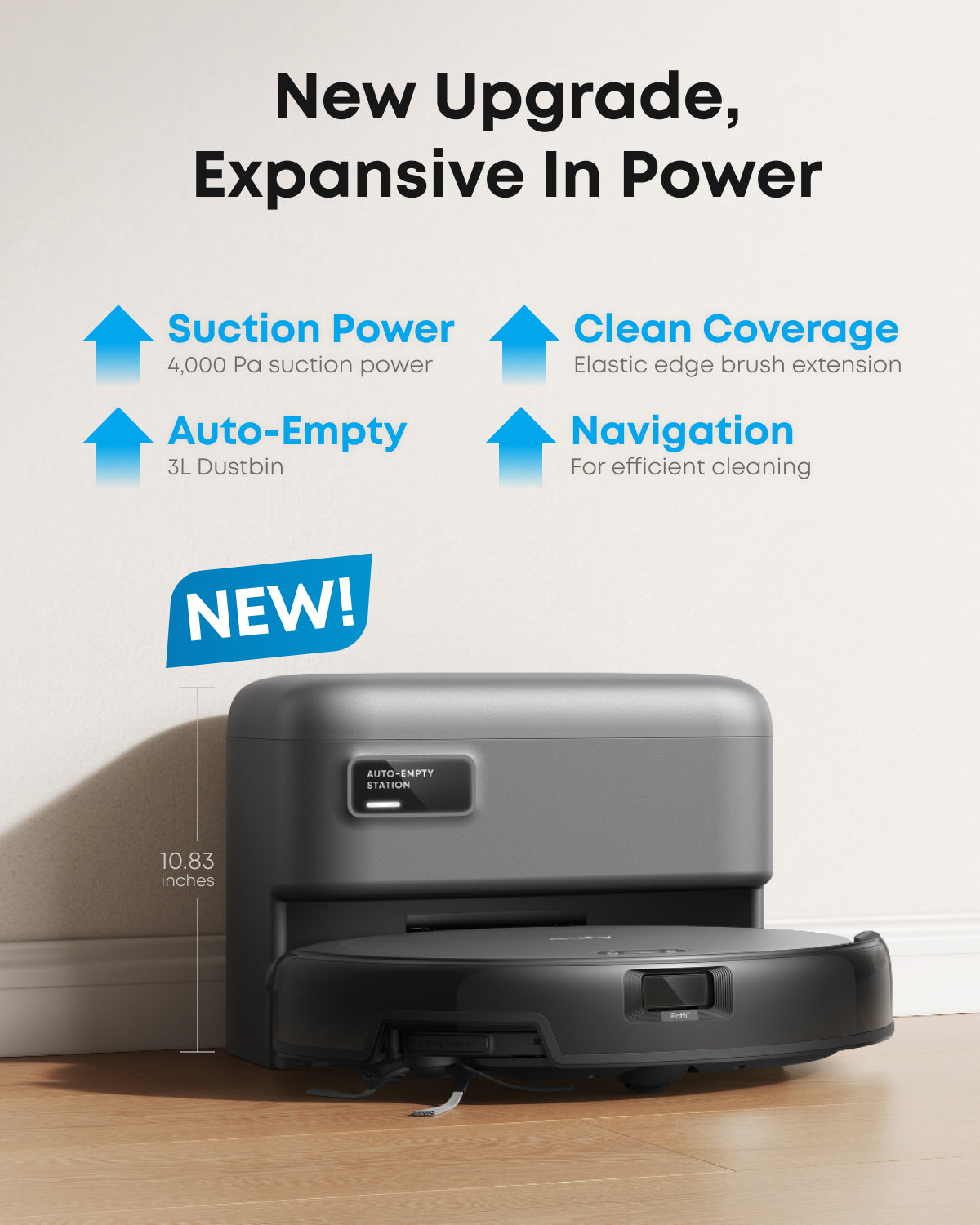
The Anker Eufy Robot Vacuum Auto-Empty C10 comes with a self-empty station standard, at a budget-tier price point. The body has an ultra-slim design, so it can slide into gaps under sofas and furniture where a typical robot vacuum can’t fit. It’s a good fit if you want to try one unit first and keep the cost down.
Thanks to the self-empty station, there’s no need to manually empty the dustbin after every run. On the flip side, at this price the mopping function is basic pad-wiping — it won’t fully lift stubborn oily grime. If you want serious mopping, go in understanding the price gap versus the higher-tier models.
It supports app-based mapping and zone cleaning, but it lacks the auto mop-washing and hot-air drying features found on higher-tier models. Think of it as an entry model suited to starting automation cheaply, or for a secondary room.
On the spec side: 4,000Pa suction, up to 120 minutes of battery runtime, a 600mL onboard dustbin, and a 3L dust bag at the self-empty station (about 60 days’ worth). Navigation is iPath laser navigation, the unit stands 72mm (2.85 in.) tall, it can climb obstacles up to 17mm, and the warranty runs up to 24 months.
SwitchBot Robot Vacuum K11+ Pro
MenaSwitchBot started out as a smart-home brand, but they make robot vacuums too. Note: the S1 Plus model isn’t sold in the US market, so I’m covering the K11+ Pro here — SwitchBot’s current compact, self-emptying pick with a mopping option.
The SwitchBot Robot Vacuum K11+ Pro is an ultra-compact model (24.8cm / 9.76 in. diameter, 9.2cm / 3.6 in. tall) with a self-empty station rated for up to 90 days hands-free. Suction is 12,000Pa, navigation uses LDS LiDAR mapping, and it supports Matter, so it works with Alexa, Google Home, and Apple Home.
One thing worth flagging honestly: mopping on the K11+ Pro requires manually attaching a mop bracket, and once it’s attached, Vacuum Mode is disabled — it’s an either-or, not simultaneous vacuum-and-mop like some higher-end models. If you want true one-pass vacuum-plus-mop, the roborock or ECOVACS picks below are a better fit. Where the K11+ Pro wins is its ultra-compact footprint for a self-emptying unit, and its native Matter support, so it fits neatly into an existing SwitchBot smart-home setup.
MSRP is $399.99 (per SwitchBot). Compared with the roborock/ECOVACS models below, which sit in the mid-range and up for a self-emptying vacuum-and-mop combo, the K11+ Pro’s self-emptying-plus-mop-option at a budget-to-mid price point is a reasonable value pick, as long as you’re fine with the mop-and-vacuum modes being separate.
roborock Qrevo Curv
Mena18,500Pa suction plus real mopping, self-emptying included — for this price it’s honestly impressive. It’s a solid first pick for anyone ready to “go all-in” on a robot vacuum.
The roborock Qrevo Curv is a mid-to-upper-range model that pairs 18,500Pa suction with real mopping. It has an AdaptiLift chassis that lifts the mop pads when crossing carpet, so it can clean an entire floor in mop mode even in a room with mixed hardwood and carpet.
The all-in-one dock doesn’t just empty the dustbin — it washes the mop pads in 167°F (75°C) hot water and dries them with warm air, so there’s no need to hand-wash the mop after every run. Once you experience this level of automation, honestly, it’s hard to go back. That said, the dock itself is on the heavier and larger side, so make sure you’ve got the floor space for it before you buy.
App mapping accuracy is strong, with fine-grained per-room/per-zone cleaning and no-go zones. It also supports Matter, so it plays well with other Matter-enabled smart-home apps. Good balance of price and features, and an easy default choice as your first real vacuum-and-mop combo.
It sits in the mid-range price tier, and suction is roughly 2.6x that of the entry-level Eufy C10 above. If you’re weighing this against roborock’s older Qrevo Pro (7,000Pa), there’s no real reason not to go with the newer Curv if you’re buying new today.
ECOVACS DEEBOT T50S PRO Omni
The ECOVACS DEEBOT T50S PRO Omni delivers 25,000Pa suction with ZeroTangle 3.0 anti-tangle brushes and a TruEdge 2.0 extendable brush-and-mop for edge coverage. The mop pads lift automatically on detecting carpet, so it tackles stubborn grime harder than a plain wipe-mop model. It’s a good fit for households dealing with pet paw prints or food spills.
On top of self-emptying, the OMNI Station handles hot-water mop washing, hot-air drying (45°C), and automatic detergent refill, so the mop is far less likely to develop that musty half-dried smell. The flip side of packing in this much automation is that initial app setup has a lot of steps — if you’re not great with gadgets, expect a bit of a learning curve at first.
Obstacle-climbing performance is also strong — it can clear doorway thresholds and typical entrance-mat height bumps. With a fully embedded dToF LiDAR module, it maps roughly 1,000 sq. ft. in about 8 minutes, a real step up in mapping speed over the outgoing model. It’s a well-balanced all-rounder for anyone who doesn’t want to compromise on either suction or mopping and wants the latest features at a mid-upper price point.
It sits in the upper mid-range price tier. Body thickness stays at a slim 3.19 in., and standard-mode operating noise stays under 70dB.
dreame L40 Ultra Gen 2
MenaThe extendable side brush that reaches all the way into wall edges and room corners genuinely impressed me the first time I saw it work. Combined with up to 75 days of self-emptying, this is a unit you can pretty much forget about for a while.
The dreame L40 Ultra Gen 2 pairs powerful 25,000Pa suction with an extendable side brush that reaches into wall edges and gaps around furniture. The mop pads also get auto hot-air drying and auto water refill, so there’s almost no hands-on step left in the cleaning cycle.
It comes with a self-emptying dust station rated for up to 75 days, cutting way down on how often you have to swap the dust bag. That said, both the robot and the dock run on the larger side, and both the footprint required and the upfront price are honestly a real consideration. For anyone shopping mainly on budget, this could end up being more machine than you need.
Obstacle-avoidance sensor accuracy is strong, steering around cables and pet litter boxes, so you can trust it even in a room with more stuff on the floor. It’s a high-end pick for anyone who wants to automate housework with as little hands-on effort as possible.
The unit delivers 25,000Pa suction, and side brush and mop pad both extend automatically to reach wall edges and corners. The dock supports a self-emptying dust bag rated for up to 75 days, with auto water refill, auto detergent top-off, and auto hot-air mop drying. It sits in the premium price tier.
roborock Saros 20
Mena36,000Pa suction combined with an ultra-slim body — as the newest flagship, this one’s genuinely in a different class. That said, this price tier is really for people who specifically want the latest, top-of-the-line performance.
The roborock Saros 20 is the newest flagship model. It hits 36,000Pa suction — industry-leading numbers — while still keeping an ultra-slim body that slides under furniture. With vacuum-and-mop combo plus an 8-way all-in-one dock, everything from dust collection to mop washing, drying, and water refill is fully automated.
Performance-wise it’s got nothing to prove, but it’s priced at the flagship/top-tier level, clearly higher than the other four models here. Honestly, if all you want is everyday comfort, the Qrevo Curv or T50S PRO Omni will satisfy most people just fine — I’d say the Saros 20 is really aimed at buyers who specifically want the latest tech and top-tier specs.
Map recognition and obstacle-avoidance AI are both on the latest generation, with improved accuracy at identifying small objects. This one’s for anyone chasing the top-tier robot vacuum experience, price aside.
This flagship achieves 36,000Pa suction via roborock’s HyperForce cleaning system. The body stays under 80mm tall despite being ultra-slim, and the AdaptiLift Chassis 3.0 mechanism lets it climb obstacles up to 3.46 in. (double-layer threshold rating). Navigation is the StarSight Autonomous System 2.0, with AI vision-sensor obstacle recognition. Mop hot-water washing runs up to 212°F (100°C), and it supports the Matter smart-home standard.
Robot Vacuum Basics: Reading Suction (Pa), Navigation, and Mopping Style
“Pa” (pascals), the unit for suction power, is a spec where a bigger number means stronger suction — but the catalog figure mostly reflects the motor alone, and real-world cleaning performance also depends on brush design, airflow design, and how clogged the filter is. That said, as a rough guideline: if you’re mostly on hardwood picking up light dust, 4,000–10,000Pa is often plenty; if you want to reach deep into carpet or lift stubborn grime, look at 15,000Pa or higher; and if you want to thoroughly clear pet hair and dust buried deep in a rug, a 25,000Pa-plus high-end unit has the edge.
All six products in this article use laser (LiDAR) or visual-sensor-based self-localization and mapping. The Anker Eufy C10 uses iPath laser navigation, the SwitchBot K11+ Pro uses LDS LiDAR mapping, and the roborock Saros 20 pairs an AI vision sensor with its StarSight Autonomous System 2.0 — generally speaking, newer-generation models tend to have better obstacle-identification accuracy and threshold-climbing performance.
“Mopping capability” covers a wide range — from a simple mode where a mop pad lightly touches the floor, to a full system that applies pressure while spinning the pad or auto-washes it with hot water — and how well it actually lifts grime differs a lot between the two. The Anker Eufy C10 offers basic pad-wiping; the SwitchBot K11+ Pro’s mop attaches as a swap-in accessory (not simultaneous with vacuuming); the roborock Qrevo Curv adds auto mop-lift plus high-temperature mop washing; the ECOVACS T50S PRO Omni adds pressurized rotating dual mops, auto-lift, and 158°F (70°C) hot-water washing; and the dreame L40 Ultra Gen 2 and roborock Saros 20 go further still, with fully automated water refill and hot-air drying. If you want to lift stubborn oily grime or pet paw prints, you’ll want a model with pressurized, hot-water mop washing.
Battery runtime generally falls somewhere between 120 and 250 minutes, and the larger your floor area, the more you’ll want a model with a longer continuous run time. The self-empty station’s capacity (dust bag size) directly determines how often you’ll need to swap it. Among the products here, that ranges from about 60 days (C10) up to 90 days (SwitchBot K11+ Pro) and 75 days (dreame L40 Ultra Gen 2). How much you want to cut down on dust-bag swaps is also worth factoring into your choice.
MenaI’ve run through a fair number of these myself, and this is a category where picking on Pa numbers alone tends to backfire. The brush shape and how easily it picks up debris can swing how the same suction number feels in practice, so I’d recommend weighing the mopping system’s actual sophistication, battery runtime, and dust-station capacity together, not suction power in isolation.
Here’s a quick guide by use case too. If you just want to start automating as cheaply as possible, or you’re setting one up in a secondary room, the Anker Eufy C10 is plenty. If you want a compact, self-emptying unit with a mop option, the SwitchBot K11+ Pro is a candidate. For your first real vacuum-and-mop combo, the roborock Qrevo Curv strikes a good balance of price and features. If pet paw prints or stubborn oily grime bother you, go with the ECOVACS T50S PRO Omni; if you want hands-on effort cut to the absolute minimum, look at the dreame L40 Ultra Gen 2; and if you want the latest, top-tier performance, the roborock Saros 20 is a candidate.
How to Choose, and What to Watch Out For
Robot vacuums are a category where model numbers change and stock cycles fast. In an earlier version of this article I skipped the SwitchBot lineup because the model I wanted was out of stock; this time around I’ve added the K11+ Pro, which is currently in stock. I’ve also swapped in the successor models for roborock (Qrevo Curv) and ECOVACS (T50S PRO Omni), both released within 2026. Always check current price and stock on the product page before you buy.
Mopping quality varies a lot by product — from “light pad-wiping” to “pressurized, self-washing, full-on mopping” — and that’s the main reason for the price spread. If you want to lift stubborn oily grime or pet paw prints, look at the ECOVACS T50S PRO Omni or above; if light dust on the floor is all you’re dealing with, the Anker Eufy C10, SwitchBot K11+ Pro, or roborock Qrevo Curv tier is plenty.
Self-emptying and mop-washing docks are convenient, but on some models the dock takes up more floor space than the robot itself. I’d recommend measuring the width and depth of your intended spot before you buy.
MenaMy honest takeaway after comparing all six: the more you pay, the closer “cleaning effort” gets to zero. Pick based on your budget and how much automation you actually want.
FAQ
Q. How much suction (Pa) is actually enough?
A. If you’re mostly on hardwood picking up light dust, a 4,000–12,000Pa unit (SwitchBot K11+ Pro, Anker Eufy C10) is plenty. If you want to reach deep into carpet or lift stubborn grime, look at 18,500Pa or higher (roborock Qrevo Curv). For thoroughly clearing pet hair and dust buried deep in a rug, a 25,000Pa-plus high-end unit (ECOVACS T50S PRO Omni, dreame L40 Ultra Gen 2, roborock Saros 20) has the edge.
Q. Will mopping alone actually get my floors clean?
A. How thorough the mopping is varies a lot by model. A basic pad-wiping system (Anker Eufy C10) may not fully lift skin-oil grime or food spills — if you’re after stubborn grime, look at a model with pressurized, rotating, hot-water-washed mopping, like the ECOVACS T50S PRO Omni or above.
Q. How often does the self-empty station need emptying?
A. Among the products here, the Anker Eufy C10’s dust bag lasts about 60 days, the SwitchBot K11+ Pro about 90 days, and the dreame L40 Ultra Gen 2 up to 75 days. This varies with room size and how often you clean, but none of them require you to manually empty the dustbin after every single run.
Q. Can I use a mopping model in a room that has carpet?
A. The roborock Qrevo Curv and ECOVACS T50S PRO Omni both lift the mop pads automatically when crossing carpet, so they can clean an entire room in mop mode even with mixed hardwood and carpet. The other models here also include carpet detection and avoidance, so you generally don’t need to worry about the mop wetting your carpet.
Q. How much floor space does the dock need?
A. Self-emptying and mop-washing docks often take up more floor space than the robot itself. Full-automation docks like the roborock Qrevo Curv’s and dreame L40 Ultra Gen 2’s are on the heavier, larger side in particular, so I’d recommend measuring the width and depth of your intended spot before you buy.
Q. Can it handle a room with thresholds or steps?
A. The Anker Eufy C10 can climb up to 17mm, and the roborock Saros 20’s AdaptiLift Chassis 3.0 mechanism handles up to 3.46 in. (double-layer threshold). Most models can clear a doorway threshold or typical entrance-mat height, but I’d check the exact spec for each product before buying.
Q. How long does the battery last?
A. Among the products here, the Anker Eufy C10 runs up to 120 minutes, the SwitchBot K11+ Pro’s self-empty coverage is rated for a 90-day cycle (per-run time isn’t separately published), the roborock Qrevo Curv runs up to roughly 180 minutes, and the ECOVACS T50S PRO Omni runs up to about 255 minutes in quiet mode. For a larger floor area, picking a model with a longer runtime means fewer mid-clean returns to the dock to recharge.
You Might Also Like
Summary
I compared six mopping robot vacuums across four axes: suction power, mopping capability, degree of automation, and price. Even a budget entry model gets you self-emptying, and at the flagship tier, mop washing and drying are fully hands-off too.
If you want to try one cheaply, go with the Anker Eufy C10. For a compact self-emptying unit with a mop option, look at the SwitchBot K11+ Pro. To go all-in on a vacuum-and-mop combo, consider the roborock Qrevo Curv or ECOVACS T50S PRO Omni. And if you want to cut hands-on effort to the bone, take a look at the dreame L40 Ultra Gen 2 or roborock Saros 20.