
This article contains affiliate links. If you make a purchase through these links, we may earn a commission at no additional cost to you.
 メナ
メナHey, it’s Mena. Portable power stations aren’t just “nice to have” — there are definitely situations on job sites where you’re completely stuck without one. Job sites where temporary power isn’t ready, indoor locations where you can’t use a generator, tools running low on charge — after experiencing those situations, the portable power station became standard gear on my job sites.
In this article, I’ll introduce 10 carefully selected portable power stations that work for construction, DIY, and disaster preparedness. I’ll organize the specs from an engineer’s perspective — capacity (Wh), rated output (W), weight, charging speed, and battery type — and explain which situations each model is actually suited for.
“I don’t know which portable power station to choose,” “Can electric tools really run on them at a job site?”, “Is bigger capacity always better?” — I’ll answer those kinds of questions.
How to Choose a Portable Power Station | 4 Key Factors for Construction, DIY, and Disaster Use
① Capacity (Wh): Determine Based on What You’ll Use and How Long
Capacity is expressed in Wh (watt-hours). A 1,000Wh unit can theoretically power a 100W device for about 10 hours, but in practice, conversion losses mean the real figure is about 70–80% of the rated value. Here are capacity guidelines by job site use:
Up to 300Wh: Smartphone and tablet charging, LED lighting, light-duty tool charging. Solo camping or emergency use.
700–1,000Wh: Continuous use of light power tools like electric screwdrivers and impact wrenches. Full-day DIY power source.
1,000–1,500Wh: Medium-duty electric tools like circular saws and grinders. Half-day to full-day job site work.
2,000Wh and above: Long-term use of large power tools. Simultaneous operation of multiple tools. Primary power source for serious construction job sites.
② Rated Output (W): The Standard for Whether Your Tools Will Run
Rated output is “the power (W) that can be continuously supplied.” You need to check the power consumption of your electric tools and choose a model where the total of all the tools you want to use stays within the rated output. The peak output is a figure for handling current spikes at startup — motor-driven tools (circular saws, grinders, compressors) draw 2–3 times the rated current when starting.
③ Weight and Portability: This Affects Ease of Use on the Job Site
Even with the same capacity, weight can vary significantly. Around 1,000Wh, there can be an 8–12kg difference, and on job sites where you carry it out every day, weight directly affects fatigue. Generally, the upper limit for a woman to carry alone is around 10kg, and even for men, 15kg or more can feel heavy for everyday carrying. If you’re keeping it in the car all the time, you can prioritize capacity over weight, but if you’re loading and unloading every day, choosing a lighter model will be more sustainable long-term.
④ Charging Speed and Battery Type: Choose LFP for Long-Term Use
Charging speed matters on job sites. The standard cycle is charging overnight and taking it out the next morning, but with rapid-charging models, you can also top up during lunch breaks. For battery type, I recommend choosing LFP (lithium iron phosphate). It’s heavier than NMC (ternary), but cycle life is 3,000–4,000+ times — about 3x longer — and the risk of overheating and ignition is also lower. If you’re making a long-term investment in job site equipment used every day, LFP is the clear choice.
Top 10 Recommended Portable Power Stations for Job Sites | In-Depth Comparison by Capacity
I’ll introduce the main models from EcoFlow, Anker, Jackery, and BLUETTI in order from smallest to largest capacity. All models use LFP — Milwaukee products are excluded. Check the capacity class that matches your needs.
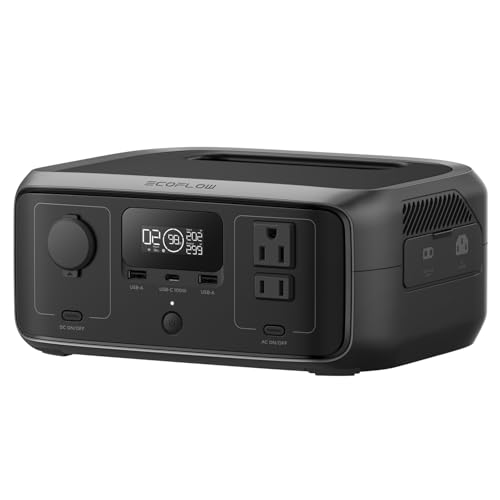
EcoFlow RIVER 3 Portable Power Station 245Wh


 メナ
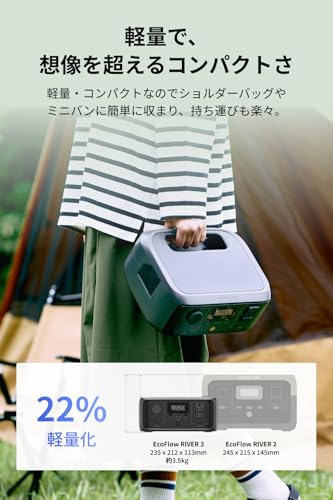
メナThe RIVER 3 does double duty for camping and light work. The charging speed and lightness are truly in a class of their own — bringing it to the job site is almost no burden at all.
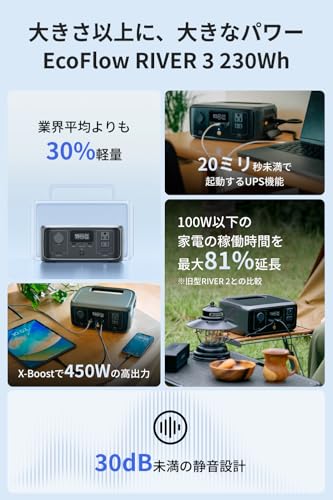
| Capacity | 245 Wh |
| Rated Output | 600 W (Peak 1,200 W X-Boost) |
| Weight | 3.5 kg |
| Charging Speed | Approx. 50 min (AC) |
| Battery | LFP (Lithium Iron Phosphate) |
The EcoFlow RIVER 3 is a lightweight compact model with 245Wh. Weighing just 3.5kg, it’s ideal for carrying to job sites or keeping in the car. It achieves class-leading AC charging in about 50 minutes, enabling a morning charge and afternoon use cycle. The X-Boost feature allows it to power appliances up to 1,200W despite a 600W rated output (auto-adjusted based on power consumption).
Its use cases are best suited for “getting a little power when you need it.” It shines in situations like charging smartphones and tablets on the job site, keeping LED lights running continuously, and rapidly charging hand tools — more “good to have” than long continuous use. It also works well as a sub-power source for camping and car sleeping.
With LFP (lithium iron phosphate) batteries and 3,000+ cycle life, it handles long-term daily use. Charging and discharging every day, it can last about 10 years. The accessible price point as an entry model is also attractive.
BLUETTI EB70S Portable Power Station 716Wh




 メナ
メナThe EB70S has an excellent balance of price and capacity. Getting over 700Wh for around $350 is great value, and it’s more than enough for LED lighting and small power tools on the job site.
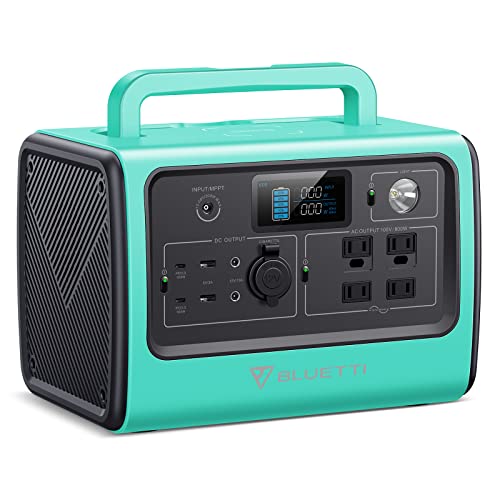
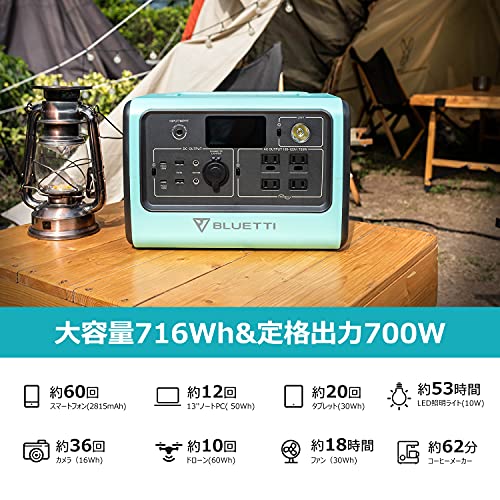
| Capacity | 716 Wh |
| Rated Output | 800 W (Peak 1,400 W) |
| Weight | 9.7 kg |
| Charging Speed | Approx. 2 hours (AC) |
| Battery | LFP (Lithium Iron Phosphate), 2,500 cycles |
The BLUETTI EB70S is a small-to-mid capacity model with 716Wh. With LFP (lithium iron phosphate) batteries and 2,500+ cycle lifespan. The 800W rated output (peak 1,400W) is sufficient to run light-to-medium power tools such as LED lights, electric screwdrivers, and impact wrenches.
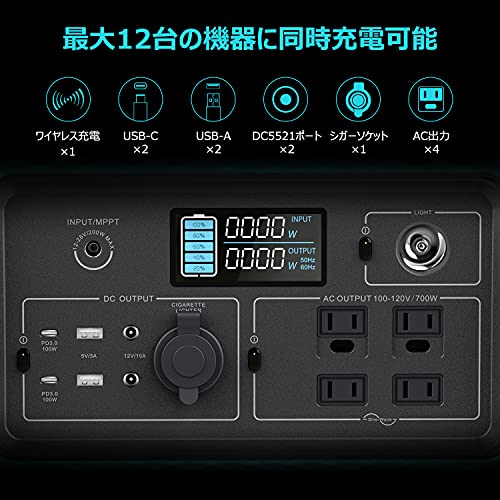
With a total of 12 AC, DC, and USB ports, simultaneous charging of multiple devices is possible. It handles various job site needs including smartphone charging and powering surveying equipment. With UPS (uninterruptible power supply) function, it switches within 20ms during a power outage to protect precision equipment.
Suited for DIY users wanting to introduce a portable power station with a focus on value, or craftspeople wanting to add supplemental power to their job site for light work. BLUETTI has extensive sales experience in the Japanese market with solid after-service support.
Anker SOLIX C800 Portable Power Station 768Wh IP54 Weatherproof


 メナ
メナThe C800’s IP54 is a real lifesaver at outdoor construction sites. Being able to use it without worry in rain or dusty conditions gives a peace of mind that other power stations can’t match.
| Capacity | 768 Wh |
| Rated Output | 1,200 W (Peak 1,600 W) |
| Weight | 10.1 kg |
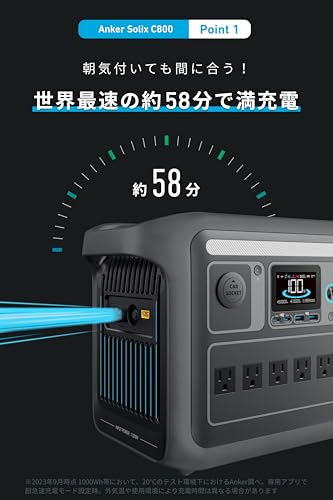
| Charging Speed | Approx. 58 min (AC) |
| Weatherproofing | IP54 |
| Battery | LFP, 10-year lifespan |
The Anker SOLIX C800 is a job-site-focused model with 768Wh and IP54 weatherproofing. The IP54 weatherproofing standard means it’s “protected against water splashes from any direction,” making it suitable for use in rainy weather, demolition sites with lots of dust, and civil engineering job sites. Being able to leave the power station outside during outdoor construction greatly enhances the convenience of portable power stations.
The 1,200W rated output (peak 1,600W) covers most power tools. AC charging in 58 minutes enables a cycle of charging during lunch break and using it in the afternoon. LFP adoption provides a 10-year (3,000+ cycle) lifespan. Performance is maintained over the long term even with daily job site use.
Supports a variety of outputs including USB-C ports (up to 100W), USB-A ports, and 3 AC outlets. Remote operation via Bluetooth and Wi-Fi through the Anker app is also possible. If you’re planning outdoor or semi-outdoor construction work, the weatherproof C800 is the first choice.

Anker SOLIX C1000 Gen 2 Portable Power Station 1024Wh



 メナ
メナThe C1000 Gen2 has world-class-fastest 54-minute charging in its class. It’s become routine to charge in the morning and use it in the afternoon at the job site — no more worrying about running out of charge.
| Capacity | 1,024 Wh |
| Rated Output | 1,500 W (Peak 2,000 W) |
| Weight | Approx. 9 kg |
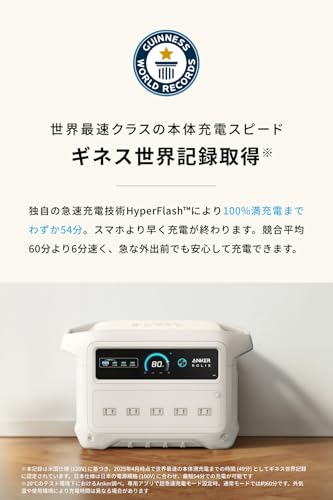
| Charging Speed | Approx. 54 min (AC, world’s fastest class) |
| Battery | LFP, 10-year lifespan |
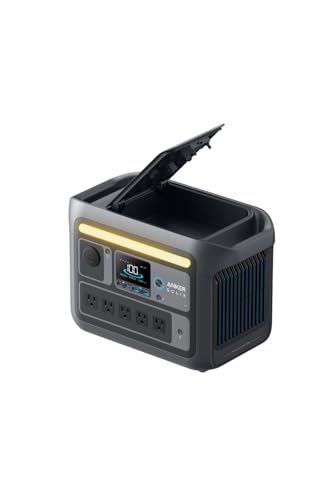
The Anker SOLIX C1000 Gen 2 is a 1024Wh model achieving world-class-fastest AC charging in 54 minutes. It’s about 15% smaller than the previous model while maintaining equivalent or better performance. LFP (lithium iron phosphate) adoption provides 3,000+ cycle lifespan with a 10-year warranty.
With 1,500W rated output (peak 2,000W), it covers major job site equipment including power tools, compressors, and LED lights. SurgePad technology enables stable operation even for motor-driven tools with large starting currents.
With 6 AC outlets, USB-C (140W×2), and USB-A (5 ports) for abundant output, simultaneous use of multiple chargers and power tools is possible. With app support, real-time monitoring of remaining capacity and power consumption, and rapid charging mode switching are also available.
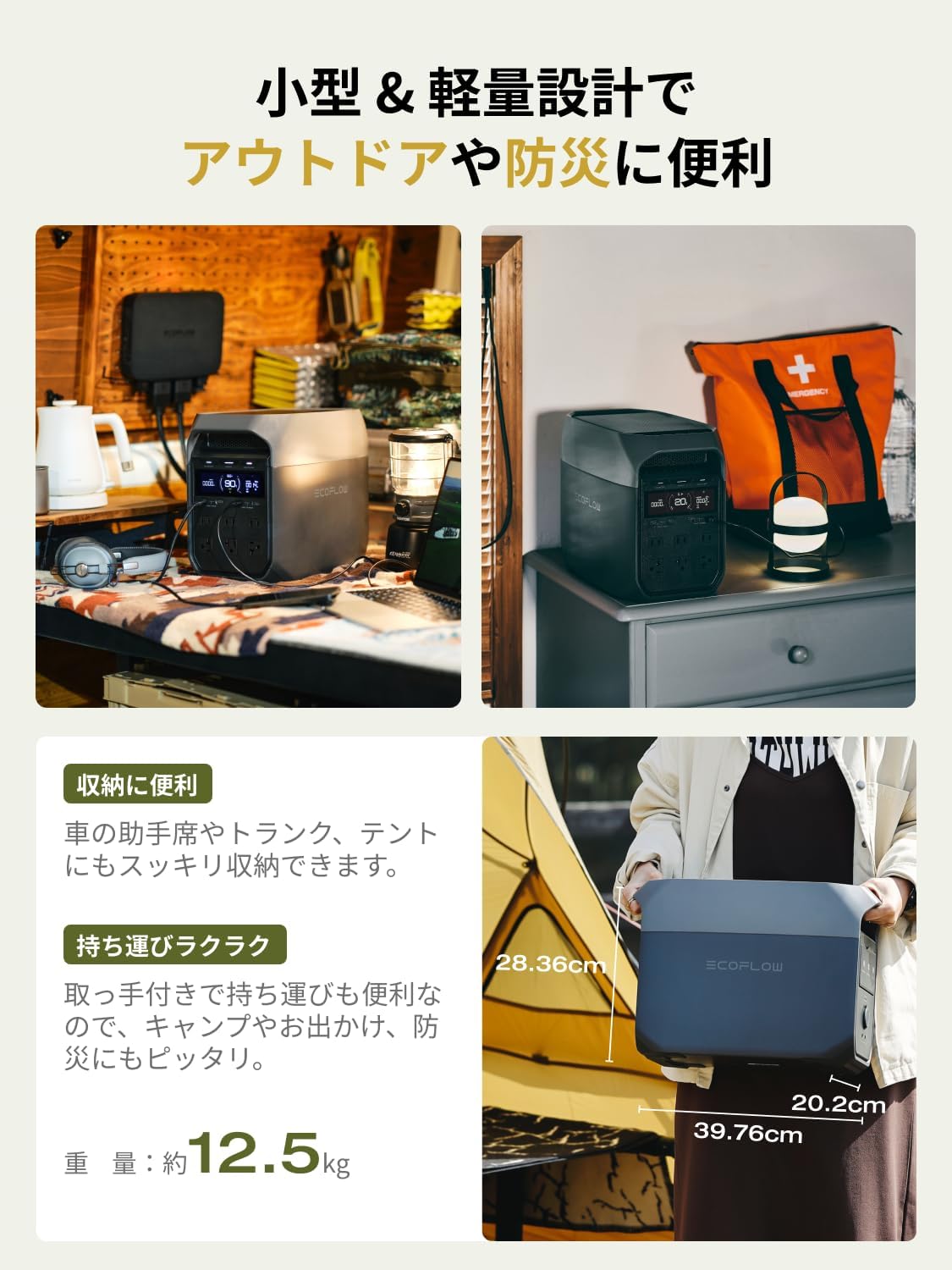
EcoFlow DELTA 3 Portable Power Station 1024Wh with Expansion Support
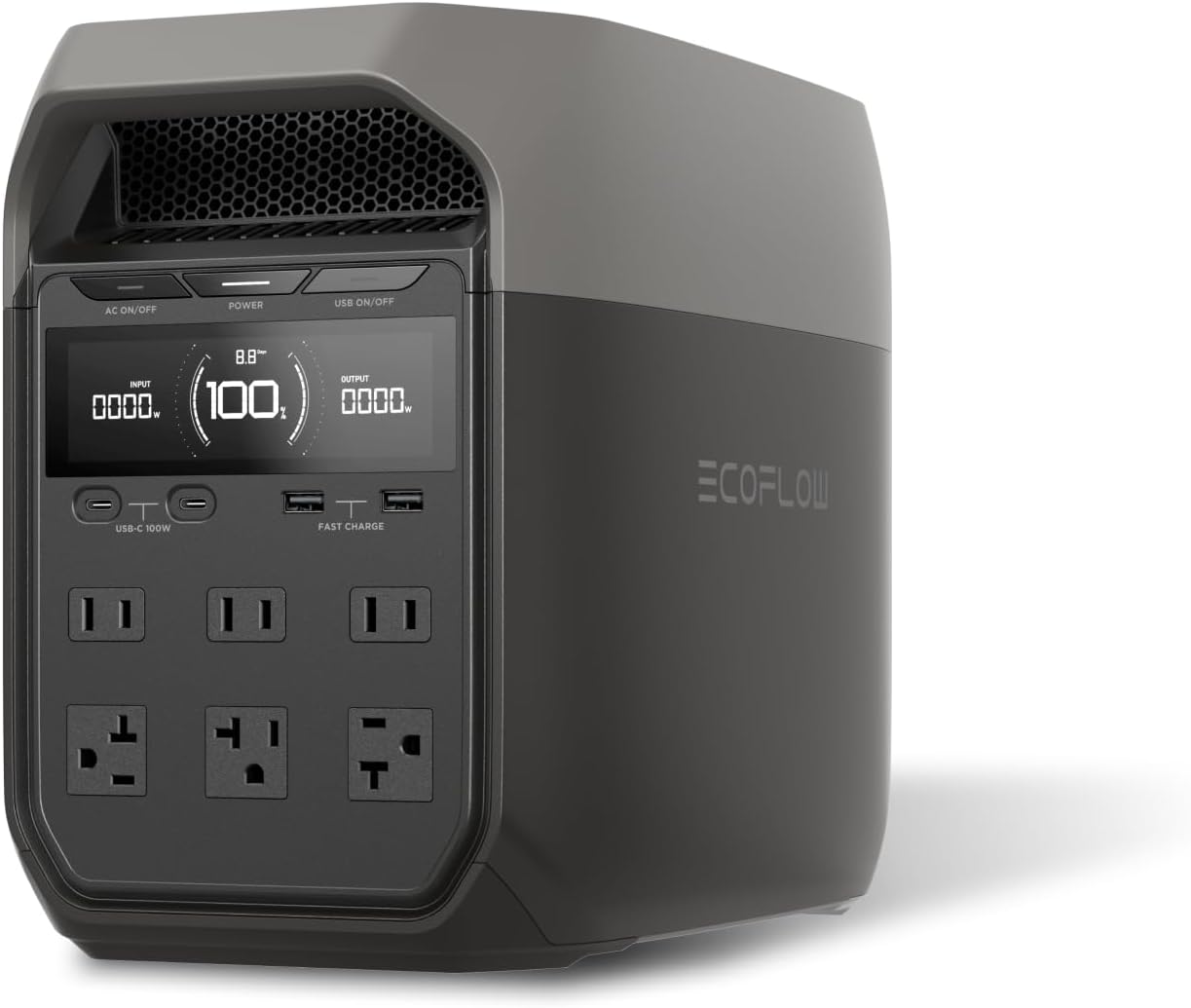
| Capacity | 1,024 Wh (up to 5,000 Wh with expansion) |
| Rated Output | 1,500 W |
| Weight | 12.5 kg |
| Charging Speed | 100% in 56 min (AC, 1,500W input) |
| UPS | Yes (under 10ms) |
| Expansion | Yes (up to 5kWh with extra battery) |
| Battery | LFP, 4,000 cycles, 10 years |
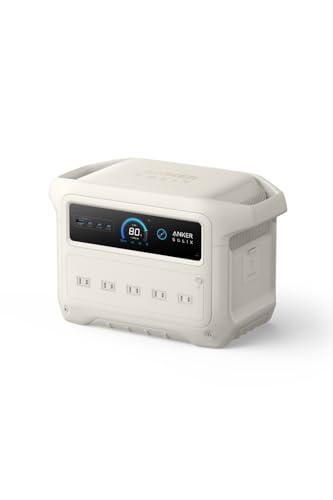
The EcoFlow DELTA 3 is a mid-capacity model with 1024Wh, the successor to the previous DELTA 2. As before, connecting an expansion battery can grow capacity to a maximum of 5kWh — it’s a “scalable power source” you can start with the capacity that fits your current job site scale and expand as the workload increases. Fast AC charging at 1,500W input gets it to 100% in just 56 minutes.
It’s equipped with a high-reliability UPS that switches in under 10ms, a major speed-up from the DELTA 2’s under-30ms switching. Even a sudden power outage won’t compromise data integrity or equipment safety. The LFP battery cells retain 80% capacity after up to 4,000 cycles, for a long 10-year lifespan.
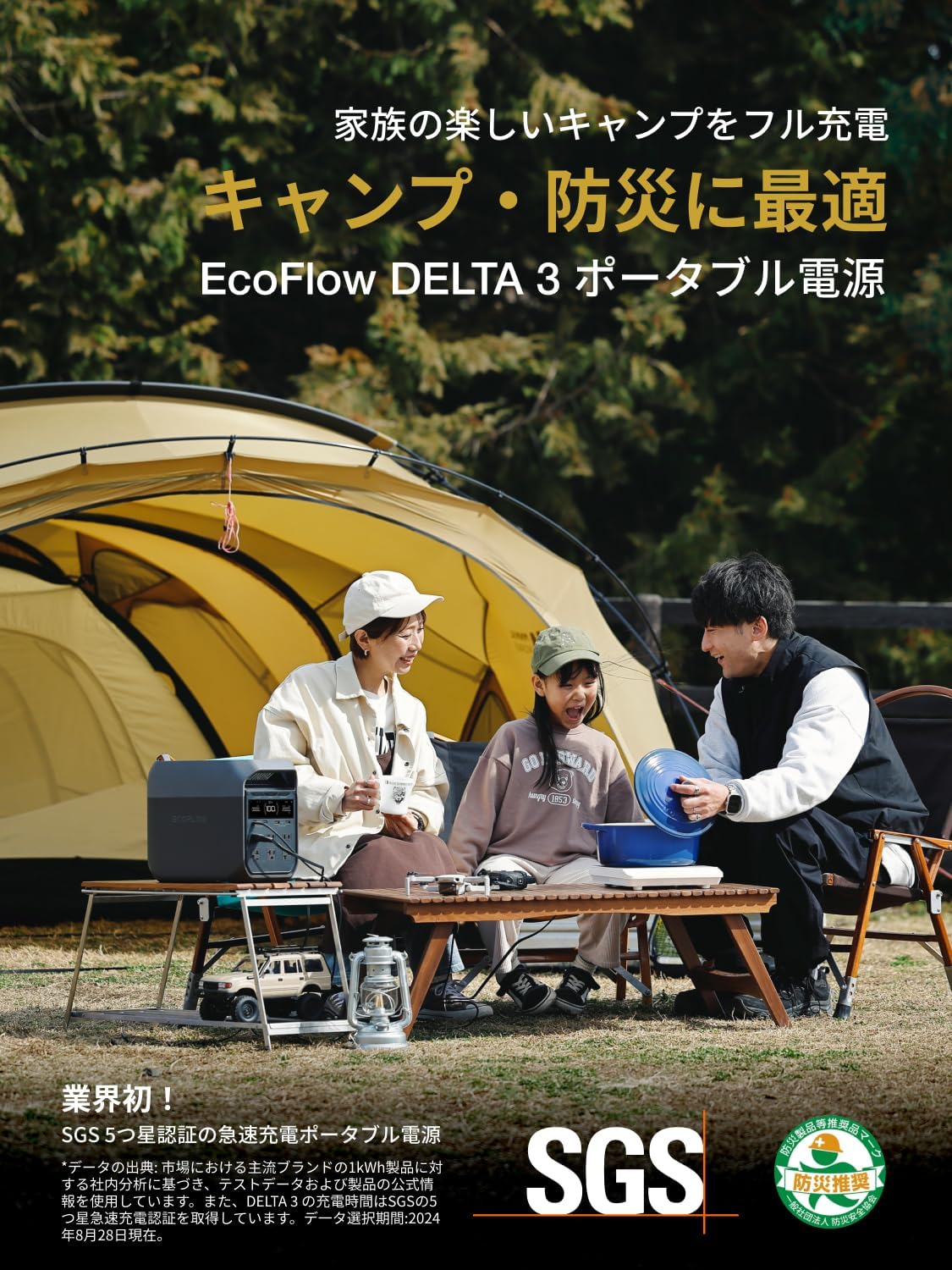
High power consumption tools like circular saws and disc grinders can be used for extended periods with the large capacity after expansion. For those who think “1000Wh is enough for now, but I might need more in the future,” expansion support is a major advantage.
Jackery Portable Power Station 1000 New 1000Wh


 メナ
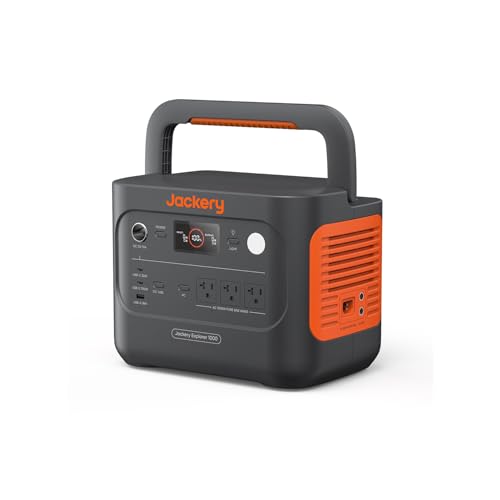
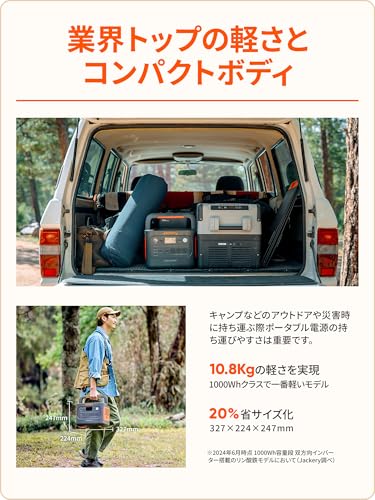
メナThe 1000 New’s strength is combining lightness and cost performance. Among models in the same class, being light enough to hand-carry makes moving around single-person job sites easy.
| Capacity | 1,000 Wh |
| Rated Output | 1,500 W (Peak 3,000 W) |
| Weight | 8.9 kg |
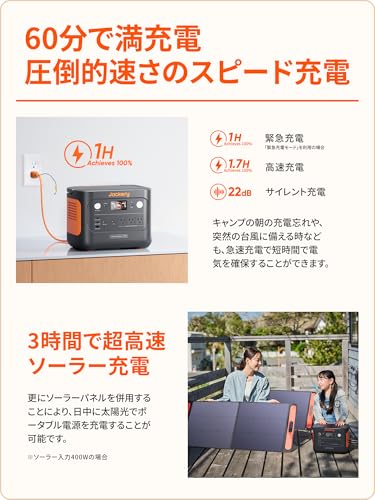
| Charging Speed | Approx. 1 hour (AC) |
| Battery | LFP long lifespan |
The Jackery Portable Power Station 1000 New features a lightweight design of 8.9kg in the 1000Wh class. While most models in the same capacity class weigh 10–12kg, this fits into a portable size. The 1,500W rated output (peak 3,000W) handles the starting current of power tools as well.
Supports fast AC charging in about 1 hour. LFP battery adoption for long lifespan. Off-grid operation on job sites is also possible by combining with solar panels (optional). Jackery’s solar panels are purpose-designed for easy connection.
Suited for those who want a portable power station with a focus on cost performance. A highly versatile model for weekend DIY work, supplemental power at construction sites, and disaster preparedness stockpiling.
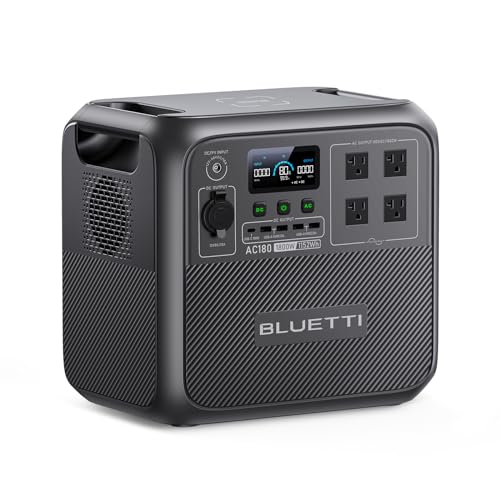
BLUETTI AC180 Portable Power Station 1152Wh 1800W


 メナ
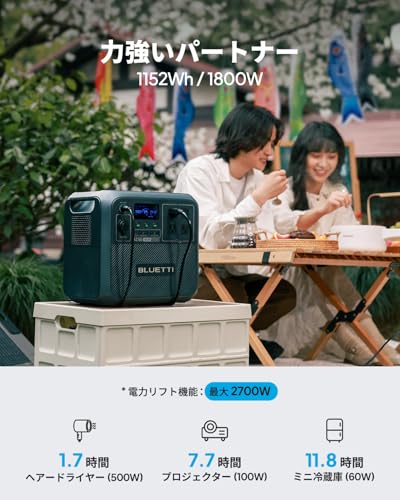
メナThe AC180’s Power Lift (2700W output) is the most helpful feature on the job site. An output that can run both an electric circular saw and an electric hammer drill is hard to find in a 1kWh-class power station.
| Capacity | 1,152 Wh |
| Rated Output | 1,800 W (2,700 W with Power Lift) |
| Weight | 16 kg |
| Charging Speed | Approx. 45 min (dual AC simultaneous) |
| Battery | LFP, 3,500 cycles |
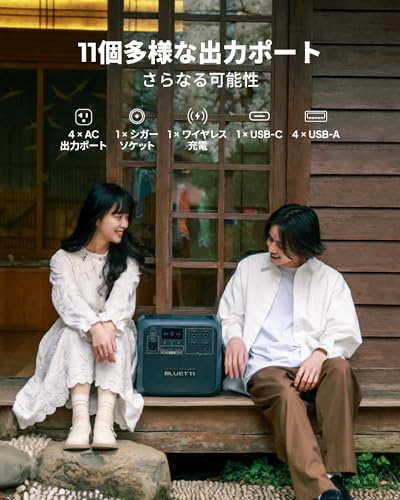
The BLUETTI AC180 is a high-output mid-capacity model with 1152Wh and 1800W rated output (2700W with Power Lift). The Power Lift feature allows use of high power consumption equipment that normally can’t be run. Suited for job sites wanting to use high power consumption tools like circular saws, sanders, and electric hammer drills. AC charging in 45 minutes, which is the value for dual-port simultaneous charging, is among the fastest in the industry.
LFP adoption with 3,500+ cycle lifespan (higher than industry average). Equipped with UPS function (20ms switching) to protect precision equipment during power outages. Remote operation and power monitoring via app are possible, enabling smart power management on job sites.
When operating multiple tools at a construction site simultaneously (LED lights + power tools + chargers), the 2,700W output has plenty of margin. BLUETTI’s proprietary “Eco Mode” (automatic standby power off) that suppresses waste consumption is also convenient.
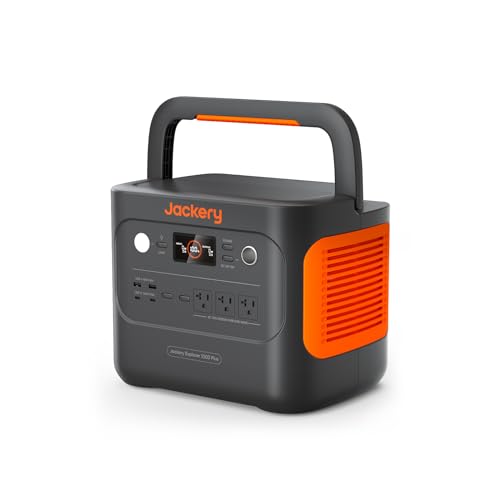
Jackery Portable Power Station 1000 Plus 1264Wh LFP 2000W


 メナ
メナThe 1000 Plus’s 2000W output is top-class in its segment. With LFP safety and long lifespan, combined with an output that can run large tools, it’s a serious job-site spec unit.
| Capacity | 1,264 Wh |
| Rated Output | 2,000 W (Peak 4,000 W) |
| Weight | 15.7 kg |
| Charging Speed | Approx. 1.7 hours (AC) |
| Battery | LFP, 4,000 cycles |
The Jackery Portable Power Station 1000 Plus is a high-output model with 1264Wh and 2000W rated output (peak 4000W). LFP adoption with 4,000+ cycle lifespan is a high standard even in the industry. Expecting more than 10 years of performance with daily charge/discharge cycles, it’s an excellent long-term investment.
The 2000W rated output handles high power consumption tools like circular saws, grinders, and compressors. The peak 4000W stably starts even motor-driven tools with large starting currents. AC charging in about 1.7 hours is standard speed for the large capacity class.
Expansion battery support allows for future capacity increases. When introducing this as a full job-site power source, the combination of long-life LFP and high rated output makes it a high total cost-performance choice.
EcoFlow DELTA 3 Max Portable Power Station 2048Wh 2200W
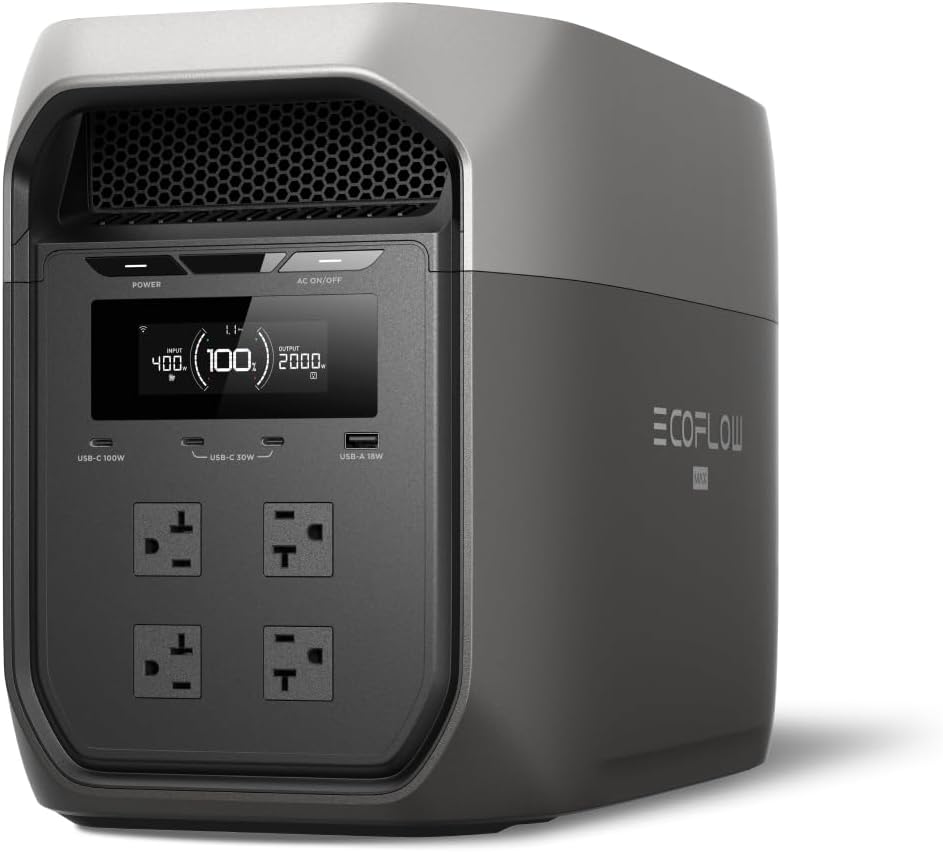
| Capacity | 2,048 Wh |
| Rated Output | 2,200 W (X-Boost up to 2,700 W) |
| Weight | 20.3 kg |
| Charging Speed | 80% in 68 min, full charge in 108 min (1.8h, AC) |
| UPS | Yes (under 0.01 sec) |
| Expansion | Not supported |
| Battery | LFP, 10 years |
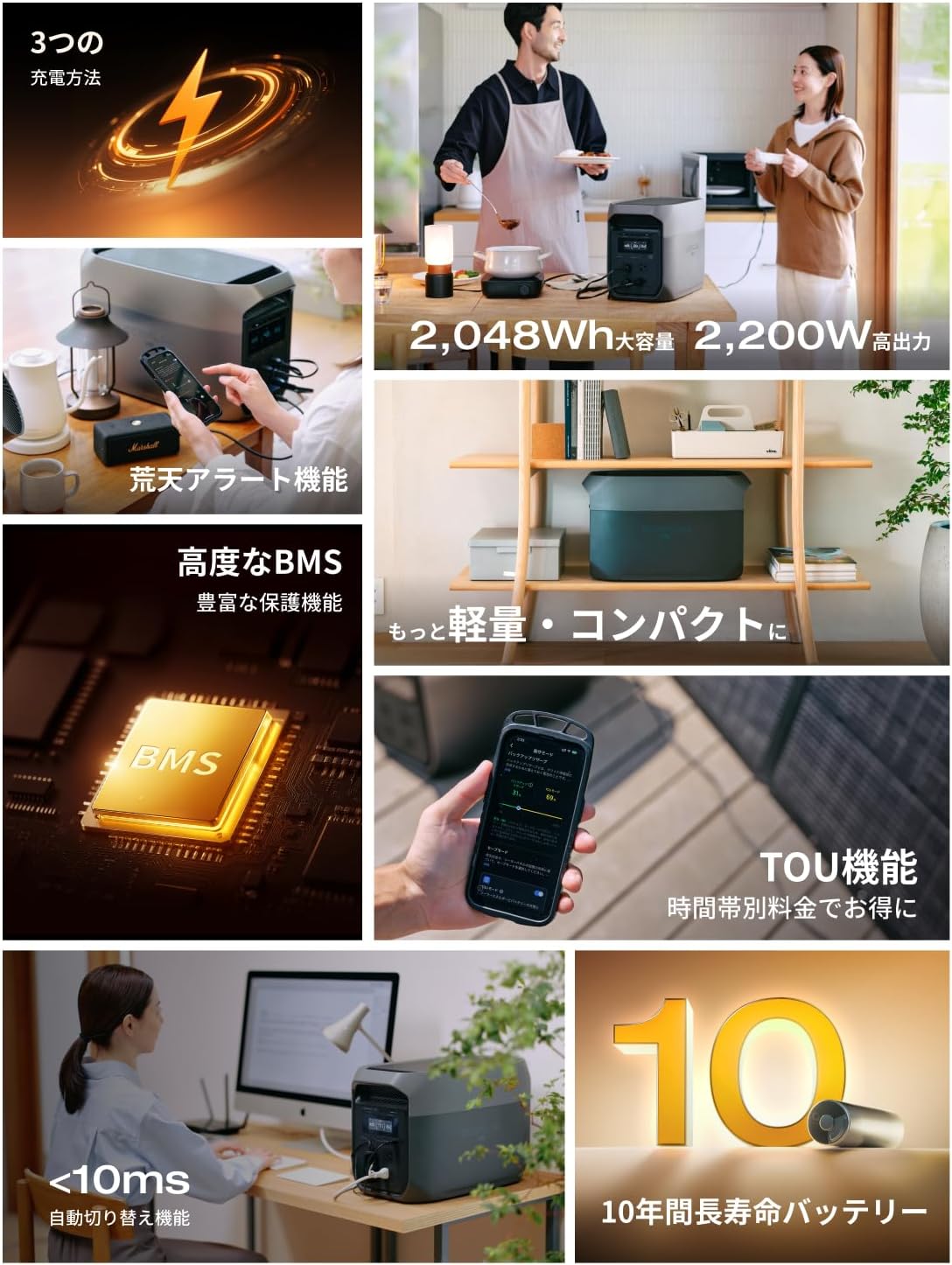
The EcoFlow DELTA 3 Max is a large-capacity model with 2048Wh, the successor to the previous DELTA 2 Max. Thanks to an EV-derived CTC (Cell-to-Chassis) structure, it’s about 2.7kg lighter than the previous model (23kg → 20.3kg) while rated output climbs from 2,000W to 2,200W. It works as the primary power source on job sites where many tools run all day, such as electrical, plumbing, and carpentry work.
AC charging reaches 80% in 68 minutes and a full charge in 108 minutes (1.8 hours), thanks to EV-derived SiC power semiconductor fast charging. Note that unlike the DELTA 2 Max, the DELTA 3 Max does not support an expansion battery (if you need expansion, consider the higher-tier DELTA 3 Max Plus).

It’s equipped with an automatic power-outage switchover that kicks in under 0.01 seconds, protecting refrigerators, PCs, 3D printers, and other devices that shouldn’t suddenly lose power. When considering full introduction for a job site, 2kWh capacity is enough to cover a full day’s power in many cases. (Reference: circular saw 1,200W × 4 continuous hours ≈ 4.8kWh is a rough guide.)
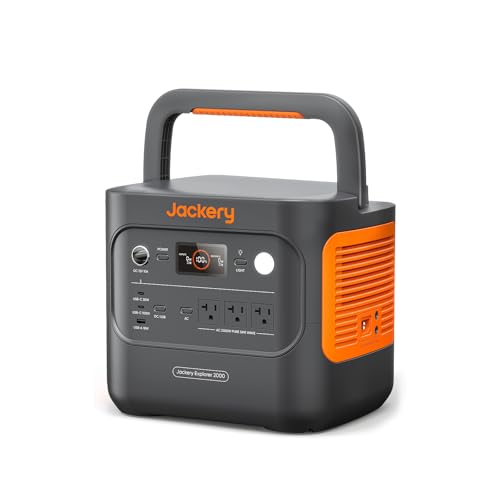
Jackery Portable Power Station 2000 New 2042Wh 2200W


 メナ
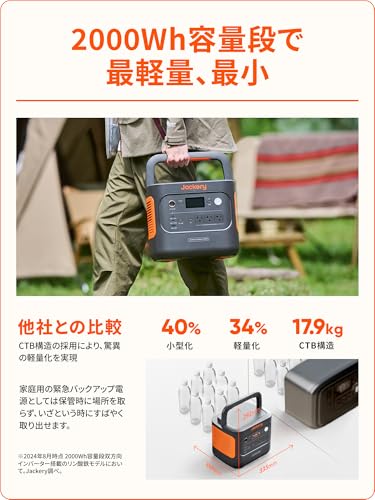
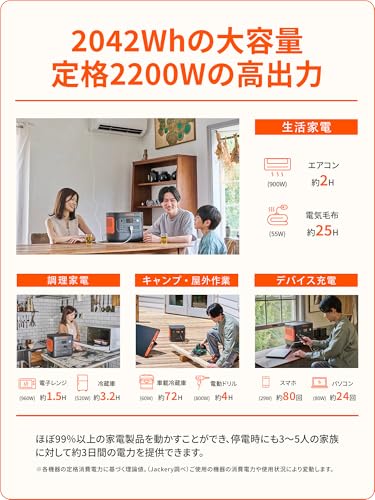
メナThe 2000 New’s 2kWh-plus is sufficient capacity as a primary power source for large job sites. With a 2200W rated output, you can run grinders and electric hammer drills for extended periods.
| Capacity | 2,042 Wh |
| Rated Output | 2,200 W (Peak 4,400 W) |
| Weight | Approx. 22 kg |
| Charging Speed | Approx. 1.7 hours (AC) |
| Battery | LFP, 10-year lifespan |
The Jackery Portable Power Station 2000 New is a large-output model with 2042Wh capacity and 2200W rated output (peak 4400W). The peak 4400W is high even within the same class, reliably starting compressors, pumps, and large power tools with big starting currents. LFP adoption with a 10-year lifespan is designed to withstand daily job site use.
Supports fast charging at 2000Wh+ in about 1.7 hours. Night charging enables a full day of use the next day cycle. Also equipped with app support for remote monitoring and UPS function.
Plenty of capacity even when simultaneously using multiple power tools (grinders, electric hammer drills, chargers, etc.). The optimal class for large-scale renovation, exterior work, and facility construction sites that require long-duration, high-power operation.
Recommended Portable Power Stations by Use Case | Construction, DIY, and Disaster Preparedness
Construction and Electrical Job Sites
The primary use on construction sites is as a “temporary power alternative” or “supplemental power.” For indoor construction where generators can’t be used, portable power stations with no exhaust fumes and no noise are strong allies. The recommended capacity is 1,000–2,000Wh. If you need to run a circular saw (about 1,200W) and grinder (800–1,200W), you need at least 1,500W or more of rated output. For outdoor or semi-outdoor use, the Anker SOLIX C800 (IP54 weatherproof) gives peace of mind. For a full day of serious construction, the EcoFlow DELTA 3 Max (2,048Wh) or Jackery 2000 New (2,042Wh) can handle it.
DIY and Weekend Work
DIY use often follows a “use only when needed” pattern, so ease of use and price are more important than capacity. The 700–1,200Wh class has a good balance of price, capacity, and weight. The BLUETTI EB70S (716Wh) has a cost advantage and is sufficient capacity for weekend DIY work. The Jackery 1000 New (1,000Wh) is lightweight with high cost performance, popular as an entry model.
Disaster Preparedness and Power Outage Protection
For disaster preparedness use, “capacity and reliability” are the top priorities. To secure power for several days during a power outage, 2,000Wh or more is reassuring. LFP batteries have low self-discharge even after long-term storage, with many models retaining 80%+ capacity even after 5 years of storage. Choosing models with UPS (uninterruptible power supply) function enables automatic switching during power outages to protect precision equipment. Both BLUETTI EB70S and BLUETTI AC180 support UPS function and can also protect medical devices, PCs, and routers.
Frequently Asked Questions (FAQ)
Q. Can a circular saw run on a portable power station at a job site?
A. Circular saws consume about 1,000–1,800W. Models with 1,500W or more rated output will run them. Since the starting current is large, models with 2,000W or more peak output are more reassuring. The EcoFlow DELTA 3 Max (2,200W rated) and Jackery 2000 New (2,200W rated) can handle it with margin.
Q. How long does charging take?
A. It varies by capacity and model, but rapid charging has greatly improved in the latest models. The Anker SOLIX C1000 Gen 2 fully charges 1,024Wh in 54 minutes. The EcoFlow DELTA 3 Max fully charges 2,048Wh in 108 minutes (1.8 hours). Overnight charging for a full charge next morning is viable at that speed.
Q. Which is better, LFP or NMC?
A. For job site use every day, LFP is the clear choice. LFP has a long cycle lifespan of 3,000–4,000+ times and is resistant to overcharging and overheating. NMC has higher energy density and is lighter, but lifespan is shorter at 500–1,000 cycles. Current major portable power stations (EcoFlow DELTA 3 series, Anker SOLIX, BLUETTI AC180, etc.) have almost all transitioned to LFP.
Q. Can they be solar charged?
A. Most models support solar charging in combination with optional solar panels. With a panel of around 200W on a sunny day, you can charge a 1,000Wh class unit in 6–8 hours. EcoFlow, Jackery, Anker, and BLUETTI each offer dedicated solar panels with easy connection via proprietary connectors. If you’re considering off-grid operation on job sites, check the expansion options.
Summary | Portable Power Stations Are Worth Introducing as “Mobile Power Infrastructure” for Job Sites
メナAll 10 models introduced here are at a level where they can actually be used for job sites, DIY, and disaster preparedness. Balance capacity, output, weight, and price to choose the one that fits your use case. If you’re unsure, the shortcut is to calculate your required capacity as “maximum power consumption of the work you’ll do (W) × working time (h) × 1.3 (loss factor).”
Small capacity (up to 300Wh): EcoFlow RIVER 3 — ultra-lightweight, camping, emergency use
Small-to-mid capacity (700–800Wh): BLUETTI EB70S (cost performance) · Anker SOLIX C800 (IP54 weatherproof, outdoor construction)
Mid capacity around 1,000Wh: Anker SOLIX C1000 Gen 2 (world’s fastest charging) · EcoFlow DELTA 3 (expansion support) · Jackery 1000 New (lightweight cost performance)
Mid-large capacity (1,100–1,500Wh): BLUETTI AC180 (high output 2,700W) · Jackery 1000 Plus (LFP long lifespan)
Large capacity (2,000Wh and above): EcoFlow DELTA 3 Max (high output 2,700W) · Jackery 2000 New (peak 4,400W)
A portable power station is a long-term investment you’ll use for 5–10 years after purchase. Rather than starting with a cheap model, investing in a reliable model with LFP will result in lower long-term costs. For full introduction to construction job sites, consider 1,000Wh or more; for outdoor use, consider IP54 weatherproof models.
Related articles: Portable Power Station Comparison | Power Tool Manufacturer Comparison Ranking