

Affiliate Disclosure: This article contains affiliate links. If you make a purchase through these links, we may earn a commission at no additional cost to you.
 Mena
Hi, I’m Mena, a hybrid engineer. “I need to cut metal, but grinder? chop saw? plasma?” is a tool question that trips people up more than it should – the short version is that the right method depends on thickness, shape, and how clean the cut needs to be, not on which tool is “strongest.”
When it’s time to cut metal, most people reach for an angle grinder first. But a grinder isn’t a universal answer – thickness, cut length, precision, straight vs. curved, power source, and finish quality all push toward different methods being the right call. This isn’t a “best cutting tools” ranking; it’s a method-selection guide comparing all six approaches – angle grinder, abrasive chop saw, metal-cutting (cold) saw, jigsaw, portable band saw, and plasma cutter – by capacity, precision, power requirements, and finish.
The short answer: material x thickness x shape decides the method
Here’s the conclusion up front. Choosing a metal-cutting method comes down to four conditions: material, thickness, straight vs. curved, and cut length. What matters isn’t picking the “strongest” tool – it’s switching to whichever method actually fits the condition in front of you.
| What you’re cutting / the condition | The reasonable method |
|---|---|
| Curves/cutouts in thin sheet (up to ~3/8 in. / 10mm) | Jigsaw (the only method here that handles curves) |
| Straight, short, on-the-spot work in thin-to-mid gauge | Angle grinder + cutting wheel |
| Many pipes/angle/channel cut to the same length | Chop saw |
| Same as above, prioritizing finish (less burr/heat) | Cold saw (carbide metal-cutting saw) |
| Round tube/round bar, straight, minimal sparks | Portable band saw |
| Non-ferrous too (stainless/aluminum), high speed | Plasma cutter (thinner gauges only) |
Worked example: “I need to cut about 3mm (roughly 1/8 in.) mild steel”
Let’s run the table above on a real case. “3mm mild steel” alone doesn’t settle the method yet – next you need to check whether the cut is straight or curved, and roughly how long it is.
Straight and long (guided against a fence or straightedge)
A chop saw or cold saw are the candidates. Both clamp the stock in a vise for repeatable cut-to-length work, which suits cutting several pieces to the same length. Favor the chop saw for speed, or the cold saw when a cleaner, lower-burr finish matters more.
Straight and short (a single, one-off cut)
Mounting a cutting wheel on an angle grinder is the quick choice here. It’s portable and doesn’t require setting up a benchtop machine, which suits a one-off job. Keep in mind it’s the least precise of the six methods, and heat discoloration and burrs are common.
Curved, or a cutout is needed
Of the six methods, only the jigsaw can follow a curve. Mild steel sheet is generally rated up to about 3/8 in. (10mm) with a metal-cutting blade, so a 3mm sheet is well within range.
Non-ferrous metal (stainless/aluminum) at the same thickness
A plasma cutter becomes an option here too. The LTP5000D above is rated for a clean cut up to about 5/8 in. (16mm) at 220V, so a single 3mm sheet in any of these materials is comfortably within range. It does add a separate air compressor to the setup, so the power and equipment requirements run heavier than the other methods.
Comparing all six methods one at a time
From here, each of the six methods is covered on thickness capacity, cutting ability, precision, power requirements, finish quality, and where it falls short – based on each manufacturer’s published specifications.
1. Angle grinder: looks universal, but the least precise of the six
Makita 9557PBX1 4-1/2 Inch Angle Grinder Kit — The grinder most people reach for first – fast and portable, but the least precise of the six methods


| Disc diameter | 4-1/2 in. (115mm) |
| Current draw | 7.5A |
| No-load speed | 11,000 RPM |
| Weight | 4.5 lbs. (about 2.0kg) |
MenaA grinder can be steered into a straight or a curved line, which is exactly why it’s the least precise of the six – that same freedom of movement is what invites heat discoloration and burrs.
Per the Makita listing, the 9557PBX1 draws 7.5A and spins its 4-1/2 in. wheel at 11,000 RPM, weighing about 4.5 lbs. Manufacturers don’t publish a maximum cutting thickness for angle grinders, because the cut depends entirely on how the operator feeds the wheel – thin sheet to thick stock can all be cut by hand pressure alone.
That same manual-feed freedom is the tradeoff: precision is the lowest of the six methods here, and heat discoloration, sparks, and burrs are common. Eye and face protection plus dust control are not optional with this tool.
DEWALT DW8062B5 4-1/2 Inch Metal Cutting Wheel, 5-Pack — The grinder itself can’t cut metal – a dedicated cutting wheel is what actually does the work


| Diameter x thickness x arbor | 4-1/2 in. x .045 in. x 7/8 in. |
| Abrasive | Aluminum oxide |
| Use | Cutting only – not for side-grinding |
| Pack size | 5 wheels |
MenaThe bare grinder can’t cut anything on its own – it only becomes a cutting tool once you mount a wheel rated for cutting, not grinding.
A thin .045 in. cutting wheel is a different product from a thicker grinding wheel: it’s built to be pushed straight into the material, not used on its face or edge for surface grinding. Confirm the wheel’s maximum rated speed meets or exceeds your grinder’s no-load RPM before mounting it – a mismatch is a wheel-failure risk, not just a performance issue.
Never use the flat side of a cutting wheel for grinding, and never force the wheel sideways into a cut – both can shatter a wheel that’s designed to be pushed straight through the material.
2. Chop saw: strong at cutting heavier pipe and structural shapes to length
DEWALT DW872 14 Inch Multi-Cutter Abrasive Chop Saw — Clamps in a vise for fast, repeatable cut-to-length work on heavier pipe and structural shapes
| Blade diameter | 14 in. (355mm) |
| Motor | 15A, 5.3 HP |
| Cutting capacity | up to 5 in. black pipe / 2-9/16 in. solid round bar |
| Included | Quick-locking vise, tool-free miter adjustment |
MenaA chop saw earns its keep when you’re cutting the same length over and over – the built-in vise is what makes repeated, consistent cuts realistic.
Per the DEWALT listing, the DW872 is a 15A/5.3 HP abrasive cut-off saw built around a 14 in. wheel, with capacity up to 5 in. black pipe or a 2-9/16 in. solid round bar. Like the angle grinder, it’s an abrasive (grinding-type) cutting method, so sparks and noise are significant – hearing and eye protection matter here too, and keep flammable material clear of the work area.
Don’t force stock that exceeds the saw’s rated capacity into the vise – oversized material can bind the wheel or kick back. For a side-by-side comparison across more chop-saw models, see our dedicated roundup (linked where a local-market version exists); this guide stops at method selection.
3. Cold saw: prioritizes finish over raw speed
Makita LC1230 12 Inch Metal Cutting Saw (Carbide-Tipped) — Same clamped-and-fixed setup as the chop saw, but the goal is finish quality, not raw speed
| Blade diameter | 12 in. (305mm) |
| Motor | 15A |
| No-load speed | 1,700 RPM |
| Cutting capacity | 4-1/2 in. @ 90° / 3-1/2 in. @ 45° |
MenaA chop saw removes material by abrasive friction; this saw’s carbide teeth shave it away instead – slower, but with far less burr and heat discoloration.
Per the Makita listing, the LC1230 runs a 12 in. carbide-tipped blade at 1,700 RPM off a 15A motor, with cutting capacity of 4-1/2 in. at 90 degrees and 3-1/2 in. at 45 degrees. Where the chop saw grinds through material with an abrasive wheel, this saw’s carbide teeth cut it tooth-by-tooth – the tradeoff is a slower cut in exchange for a noticeably cleaner one.
This is a bench-mounted, vise-clamped tool, not something meant to be held freehand. It’s the better pick whenever finish quality (minimal burr, no heat discoloration) matters more than raw cutting speed.
4. Jigsaw: the only method that handles curves and cutouts
Makita 4329K 3.9 Amp Variable-Speed Top-Handle Jig Saw — The only one of the six methods that can follow a curve or cut out an interior shape


| Current draw | 3.9A |
| Stroke rate | 500-3,100 SPM (variable) |
| Orbital settings | 3 orbital settings + straight cut |
| Weight | 4.2 lbs. |
MenaIf a cut has to curve, or you’re cutting a shape out of the middle of a panel, the jigsaw is the only one of these six tools built for it.
Per the Makita listing, the 4329K draws 3.9A with a variable 500-3,100 SPM stroke rate and three orbital settings plus straight-line mode, at 4.2 lbs. A jigsaw is generally rated for mild steel sheet up to roughly 3/8 in. (about 10mm) with the right metal-cutting blade – beyond that, blade wear and wander both increase quickly.
Blade deflection keeps precision in the middle of the pack rather than the top, but the curve- and cutout-cutting ability is unique to this tool among the six. Always fit a blade rated for metal – running wood blades against steel wears them out almost immediately and is not a safe substitute.
5. Portable band saw: straight, near-sparkless cuts on round tube and round bar
Milwaukee 2629-20 M18 18V Cordless Band Saw (Bare Tool) — The method for repeat, straight, near-sparkless cuts on round tube and round bar




| Voltage | 18V (M18 battery system) |
| Max round capacity | 3-1/4 in. |
| Weight | 10-1/4 lbs. |
| Note | Bare tool – battery and charger sold separately |
MenaA band saw’s thin blade removes a narrow kerf and throws almost no sparks – the tradeoff is that it’s built for round stock, not flat panels.
Per the Milwaukee listing, the 2629-20 is an 18V cordless portable band saw with a maximum round-stock capacity of about 3-1/4 in., weighing 10-1/4 lbs. A thin band blade cuts a narrow kerf, which means less material wasted and very little spark compared to abrasive methods – it excels at repeated, perfectly straight cuts on round tube and round bar.
It isn’t built to feed flat plate through, so it’s a poor match for sheet work; square stock is fine as long as its diagonal measurement stays within the 3-1/4 in. capacity. Never force oversized round stock into the clamp – exceeding rated capacity risks binding or blade breakage.
6. Plasma cutter: the only method that’s equally fast on any metal
LOTOS LTP5000D 50A Plasma Cutter, Dual Voltage 110/220V — The only one of the six methods that cuts steel, stainless, and aluminum equally fast
| Rated output | 50A, dual voltage 110V/220V |
| Clean cut | up to 5/8 in. (16mm) @ 220V / 3/8 in. (10mm) @ 110V |
| Severance cut | up to 3/4 in. (20mm) |
| Requires | A separate air compressor (not included) |
MenaGrinders and saw-type methods are slow but material-agnostic; a plasma cutter flips that – fast, but with a shallower maximum thickness.
Per the manufacturer listing, the LTP5000D is a 50A dual-voltage (110V/220V) plasma cutter rated for a clean cut up to about 5/8 in. (16mm) at 220V, or 3/8 in. (10mm) at 110V, with a maximum severance cut around 3/4 in. (20mm). Unlike the grinding- and saw-type methods above, cutting speed and quality barely change between mild steel, stainless, and aluminum – it’s the only one of the six that treats all three materials the same way.
It also needs a separate air compressor, which is a heavier setup requirement than any of the other five methods. Shade-rated eye and face protection against arc flash is mandatory, along with a respirator and good ventilation – plasma cutting produces metal fume that shouldn’t be breathed in an enclosed space.
Accessories: battery, charger, and case for the band saw
The band saw above is a bare tool. If you already own M18 batteries, buying the bare tool keeps cost down; if you’re starting a cordless kit from scratch, the batteries-and-charger kit below avoids buying a battery platform twice.
Bare tool vs. kit: which to buy
Milwaukee 2629-22 M18 18V Cordless Band Saw Kit (2 Batteries + Charger + Case) — If you’re not already invested in the M18 battery platform, the kit is the less wasteful buy
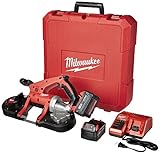


| Included | Band saw + 2x M18 XC batteries + charger + carrying case |
| Tool specs | Same as the bare-tool 2629-20 above |
| Voltage | 18V (M18 battery system) |
| Best for | Buyers with no existing M18 batteries |
MenaIf you already own M18 batteries, the bare tool above saves money; if you don’t, this kit gets you cutting without a separate battery purchase.
The tool itself is identical to the 2629-20 bare unit – the price difference buys two XC batteries, a charger, and a case. Choose this kit if you’re not already running other Milwaukee M18 tools.
If you already have M18 batteries from other tools, the bare tool above is the more cost-effective route and lets you put those existing batteries to work immediately.
Once you’ve picked a method: matching wheel/blade size and air supply
For the angle grinder, confirm the wheel’s diameter/thickness/arbor match the tool, and that the wheel’s maximum rated RPM is equal to or higher than the grinder’s no-load speed (11,000 RPM for the 9557PBX1 above). For the chop saw and cold saw, cutting capacity is set by the blade diameter (14 in. and 12 in. respectively above) – don’t force oversized pipe or structural shapes into the vise. The band saw’s round-stock capacity tops out at about 3-1/4 in.; don’t clamp anything larger. The plasma cutter needs a compressor that can supply air within its rated pressure range – check the manufacturer’s spec sheet for the exact figure before buying a compressor.
Under the hood: three cutting principles behind these six methods
The three principles
Seen by mechanism, the six methods split into three principles. The angle grinder and chop saw are both “abrasive” methods – a hard-grit cutting wheel spins fast and wears the metal away. The cold saw, jigsaw, and band saw are all “saw-type” methods – a toothed blade shaves off metal a small amount at a time as it advances. The plasma cutter is a “fusion” method – arc heat melts the metal while a high-velocity gas jet blows the melt out of the cut simultaneously.
Heat-affected zone and finish quality
Every principle puts some heat into the cut, creating a heat-affected zone (the region near the cut where the metal’s microstructure changes). The abrasive methods (grinder, chop saw) generate friction-driven heat that concentrates quickly, which is exactly why they’re prone to heat discoloration, burrs, and sparks.
Why the cold saw finishes cleaner than the chop saw
The chop saw removes material abrasively, with a cutting wheel; the cold saw shaves it away tooth by tooth with a carbide blade. The abrasive method generates more friction heat and is more prone to sparks, heat discoloration, and burrs, while the saw-type method removes less material per tooth pass, which limits heat concentration and burr formation and produces a cleaner finish – the tradeoff being a slower cut than the chop saw.
The option with no product card: rent it, or pay someone else to cut it
Every tool covered here runs from roughly fifty to several hundred dollars. For a once-in-a-lifetime DIY job, or a single cut through heavy stock or thick plate, renting the tool – or simply paying a metal shop or fabricator to make the cut – can end up cheaper than buying. This option doesn’t need a product card; the real question for buying is whether you’ll be cutting metal repeatedly going forward.
Frequently asked questions
Q. If I own a grinder, do I need any of the other tools?
A. Not necessarily, but a grinder has the lowest precision of the six methods and is prone to heat discoloration and burrs. Switch to a chop saw or cold saw when cut-to-length work or finish quality matters, and to a jigsaw when you need a curve.
Q. Chop saw or cold saw – which should I choose?
A. Pick the abrasive chop saw (1,300 RPM on the DW872 above) if cutting speed matters most; pick the saw-type cold saw (1,700 RPM on the LC1230 above) if a clean, low-burr finish matters most. Both assume the material is clamped in a vise on a fixed base.
Q. Can a plasma cutter handle thick plate?
A. The LTP5000D above is rated for a clean cut up to about 5/8 in. (16mm) at 220V. Beyond that thickness, switch to a chop saw or cold saw instead.
Safety notes
Never use a cutting wheel’s side face for grinding. Don’t force pipe or structural shapes that exceed a chop saw’s or cold saw’s rated capacity into the vise. Never run a jigsaw against metal without a blade rated for metal. Don’t force round stock larger than a band saw’s rated capacity into the clamp. A plasma cutter requires shade-rated eye/face protection against electric shock and arc flash, and shouldn’t be run with air supply outside its rated pressure range – it also produces metal fume, so use it with a respirator and adequate ventilation, not in an enclosed space.
Summary
MenaChoosing how to cut metal isn’t about picking the strongest tool – it’s about matching the method to material, thickness, straight-vs-curved, cut length, and power source. Get that match right and precision and speed stop being a tradeoff.
A jigsaw for curves in thin sheet, a chop saw or cold saw for cutting heavier stock to length, a band saw for round tube and round bar, a plasma cutter when non-ferrous metals are in the mix, and an angle grinder when portability on the job site matters most – switching methods to match the condition lets you keep both precision and speed without straining either.
The one thing worth remembering: a grinder is not a universal tool. Keep that in mind and your next metal-cutting decision gets a lot easier – the answer to “what do I cut that metal with” comes down to choosing a method by thickness, shape, and precision.