
Affiliate Disclosure: This article contains affiliate links. If you make a purchase through these links, we may earn a commission at no additional cost to you.
 メナ
メナI’m a licensed electrician who’s worked everything from new construction to remodels and finish work. A laser distance measurer rides in my tool belt every single day — once you switch from a tape measure, you don’t go back. Here’s how I actually choose one.
Ever used a laser distance measurer? Most people who try one never pick up a tape measure again for anything longer than a stud bay.
Bosch, Leica, Makita, DEWALT and Milwaukee alone put out a dozen-plus models between them. Buy on price alone — without understanding range, accuracy, IP rating, and Bluetooth logging — and you’ll regret it the first rainy day on site.
I’ve picked these seven from a working electrician’s point of view: can it survive outdoors, can it push readings to my phone, does it fit in a belt pocket without getting in the way. If you’re not sure where to start, the Bosch GLM165-25G or the DEWALT DW03050 are the two I’d point a new hire toward first.
This is a tool you reach for dozens of times a day — locating outlets and switches, checking a run to the panel, laying out a room. I’m breaking down what actually matters on the job so you can pick with confidence.
Why Every Electrician Ends Up Carrying One
The places a laser measurer earns its keep on an electrical job come up more often than you’d think: locating outlet and switch boxes, tracing a conduit run, working out the distance back to the panel. It’s a daily-use tool, not a specialty one.
A job that used to take two people and a tape measure now takes one person and a button press. Ceiling height is the clearest win — what used to mean climbing a ladder with a tape now happens from the floor, solo. Fewer trips up a ladder means better safety and better efficiency at the same time.
Builders and interior contractors get the same benefit — curtain rod layout, furniture placement, ceiling height checks. Any trade that measures daily gets a fast payback on this tool.
Bluetooth-capable models can push a reading straight into a phone note or a spreadsheet, cutting out transcription errors and speeding up as-built drawings after the work is done.
5 Things That Actually Matter When You’re Choosing
Here are the five specs worth checking before you buy — use this as your checklist.
1. Range: match it to where you actually work
20–50 m (65–165 ft) covers most residential and light commercial work. Large new-build projects, warehouses, and industrial spaces want 50–120 m (165–395 ft). Compact models under 15 m (50 ft) trade range for pocketability — fine for tight interior spaces. Don’t buy more range than your work actually needs.
2. Accuracy: your trade decides how tight you need to go
± 1.5–2 mm (about 1/16 in) is plenty for general construction and finish work. Precision installs or CAD-ready measurements sometimes call for sub-millimeter accuracy, but most electrical work is comfortable at the standard tolerance. Accuracy tends to matter more as distance increases, so check the spec closely on any long-range model.
3. IP rating: are you indoors or out?
IP65+ is dust-tight and water-resistant enough for genuine outdoor use. IP54 handles dust and light splash but isn’t built to be submerged. Indoor-only models often skip an IP rating entirely and cost less as a result. Be honest with yourself about where the tool will actually live.
4. Bluetooth and app support
A model that pushes readings straight to a phone app or spreadsheet cuts transcription errors and saves time re-entering numbers into a drawing later. If you spend a lot of time exporting measurements to reports, prioritize Bluetooth models. Bosch’s Measure On app even builds floor plans from your readings.
5. Backlight and readability
If you work in dim panels, attics, or crawlspaces regularly, a backlit display isn’t optional. A green beam reads roughly four times brighter than red in daylight — worth paying for if you’re outdoors often.
メナBoiled down: mostly outdoors → IP54+ and a green beam. Logging a lot of data → go Bluetooth. Budget-conscious → the Bosch GLM 50 C. Want the full-featured pro tool → the Leica DISTO D2 or the Milwaukee 48-22-9802. Picture your actual workday before you buy and you won’t go wrong.
7-Model Spec Comparison
All seven models at a glance — use this before you decide.
| Model | Max range | Accuracy | IP rating | Bluetooth | Standout feature |
|---|---|---|---|---|---|
| Bosch GLM 50 C | 165 ft | ± 1/16″ | None | Yes | Ultra-compact, budget-friendly |
| Bosch GLM165-25G | 165 ft | ± 1/16″ | IP54 | No | Green beam for bright daylight |
| Bosch GLM165-40 Pro | 165 ft | ± 1/16″ | IP54 | No | Backlit, 10-reading memory |
| Leica DISTO D2 | 330 ft | ± 1.5 mm | IP54 | Yes | Swiss precision, 3-yr warranty |
| Makita LD080P | 262 ft | ± 1/16″ | n/a | No | Longest range, Pythagoras modes |
| DEWALT DW03050 | 165 ft | ± 1/16″ | IP54 | No | Job-site tough, AA batteries |
| Milwaukee 48-22-9802 | 150 ft | ± 1/16″ | Impact-resist. | No | Color backlit, 30-reading memory |
7 Laser Distance Measurers, Compared by a Working Electrician
Bosch GLM 50 C

 メナ
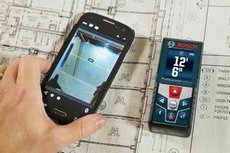
メナThis is the one I hand to apprentices — small enough to live in a shirt pocket, and Bluetooth means the readings land straight in a phone note instead of a scrap of paper.
The GLM 50 C is Bosch’s compact everyday measurer: real-time distance, area, and volume readings, plus Bluetooth 4.0 so numbers sync straight to your phone instead of getting scribbled on a 2×4. It’s the size of a large lighter and clips onto a keyring loop without feeling bulky in a pocket.
There’s no IP rating on this one, so it’s built for indoor rough-in and finish work rather than a rainy job site. If you’re outdoors most of the day, skip ahead to the GLM165 models below.
Good fit for electricians and finish carpenters who mostly work indoors and want a reliable everyday tool without paying for outdoor-rated toughness they’ll never use.
Bosch GLM165-25G BLAZE Green-Beam
 メナ
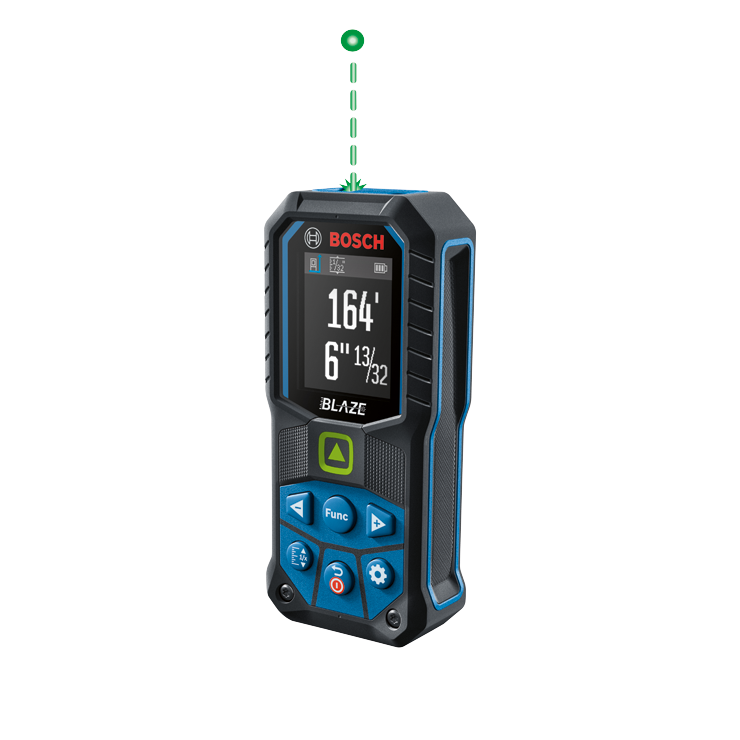
メナThe green beam is the whole reason to buy this one — on a sunny slab pour you can actually see the dot, which a red laser just can’t manage.
BLAZE’s green beam reads roughly four times brighter than a standard red laser in daylight, which matters a lot once you’re measuring a bright concrete pad or a white stucco wall at noon. Range tops out at 165 ft with the same ± 1/16 in accuracy as the GLM 50 C.
IP54 covers dust and light splash, so a job-site drizzle or a dusty slab won’t take it out, but this isn’t a tool you want fully submerged. No Bluetooth on this model, so if data logging matters more than visibility, look at the BLAZE Pro below instead.
Best for anyone doing exterior layout, slab work, or bright-daylight measuring where a red beam simply disappears.
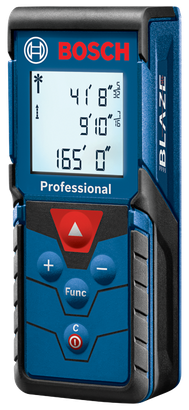
Bosch GLM165-40 BLAZE Pro
 メナ
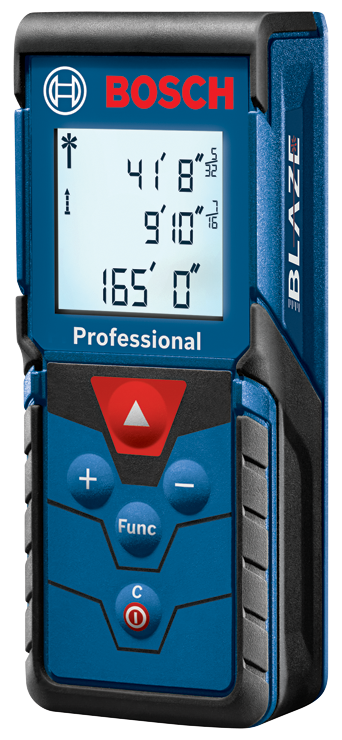
メナThis is the one that lives in my tool belt full-time — backlit display, 10-reading memory, and it still fits in a pocket without feeling like a brick.
BLAZE Pro packs a backlit display and 10-measurement onboard storage into a body that still fits a tool-belt pocket. Area, volume, and continuous measurement modes cover most rough-in and layout tasks without needing a phone app.
There’s no Bluetooth here — readings stay on the device until you write them down — so if you need to export data to a spreadsheet, the GLM 50 C is the better pick despite its shorter feature list.
A solid middle-ground pick for electricians and remodelers who want pro-grade toughness without paying for app connectivity they won’t use.
Leica DISTO D2
メナLeica built its name on survey-grade instruments, and the D2 carries that reputation down to a 100g body — it’s the one I trust when a number absolutely has to be right.
Leica Geosystems has built precision measuring instruments for over a century, and the DISTO D2 brings that pedigree to a 3.5 oz body that fits in a shirt pocket. Range runs to 330 ft with ± 1.5 mm accuracy, and the flip-out end piece lets you measure from outside or inside corners without doing math.
IP54 protects against dust and light splash, and Bluetooth 4.0 pairs cleanly with Leica’s own app for area, volume, and Pythagoras calculations. The 3-year warranty (with online registration) is longer than most competitors offer.
Best for MEP contractors, appraisers, and anyone whose measurements end up on a stamped drawing — the accuracy and reputation justify the higher price.
Makita LD080P
メナIf you’re already running Makita gear on the truck, the LD080P just feels right — same button logic, same no-nonsense build.
The LD080P reaches 262 ft — further than the Bosch and DEWALT models here — with distance, area, volume, permanent, min/max, add/subtract, and three Pythagoras modes (2-point, 3-point, and partial height) for indirect measurements you can’t reach directly.
It runs on 2 AAA batteries rather than a built-in rechargeable, which some crews prefer since a spare battery is always cheaper and easier to find than a charging cable on a job site. Auto power-off helps stretch battery life.
A strong pick for anyone who already carries Makita tools and wants one less brand to keep track of, or who needs the extra range for larger commercial spaces.
DEWALT DW03050
メナDEWALT yellow means it survives a drop off a ladder, and this one has taken more than a few without complaint.
The DW03050 uses a Class 2 laser to measure length, width, and height with ± 1/16 in accuracy out to 165 ft. It handles distance, area, volume, and indirect (Pythagoras) height calculations — the core functions most electricians actually use day to day.
IP54 dust/splash resistance and a rugged housing match the rest of the DEWALT line, so it takes the abuse of living in a tool bag next to drivers and pliers without babying.
A go-to for electricians and contractors who already run yellow-and-black tools and want one less charger to manage — this one just takes AA batteries.
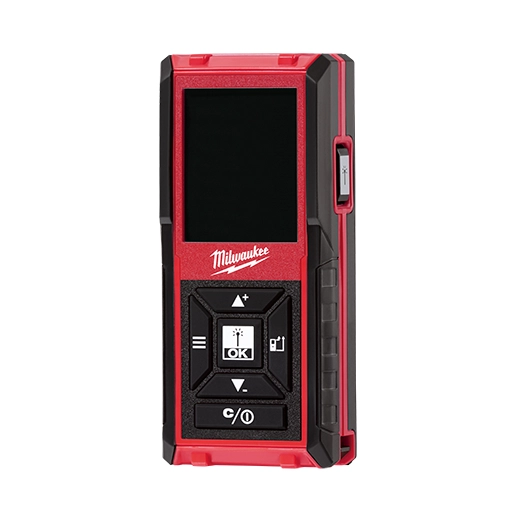
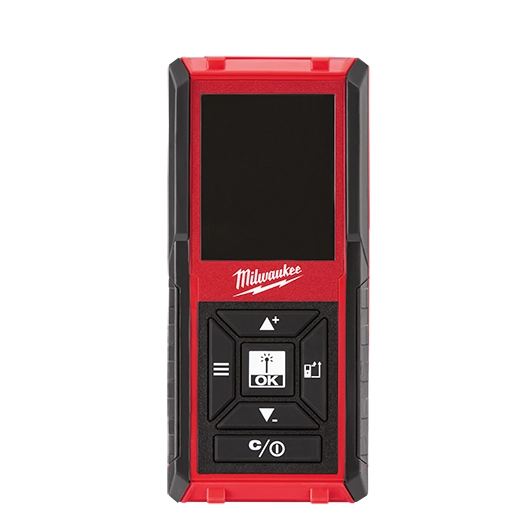
Milwaukee 48-22-9802
 メナ
メナThe red-and-black impact housing has saved this one from a couple of drops that would have cracked a cheaper unit, and the backlit color screen is genuinely easy to read in a dim panel room.
Milwaukee’s laser distance meter pairs a backlit color display with an impact-resistant housing built for the same abuse as the rest of the M18 lineup. It stores up to 30 measurements on-device, which covers a full room-by-room walkthrough without re-entering numbers.
Range tops out at 150 ft, a bit shorter than the Leica or Makita here, and there’s no Bluetooth — data stays on the unit until you transcribe it.
A natural fit for electricians already carrying Milwaukee hand tools who want the same red-and-black durability in their measuring tool.
Which One Fits Your Work?
Electricians and general contractors on active sites
Outdoors often, exposed to dust and rain? The IP54 Bosch GLM165 models or the DEWALT DW03050 are built for it. Need the extra range for larger commercial spaces? The Makita LD080P covers the most ground. Heavy Bluetooth data logging? Stick with the GLM 50 C or the Leica DISTO D2.
MEP and finish trades doing precision layout
For indoor layout work where the number ends up on a drawing, the Leica DISTO D2’s accuracy and reputation are worth the premium. If cost matters more than the Leica name, the Bosch BLAZE Pro covers most of the same ground for less.
DIY and home renovation
Start with the budget-friendly GLM 50 C — one-button operation, no learning curve, and more than enough range for room layout, curtain rods, and furniture placement.
Accessories Worth Adding to Your Kit
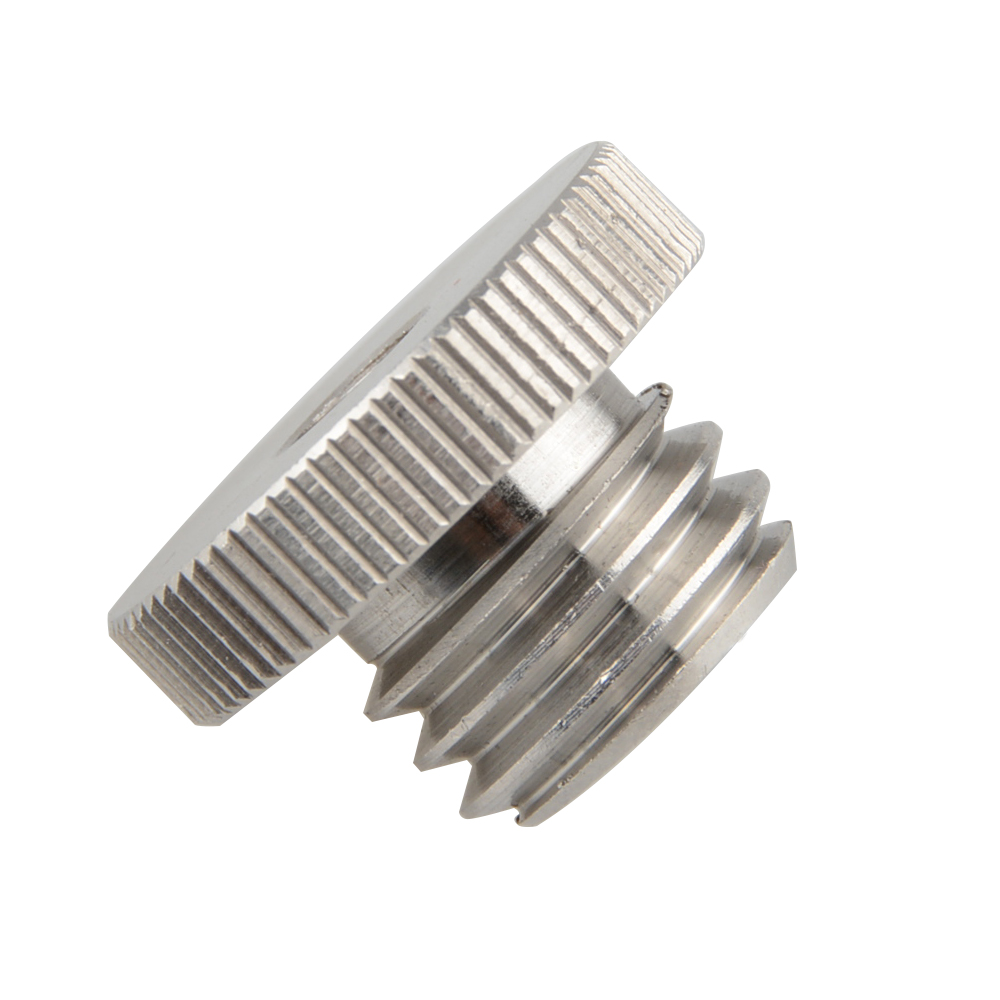
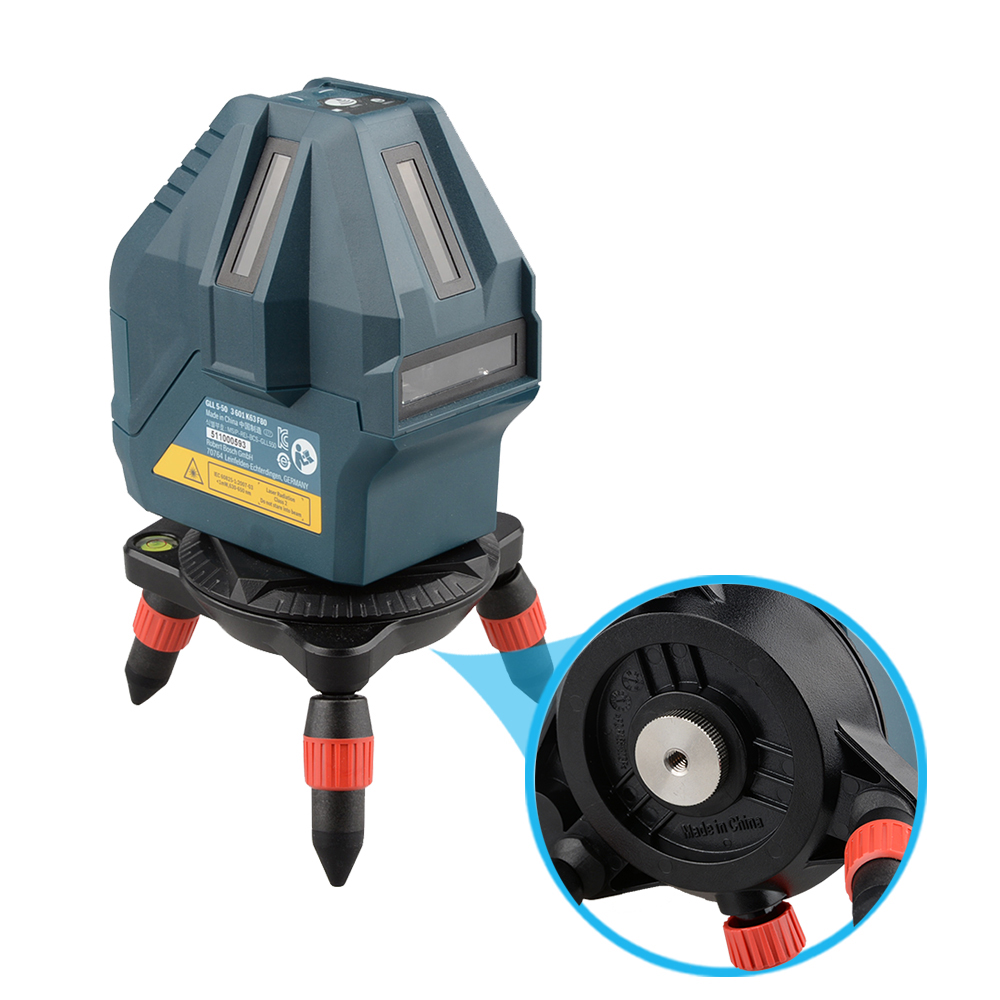
CAMVATE 1/4″-20 to 5/8″-11 Tripod Thread Adapter
 メナ
メナCheap insurance against hand-shake error on a long shot — screw the meter onto any camera tripod and the reading gets noticeably more consistent.
A simple stainless steel adapter that converts a standard 1/4″-20 tripod mount to the 5/8″-11 thread some laser measurers use (or vice versa, depending on your tool). Mounting on any photo tripod removes hand shake on long-distance readings, which matters most on the 100m+ Leica and Makita models above.
If your measurer doesn’t have a threaded mount at all, check the spec sheet before buying — not every compact model includes one.
Aproca Hard Carry Case (Bosch-compatible)
メナA $2,000 tool bag drop can end a $150 laser measurer in one second — a hard case is the cheapest insurance on this whole list.
A hard-shell travel case sized for Bosch’s compact laser measurers, with room for the unit, a spare battery, and small accessories. Most compact models ship with a soft pouch at best, which won’t save the tool from a drop off a ladder or a tool bag getting kicked across a job site.
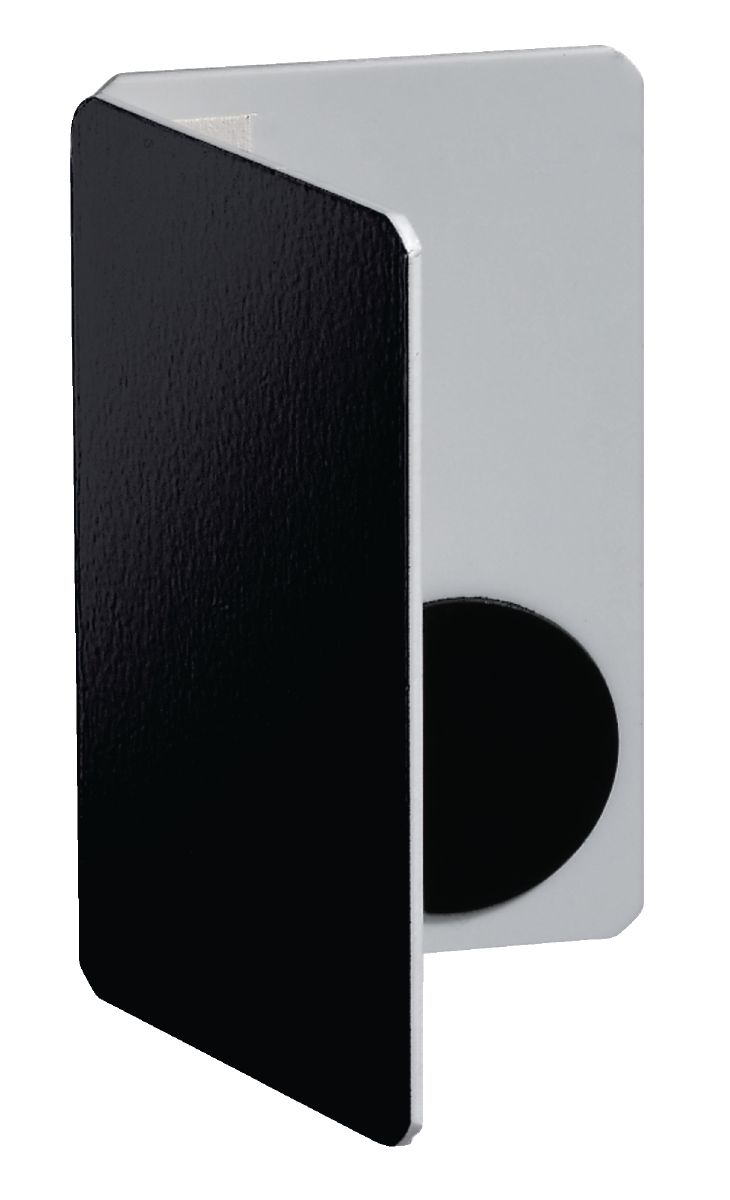
Hilti PDA 50 Laser Target Plate
 メナ
メナOn a bright slab or a dark concrete wall, the laser dot practically vanishes without one of these — it turns a guess into a real reading.
A reflective target plate that makes the laser dot visible on long-distance, low-contrast, or brightly-lit surfaces where the beam would otherwise wash out. Especially useful with the green-beam Bosch model above at its longer range settings, or on dark concrete where even a green dot struggles.
Frequently Asked Questions
How accurate are laser distance measurers, really?
± 1/16 in (about 1.5 mm) is standard on pro-grade models — plenty for general construction and finish work. If you need tighter tolerances, the Leica DISTO D2’s reputation for precision is worth the extra cost. Accuracy tends to matter more as distance increases, so check the spec closely for long-range use.
Are these safe to use outdoors?
IP54-rated models (Bosch GLM165 series, DEWALT DW03050) handle dust and light splash fine. Models without an IP rating are best treated as indoor-only. Direct sunlight can wash out a red beam — that’s where a green-beam model earns its keep.
Battery or rechargeable — which is better?
For job-site use, AA/AAA battery models tend to be more practical — dead batteries are a quick swap, and you can grab spares at any hardware store or gas station. Built-in rechargeable models like the Leica DISTO D2 are great until you forget to charge one; keeping a battery-powered backup isn’t a bad idea either way.
メナI reach for the Bosch GLM165-25G most days — the green beam and IP54 rating handle whatever the job site throws at it. If you’re just starting out, the GLM 50 C is a great, affordable place to begin.
Bottom Line: Match the Tool to How You Actually Work
We compared seven laser distance measurers from an electrician’s point of view. The short version: outdoors most of the time → IP54 or better. Precision layout → Leica. Budget-conscious → Bosch GLM 50 C. Want it all → the Bosch BLAZE series or Milwaukee 48-22-9802.
The real win with a laser measurer is turning a two-person tape-measure job into a one-person, one-button task — faster, and safer since it cuts down on ladder trips. This is a tool you’ll use dozens of times a day, so it’s worth matching to how you actually work.
Hopefully this helps narrow down your pick. Check the product links above for current pricing and availability.