
Affiliate Disclosure: This article contains affiliate links. If you make a purchase through these links, we may earn a commission at no additional cost to you.
 Mena
Hey, it’s Mena (@menachite), the hybrid engineer who covers both mechanical and electrical gear. This time it’s a comparison of rugged jobsite radios and Bluetooth speakers. I was surprised how many of these now run on the same battery as your cordless tools, so I put together a rundown.
Short answer up front: if you want a speaker that shares a battery platform with your existing cordless tools, go Makita or Metabo HPT (formerly HiKOKI) depending on what you already own; if weight and portability matter most, the Metabo HPT UR18DAQ4M is the lightest pick here; and if you want something for a multi-person crew that can also double as a power outlet, the Bosch GPB18V-5CN is the one to look at.
This time I compared three jobsite radio/speaker products from the three major cordless-tool brands — Makita, Metabo HPT, and Bosch — each with different durability ratings, output power, and power options. Whether you can share a battery with tools you already own is a big factor in the decision.
Conclusion: Quick Pick Guide by Goal
Here’s the conclusion up front. If you’re building around the Makita 18V LXT platform, go with the Makita XRM06B. If you want the lightest, most portable option, the Metabo HPT UR18DAQ4M is the pick. If you’re outfitting a crew that needs both sound and an AC power source, the Bosch GPB18V-5CN is the one to look at.
| Product | Durability | Features | Best for |
|---|---|---|---|
| Makita XRM06B | Water/dust resistant construction (no official IP rating published) | Bluetooth, two 3″ side-firing speakers | Already on the Makita 18V LXT platform |
| Metabo HPT UR18DAQ4M | Not IP-rated (compact design priority) | 15-level EQ, 9 FM presets, 18-hr runtime | Wanting the lightest, most portable unit |
| Bosch GPB18V-5CN | Rugged roll-cage construction | 40W total output w/ subwoofer, four 120V outlets | Multi-person crews, doubling as a power source |
3 Recommended Jobsite Radios & Bluetooth Speakers
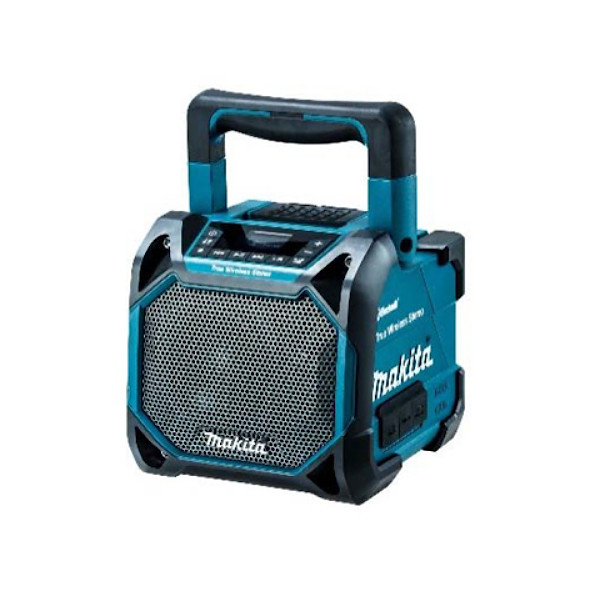
Makita XRM06B 18V LXT Cordless Bluetooth Job Site Radio
MenaUsed to worry about a regular Bluetooth speaker holding up on a dusty outdoor site, but with water- and dust-resistant construction, the XRM06B is the kind of unit you can just leave sitting out and not think twice about.
The Makita XRM06B is a jobsite Bluetooth speaker built with water- and dust-resistant construction and protective bumpers. It runs on Makita’s 12V max CXT, 14.4V, or 18V LXT Lithium-Ion batteries, or via AC power. It delivers stereo sound from two 3″ side-firing speakers, has an aux port for wired playback, and a USB port for charging your phone.
If you don’t already own a Makita cordless battery, this ships as a bare tool, so you’ll need to pick up a battery and charger separately. If you’re already invested in Makita’s 18V lineup, this is the cheapest way in.
Recommended if you already own Makita cordless tool batteries, or you want a speaker built to shrug off a dusty, wet jobsite.
Metabo HPT UR18DAQ4M 18V MultiVolt Cordless Bluetooth Radio
MenaNote: HiKOKI power tools are sold in the US under the Metabo HPT brand. Given that no plain “HiKOKI”-branded jobsite radio is sold in this market, I’m covering the equivalent Metabo HPT model here — currently the lightest, most portable pick in this lineup.
The Metabo HPT UR18DAQ4M is a compact cordless Bluetooth radio with a 15-level equalizer and 9 FM station presets. It runs on the 18V compact MultiVolt battery system (18V and 36V compatible) or the included AC adapter, and it’s rated for up to 18 hours of runtime on an 18V 3.0Ah battery.
The design prioritizes compact size and light weight, so there’s no official IP (dust/water resistance) rating published. On a site with frequent outdoor rain exposure, I’d recommend pairing it with one of the other, more weather-sealed picks here rather than relying on this one alone.
Recommended if you just want something light and compact, or if you’re moving it between sites often. MSRP is $99 for the bare tool.
Bosch GPB18V-5CN 18V Jobsite Radio with Bluetooth 5.0 and Power Station
MenaOn crews where people are working spread out around the radio rather than huddled next to it, the GPB18V-5CN’s four-way speakers plus subwoofer threw sound far enough that everyone could hear it clearly, wherever they were standing.
The Bosch GPB18V-5CN is a jobsite radio with a rugged roll-cage build, delivering 40 watts total from its four-way speakers and integrated subwoofer. On top of Bluetooth 5.0, it has four 120V AC outlets (great as a de facto power strip for corded tools and chargers) and a 2.1A USB port for charging phones.
All that power and functionality comes at a cost: at about 19.4 lbs, it’s noticeably heavier than the other two here — this is more of a “set it down at basecamp” unit than something you’ll want to carry around all day.
Recommended if you want sound that reaches a whole crew, or you want a radio that doubles as a power strip.
Accessory Worth Grabbing Alongside
Radios sold as a bare tool need a compatible battery to actually run cordless. If you don’t already have one from that brand’s ecosystem, it’s worth checking before you buy.
Makita BL1860B 18V LXT 6.0Ah Battery
MenaPicking a battery for a bare-tool radio like the XRM06B can be confusing at first. Going with the BL1860B and its onboard charge-level indicator makes it easy to check exactly how much runtime is left before heading out to a site.
The Makita BL1860B is a high-capacity 18V, 6.0Ah lithium-ion battery. It has an onboard LED charge-level indicator and works with fast chargers like the DC18RF. It’s compatible with the XRM06B above and with Makita’s whole 18V LXT slide-pack tool lineup.
If you’re also running this battery across other 18V tools, it’ll drain faster from shared use — if you want it dedicated to the radio, it’s worth picking up a spare.
Recommended if you bought the XRM06B bare, or you want to share batteries across your Makita 18V tool lineup.
Jobsite Radio & Speaker Basics: How to Choose
Durability on a jobsite speaker is usually expressed as an IP rating — two digits after “IP,” where the first digit is the dust rating and the second is the water rating. A higher number means better protection. Not every jobsite unit publishes an official IP number, though — some brands prioritize a compact, lightweight build instead and skip formal certification, so it’s worth checking the spec sheet for each specific model rather than assuming.
Sharing a Battery Platform Makes Life Easier
If you already run cordless tools from a given brand, being able to share that same battery with your jobsite radio means you don’t need a separate dedicated power source. Standardizing on one brand’s battery platform when you’re first buying tools pays off down the line.
Check Output Power and Connection Count Too
For a large site or outdoor use with multiple people, output wattage and whether the unit has omnidirectional sound both affect how well everyone can actually hear it. A model that supports more simultaneous Bluetooth connections also makes life easier when a crew is passing phones back and forth.
Tips for Use
Most jobsite radios can switch between battery and AC power. I’ve personally forgotten to charge the battery and ended up with no sound on site more than once — since I started deliberately using AC power on days I’m based somewhere with an outlet, and battery power on days I’m moving around outdoors a lot, I’ve had a lot fewer dead-battery surprises.
Even a model rated for dust and water resistance isn’t designed to be submerged or hosed down with a pressure washer. Keep use in the rain occasional rather than constant, and wipe off any moisture after use to make it last.
FAQ
Q. How much IP protection do I actually need?
A. None of the three US-market picks here carry a formal IP rating. If your work is mostly outdoors with a lot of dust and splashing water, the Makita XRM06B’s water- and dust-resistant construction is the most protective option by design, even without an official number attached. If you’re mostly under a roof or in a fixed spot, a compact unit like the Metabo HPT UR18DAQ4M is plenty practical. Pick based on your actual working environment.
Q. Can I use another brand’s cordless tool battery?
A. Jobsite radios are basically designed for one specific manufacturer’s battery system. There’s no cross-brand compatibility, so pick a model that matches the tool brand’s batteries you already own.
Q. Can these run on regular AC power?
A. All three products covered here support AC power, so you can run them off a wall outlet even without a battery installed.
MenaHow much you enjoy using a jobsite radio or speaker comes down to durability rating and power options. Pick based on your site conditions and the cordless tool brand you already use.
Summary
I compared three jobsite radios and Bluetooth speakers across three axes: durability, output power, and power options. If durability is your top priority, go with the Makita XRM06B; for the lightest and most portable, the Metabo HPT UR18DAQ4M; and for use with a crew or doubling as a power strip, the Bosch GPB18V-5CN is a strong candidate.
If you can share a battery with cordless tools you already own, you can add one of these without extra cost. Pick the one that fits your site conditions.