
Affiliate Disclosure: This article contains affiliate links. If you make a purchase through these links, we may earn a commission at no additional cost to you.
 Mena
Hey, it’s Mena (@menachite), the hybrid engineer. This time I’m covering epoxy adhesives. It’s easy to assume the “5 minute” or “30 minute” printed on the package is just about how fast it sets, but it’s actually a real fork in the road that also affects heat and chemical resistance once cured.
Short answer up front: there are three things to check when choosing an epoxy adhesive. (1) Cure time — a 5-minute type for quick fixes, a 30-minute type or slower for joints that carry load or heat. (2) For vertical surfaces or gaps, pick a non-sag (NS/thixotropic) type. (3) Don’t reach for epoxy at all for PP/PE, soft materials, or joints that flex a lot. Let’s walk through each of these three axes in detail.
Conclusion: Cure Time × Use Case × Heat/Chemical Resistance — Quick Reference
Here’s the big picture first, in table form. The reasoning is explained in later sections — for now, just check which category matches what you’re actually working on.
| Cure-time type | Best suited for | Heat/chemical resistance tendency |
|---|---|---|
| 5-minute type (e.g. ClearWeld) | Emergency repairs, model/craft assembly, securing small parts | Manufacturers generally position these for quick, temporary repairs and recommend a 30-minute-or-slower type where more water resistance is needed (see column below). Don’t over-rely on it for load- or heat-bearing joints. |
| 30-minute type (e.g. structural epoxy) | Metal part repair, structural DIY joints | More working time, and manufacturers generally claim better heat, water, and chemical resistance once cured |
| 60-minute / NS (non-sag) type (construction/industrial grade, per manufacturer TDS) | Outdoor structures, industrial joints involving vertical surfaces or gap-filling | High water/weather/oil/chemical resistance (typical of 60-minute-cure examples). NS types are designed with thixotropy (won’t sag on vertical surfaces) and increased toughness, per manufacturer technical data sheets. |
What Is Epoxy Adhesive, Anyway?
Epoxy adhesive is a two-part adhesive: mixing a base resin (epoxy resin) with a hardener (usually an amine) triggers a chemical reaction (cross-linking) that turns the mixture into a hard, tough resin. One-part versions exist too (pre-mixed, curing only once heated), but most epoxy adhesives sold for home and DIY use — the kind this article covers — are the room-temperature-curing, two-part type.
The time you have to work with the adhesive after mixing the two parts is called “pot life” (working time); the time from when curing begins to full cure is called “cure time.” The “5 minute” or “30 minute” on the packaging refers to roughly how long until curing begins. A shorter pot life/cure time is easier to work with quickly, but as covered below, it can also affect the final cured properties. Most products mix base resin to hardener at a 1:1 ratio (by weight or volume), but always follow the exact ratio printed on the product — getting the ratio wrong causes incomplete curing.
Cured epoxy resin is hard but brittle. It’s great at rigidly locking together hard materials like metal, glass, or ceramic, but that same hardness is a weakness for joints under repeated flexing or vibration, or when bonded to a soft, flexible material like rubber — the adhesive itself can crack or delaminate. This “hard but brittle” trait is exactly why epoxy isn’t the right call for PP/PE, soft materials, or joints that move a lot, which we’ll cover shortly.
3 Things Everyday Users Should Actually Check
Epoxy packaging is covered in numbers and specs, but for home use there are really just three things worth checking.
1. Choose by Cure Time: 5-Minute for Quick Repairs, 30-Minute or Slower for Load- or Heat-Bearing Joints
A 5-minute type has a short pot life, which means you have to finish positioning fast, but in exchange there’s almost no waiting — great for emergency repairs. A 30-minute type gives you more breathing room to carefully align multiple parts or wipe off excess squeeze-out. So the rule of thumb: if you need to fix something right now, go 5-minute; if you want to take your time getting the position right, or the joint will carry load or heat, go 30-minute or slower.
2. For Vertical Surfaces or Gaps, Choose a Non-Sag (NS/Thixotropic) Type
Using a regular free-flowing epoxy on a vertical surface, a slope, or a large gap can let the adhesive sag out of position before it starts to cure. Industrial products address this with “NS” (Non-Sag) thixotropy — thick and resistant to sagging at rest, but flows more easily under applied pressure — so it can be built up on a vertical surface without running (confirmed via manufacturer technical data sheets; this is an industrial classification that doesn’t usually appear on typical home-use epoxy). So for horizontal bonding, a regular free-flowing type is fine, but if you’re filling a gap or working on a vertical surface, check the product description for wording like “non-drip,” “thixotropic,” or “NS.”
MenaHome-use epoxy almost never says “NS” outright, but if the description says “won’t drip” or “paste-like,” you can treat it as the same idea.
3. Don’t Use Epoxy for PP/PE, Soft Materials, or Joints That Move a Lot
Polypropylene (PP) and polyethylene (PE) are well known as hard-to-bond materials because of their low surface energy, which makes it difficult for adhesives to chemically grip them. Epoxy bonds weakly to these materials — it can look like it’s holding, then peel off easily. Epoxy’s hard, brittle nature is also a poor fit for soft materials that deform a lot (like rubber) or joints under constant vibration or flexing. So if what you’re bonding is PP/PE or a soft material like rubber, or the joint is somewhere that’s always moving or flexing, look at a flexible adhesive instead of epoxy (we’ll cover material-pair-specific adhesive choices in a separate article).
Column: Cure Time and Manufacturer-Recommended Uses
Curing is a “cross-linking” reaction where resin molecules bond into a network. As a general principle, heat-curing tends to produce a higher cross-link density (network density — the main factor behind the “glass transition temperature” where a resin starts to deform) than room-temperature curing; higher cross-link density generally means better heat and chemical resistance, while lower cross-link density tends to mean a more flexible polymer with better impact and cold-temperature tolerance (source: MasterBond, “How Critical Is The Crosslink Density In Epoxies for Optimizing Performance?”, checked 2026-09-02). Note that this source speaks to room-temperature vs. heat curing in general — it doesn’t directly compare two different room-temperature cure times like 5-minute vs. 30-minute.
So why is a 30-minute-or-slower type generally considered better suited to load- or heat-bearing uses than a 5-minute type? The cross-link density principle above is the background, but the direct reason is simply that manufacturers commonly position their products that way: fast 5-minute epoxies are typically marketed for quick, temporary fixes, while 30-minute-and-slower epoxies are typically marketed as the choice for more demanding structural or outdoor use where extra water/heat resistance matters. So for anything beyond an emergency repair — outdoor use, or a joint under continuous load — it makes sense to reach for a 30-minute-or-slower type that the manufacturer positions for structural/outdoor use, rather than a 5-minute type.
Real Examples: A 5-Minute Type and a 30-Minute Type
Here are two home-use epoxy adhesives with contrasting cure times — a 5-minute type and a 30-minute type. Compare how pot life and best-fit use case change even though both are “epoxy adhesive.”
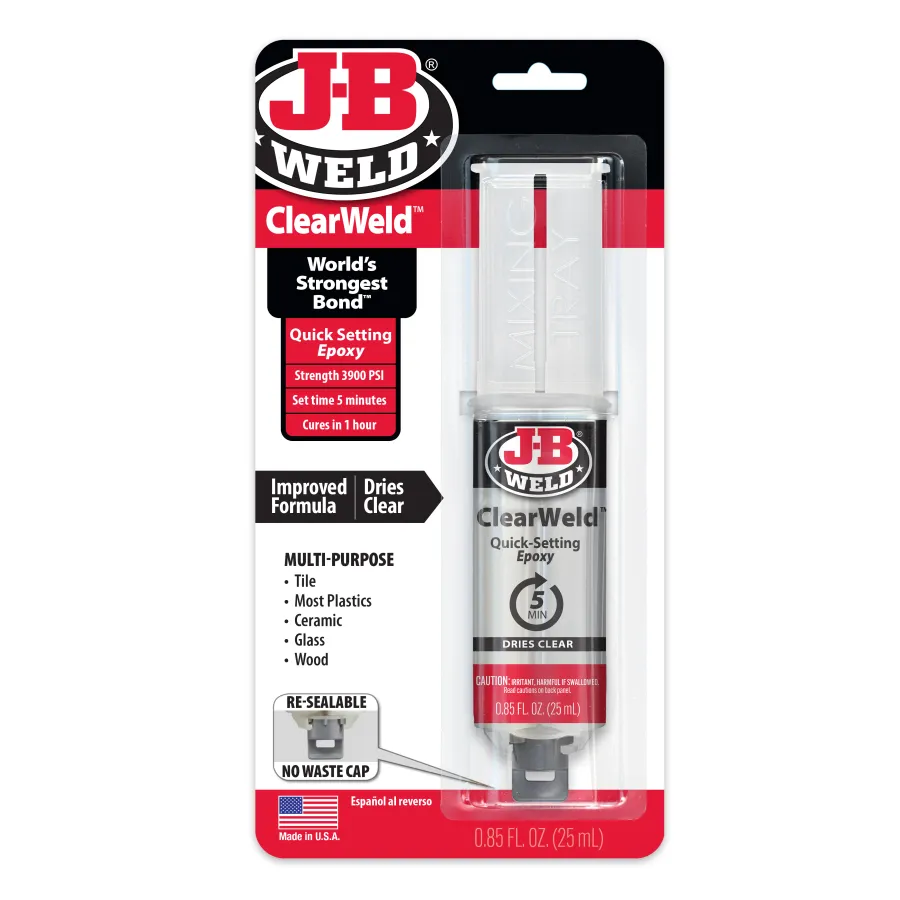
J-B Weld ClearWeld 5-Minute Epoxy
MenaThis is the “quick repair” 5-minute type. Because it cures fast, don’t over-rely on it for load- or heat-bearing uses the way you might with the 30-minute type covered next.
This two-part epoxy mixes the base resin and hardener at a 1:1 ratio and begins setting in about 5 minutes at room temperature, reaching handling strength in about an hour (per manufacturer spec). It bonds a wide range of materials — metal, glass, ceramic, tile, most plastics, wood — and its biggest selling point is that you can get to work almost immediately after mixing.
It’s a good fit for emergency repairs on broken small items, model or craft assembly, and fixing small parts on appliances or furniture — anything you want fixed and usable right away. For outdoor structures or joints under sustained load or vibration, you’re better off with the slower-curing type covered next.
Curing begins the moment you mix the two parts, so you need to finish positioning within the pot life (a few minutes). Once cured, scrape off any leftover adhesive and dispose of it, and wipe the tube opening thoroughly before recapping. If it won’t cure on next use — or worse, has already cured inside the container — that’s usually a sign it’s past its shelf life or was stored somewhere too hot, and it’s time to replace it.
Bob Smith Industries BSI-205 Slow-Cure 30-Minute Epoxy
MenaThis is the 30-minute type for “joints that carry load or heat.” There’s more breathing room between mixing and the start of curing, so you can take your time positioning things carefully.
This two-part epoxy gives you a 30-minute working time before curing begins (per manufacturer spec), with full cure reached after about 24 hours. It bonds hard materials like wood, fiberglass, metal, and most plastics, and is positioned for structural repairs where you need more strength margin than a quick 5-minute product offers.
It’s a good fit for metal-part repairs and structural DIY joints — anything where a 5-minute product’s pot life is too short, or you want more margin in the final cured strength. The longer pot life gives you room to carefully align multiple parts or wipe off squeeze-out. For an emergency repair you need fixed right now, though, the 5-minute type above is the faster choice.
If it gets on your skin, wipe it off right away and wash thoroughly with soap, and keep the area well ventilated during and for a while after use (per manufacturer safety guidance). If the cured bond later develops a white, chalky surface or noticeable chipping, that’s a sign of UV or chemical degradation, and it’s worth considering redoing the joint.
Accessory: A Must-Have for Working Safely
There’s one more thing worth having on hand besides the adhesive itself when working with epoxy: disposable gloves, to keep the hardener off your skin.
Disposable Nitrile Gloves, Powder-Free, Black, 100-Count


 Mena
Not the adhesive itself, but a must-have for using it safely. The golden rule with amine-based hardeners is: never let them touch your skin directly.
These are powder-free disposable nitrile gloves. The amines in epoxy hardener can cause skin irritation with prolonged or repeated contact, so always wear gloves while mixing and applying. Nitrile is more resistant than latex to oils and amine-based hardeners, but it’s weak against ketone solvents like acetone (which can permeate it in just a few minutes), so use a different solvent-resistant glove if you’re wiping down with solvent.
Being disposable means you can swap to a fresh pair every time you mix a new batch, with no risk of uncured adhesive from a previous job getting into the next one. Get in the habit of putting a pair on before mixing the two parts, whether you’re using the 5-minute or the 30-minute type.
Since fine positioning work needs good finger sensitivity, sizing one notch snugger than your usual size tends to make the work easier. Once a pair starts to feel thin or tears easily, it’s time to swap in a new one.
FAQ
Q. What happens if I get the mixing ratio wrong?
A. The chemical balance between resin and hardener gets thrown off, which can leave the mix never fully curing, or curing incompletely and staying tacky. Measure and mix exactly to the ratio printed on the product (often 1:1).
Q. Is a shorter cure time (5-minute type) weaker?
A. Initial bond strength itself isn’t necessarily weaker, but for durability under sustained load or heat, a 30-minute-or-slower type is generally considered the better choice. Pick the cure time that fits the job.
Q. Can I buy a non-sag (NS) type for home use?
A. “NS” (thixotropic) labeling mostly shows up on industrial products; small home-use tubes usually just say something generic like “won’t drip.” If you’re doing a lot of vertical-surface work, check the product description for wording about viscosity or thixotropy before buying.
Q. Can cured epoxy be removed?
A. Fully cured epoxy resin is extremely hard and chemically stable, so removal mainly means physical methods — scraping it off or heating it to soften it. Don’t rely on an epoxy joint being easy to take apart later.
Safety Precautions
Mixing the two parts triggers an exothermic reaction, and the more you mix at once, the more noticeable the heat can feel in your hand. Mixing in small batches, and measuring out only as much as you can use within the pot life, both help. The amines in the hardener can also cause skin irritation with prolonged or repeated contact, so wear protective gloves while working, and if any gets on your skin, wipe it off immediately and wash thoroughly with soap. Fume generation is generally low, but it’s still recommended to keep the area well ventilated during and for a while after use.
MenaChoosing an epoxy adhesive comes down to three axes: (1) cure time — 5-minute for a quick fix, 30-minute or slower for load/heat; (2) non-sag (NS/thixotropic) for vertical surfaces or gaps; (3) skip epoxy entirely for PP/PE, soft materials, or joints that move a lot. Think it through on those three, and you won’t go wrong.
Summary
Epoxy adhesive is a versatile performer that cures into something hard and tough, but knowing three things — cure time, non-sag (NS/thixotropic) behavior, and which materials it’s a poor fit for — changes both which product you pick and how the job turns out. Remember: 5-minute for emergency repairs, 30-minute-or-slower for load- or heat-bearing joints, and the industrial NS mindset for vertical surfaces or gap-filling — with a real product example for each.